THE SOLAR WIND IS HERE: A stream of solar wind is brushing Earth's magnetic field today, June 8th. The gaseous material is flowing from a northern hole in the sun's atmosphere. High-latitude sky watchers should be alert for auroras, especially in the southern hemisphere where waxing autumn darkness favors visibility. Aurora alerts: SMS Text.

B-CLASS SOLAR FLARE: New-cycle sunspot AR2765 is crackling with B-class solar flares. NASA's Solar Dynamics Observatory captured the latest explosion (category B6.4) on June 7th at 21:48 UT:

B-class solar flares are considered to be relatively minor. But consider this: A typical B-class solar flare releases as much energy as 100 million WWII atomic bombs. Only on the sun, which is itself a 1027 ton self-contained nuclear explosion, would such a blast be considered "minor."
In fact, B-flares can hurl CMEs toward Earth and spark auroras. Probably not this time, though. Initial movies of the explosion suggest that no debris is heading our way.
Realtime Space Weather Photo Gallery
Free: Spaceweather.com Newsletter
NOCTILUCENT CLOUDS SPREAD TO MID-LATITUDES: Noctilucent clouds (NLCs) are spilling across the Arctic Circle and descending to mid-latitudes. "During morning twilight, the north was unusually bright with beautiful blue-green clouds," reports Debra Ceravolo of Osoyoos, BC, Canada. "It is rare to see them here at 49 degrees latitude."

Above: Noctilucent clouds over Osoyoos, British Columbia, on June 1, 2020. Credit: Debra Ceravolo.
NLCs are Earth’s highest clouds. Seeded by meteoroids, they float at the edge of space more than 80 km above the ground. The clouds form when summertime wisps of water vapor rise up to the mesosphere, allowing water to crystallize around specks of meteor smoke.
Last summer, noctilucent clouds spread as far south as Los Angeles and Las Vegas, setting records for low-latitude sightings. It could happen again this summer. The clouds are heading south and already within 2 degrees of Seattle in the continental USA.
Observing tips: The best time to look is during the hours after sunset (or before sunrise) when the sun is more than 6 degrees below the horizon: diagram. If you see electric-blue tendrils spreading across the sky, you may have spotted a noctilucent cloud.

Realtime Noctilucent Cloud Photo Gallery
Free: Spaceweather.com Newsletter
ARCTIC WOLF PENDANT: This wolf glows in the dark--and it's been to space. The students of Earth to Sky Calculus launched this special pendant to the stratosphere on April 15, 2020, on board a high-altitude cosmic ray balloon. The payload of radiation sensors (and lupine jewelry) traveled 107,611 feet above Earth's surface:
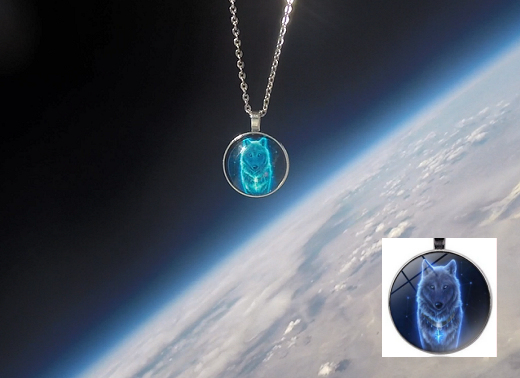
You can have it for $99.95. The students are selling these pendants to support their cosmic ray ballooning program. Each one comes with a greeting card showing the wolf in flight and describing its journey to the stratosphere and back again.
Far Out Gifts: Earth to Sky Store
All sales support hands-on STEM education
Realtime Aurora Photo Gallery
Free: Spaceweather.com Newsletter