SOLAR EXPLOSION MISSES EARTH: Yesterday, a magnetic filament connected to sunspot AT2765 exploded: movie. The debris mostly fell back to the surface of the sun and the rest is not heading our way. It will miss Earth. No auroras are in the offing as a result of the event. Aurora alerts: SMS Text.

RECORD COLD IN THE MESOSPHERE: It's getting cold in the mesosphere. Very cold. "At polar latitudes (60N-80N) temperatures have been breaking 14-year records in the last few days," says Lynn Harvey of the University of Colorado Laboratory for Atmospheric and Space Physics. This development is causing noctilucent clouds (NLCs) to spill out of the Arctic to middle latitudes.
"I've been waiting for years to see NLCs, and finally it happened!" reports Phil Halpert from London, England, on June 7th. He noticed their electric-blue ripples over local rooftops, then rushed out to photograph them in open sky over Clissold Park:


"This is the first time I have ever seen noctilucent clouds over London!" he says.
NLCs are Earth's highest clouds. Seeded by meteoroids, they float at the edge of space 83 km above the ground. The clouds form when summertime wisps of water vapor rise up to the mesosphere, allowing water to crystallize around specks of meteor smoke. Usually they are best seen after the summer solstice, but this year they are getting an early start.
What's happening? To find out, Harvey has been looking at data from NASA's Microwave Limb Sounder (MLS), which can sense conditions 83 km high where NLCs form. "These plots show that 2020 is shaping up to be a very cold and wet year," she says.

"Temperatures, in particular, are very cold," she says. "In fact, mid-latitude (35N-55N) temperatures in late May (DOY 142-148) were the coldest of the AIM record"--that is, since 2007 when NASA's AIM spacecraft began monitoring noctilucent clouds.
Last summer, NLCs spread as far south as Los Angeles and Las Vegas, setting records for low-latitude sightings. The growing chill today suggests this summer could be just as good--or maybe even better. In fact, the first sightings in the continental USA (Washington and Minnesota) have already happened.
Observing tips: The best time to look for NLCs is during the hours after sunset (or before sunrise) when the sun is more than 6 degrees below the horizon: diagram. If you see electric-blue tendrils spreading across the sky, take a picture and submit it here.

Realtime Noctilucent Cloud Photo Gallery
Free: Spaceweather.com Newsletter
THE INFINITY BLACK PEARL: It came from Tahiti--and now it's been to the edge of space. On April 15, 2020, this genuine Black Tahitian South Sea Cultured Pearl flew to the stratosphere onboard an Earth to Sky Calculus cosmic ray balloon, soaring 107,611 feet above the Sierra Nevada mountains of central California:
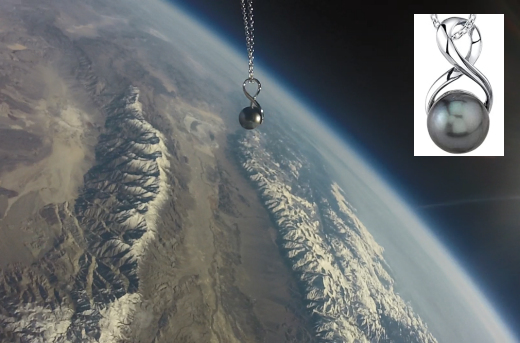
You can have it for $249.95. The students of Earth to Sky Calculus are selling these exotic space pearls to fund their cosmic ray monitoring program.
Measuring 9 mm in diameter, the pearl is mounted on a 925 sterling silver infinity twist and suspended on a matching 17 inch long sterling silver chain. Each pearl comes with a greeting card showing the pendant in flight and telling the story of its journey to the edge of space.
Far Out Gifts: Earth to Sky Store
All sales support hands-on STEM education
Realtime Space Weather Photo Gallery
Free: Spaceweather.com Newsletter
Realtime Aurora Photo Gallery
Free: Spaceweather.com Newsletter