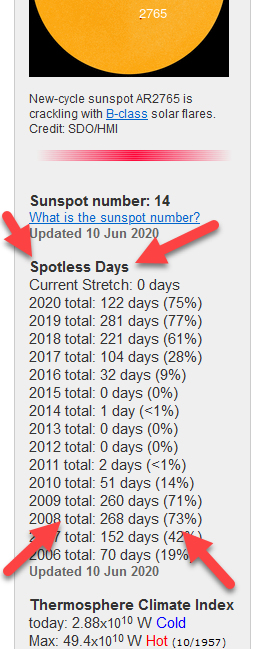
SIGNS OF LIFE FROM THE SUN: For the past few years, we've paid special attention to days without sunspots. But what about days with sunspots? Suddenly, it makes sense to talk about this again because the sun is showing signs of life. This month we've had a sunspot almost every day--10 out of 11 days so far. New Solar Cycle 25 is gaining strength, and it could bring an end to Solar Minimum during 2020. Solar flare alerts: SMS Text.
NOCTILUCENT CLOUDS IN THE USA: It's cold near the edge of space. This year, it's record cold. Unusually low temperatures in Earth's mesosphere are causing an outbreak of noctilucent clouds (NLCs). On June 9th, they descended into the United States as far south as the Utah-Idaho border. Kenneth Zia saw them first from Logan, UT:

"I saw the bright clouds just over the northern horizon in Cache Valley," says Zia. "Then, I called my brother-in-law in Boise, ID. He thought I was crazy for telling him to step outside at 10:30 PM and look for glowing clouds, but there they were!"
Zia's brother-in-law took this picture from Idaho:

"It was an awesome sight," says Zia, "and something I will continue to look for this summer!"
NLCs are Earth's highest clouds. Seeded by meteoroids, they float at the edge of space 83 km above the ground. The clouds form when summertime wisps of water vapor rise up to the mesosphere, allowing water to crystallize around specks of meteor smoke. Last summer, NLCs spread as far south as Los Angeles and Las Vegas, setting records for low-latitude sightings. This summer is shaping up to be just as good.
Observing tips: The best time to look for NLCs is during the hours after sunset (or before sunrise) when the sun is more than 6 degrees below the horizon: diagram. If you see electric-blue tendrils spreading across the sky, take a picture and submit it here.

Realtime Noctilucent Cloud Photo Gallery
Free: Spaceweather.com Newsletter
RARE RED RAINBOW: Rainbows are normally red, yellow, green and blue--in short, all the colors of a rainbow. But the rainbow Harlan Thomas photographed near Calgary, Alberta, on June 8th was simply red:

"I was hoping to find some noctilucent clouds and decided to leave a bit early to catch the sunset," says Thomas. "As I was shooting the setting sun, I looked over my shoulder and my mouth dropped to my knees. There was a rainbow that looked close enough to touch!"
What made the rainbow red? It was the only color available. All of the other colors of the rainbow had been scattered away by air molecules and dust particles in front of the low-hanging sun. It's a nice consolation prize in case you can't find any NLCs.

Realtime Space Weather Photo Gallery
Free: Spaceweather.com Newsletter
THE INFINITY BLACK PEARL: It came from Tahiti--and now it's been to the edge of space. On April 15, 2020, this genuine Black Tahitian South Sea Cultured Pearl flew to the stratosphere onboard an Earth to Sky Calculus cosmic ray balloon, soaring 107,611 feet above the Sierra Nevada mountains of central California:
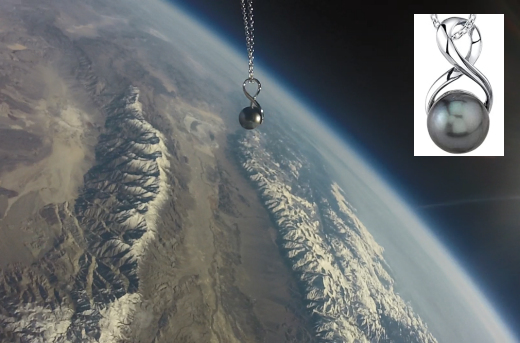
You can have it for $249.95. The students of Earth to Sky Calculus are selling these exotic space pearls to fund their cosmic ray monitoring program.
Measuring 9 mm in diameter, the pearl is mounted on a 925 sterling silver infinity twist and suspended on a matching 17 inch long sterling silver chain. Each pearl comes with a greeting card showing the pendant in flight and telling the story of its journey to the edge of space.
Far Out Gifts: Earth to Sky Store
All sales support hands-on STEM education
Realtime Aurora Photo Gallery
Free: Spaceweather.com Newsletter