COMET NEOWISE UPDATE: Good news for sky watchers. The Solar and Heliospheric Observatory (SOHO) is monitoring Comet NEOWISE (C/2020 F3) as it passes by the sun this week. Not only is the comet still intact, but also it has brightened to magnitude +2.4. This means it is likely to be an easy naked-eye object when it emerges from the sun's glare in mid-July. LATEST IMAGE.

A GLOBAL MAGNETIC ANOMALY: Lately, Earth’s magnetic field has been quiet. Very quiet. The sun is in the pits of what may turn out to be the deepest Solar Minimum in a century. Geomagnetic storms just aren’t happening.
"That’s why I was so surprised on June 23rd when my instruments picked up a magnetic anomaly," reports Stuart Green, who operates a research-grade magnetometer in his backyard in Preston UK. "For more than 30 minutes, the local magnetic field oscillated like a sine wave."

Green quickly checked solar wind data from NOAA's DSCOVR satellite. "There was nothing–no uptick in the solar wind speed or other factors that might explain the disturbance," he says.
He wasn't the only one who noticed. In the Lofoten islands of Norway, Rob Stammes detected a similar anomaly on his magnetometer. "It was remarkable,” says Stammes. "Our magnetic field swung back and forth by about 1/3rd of a degree. I also detected ground currents with the same 10 minute period."
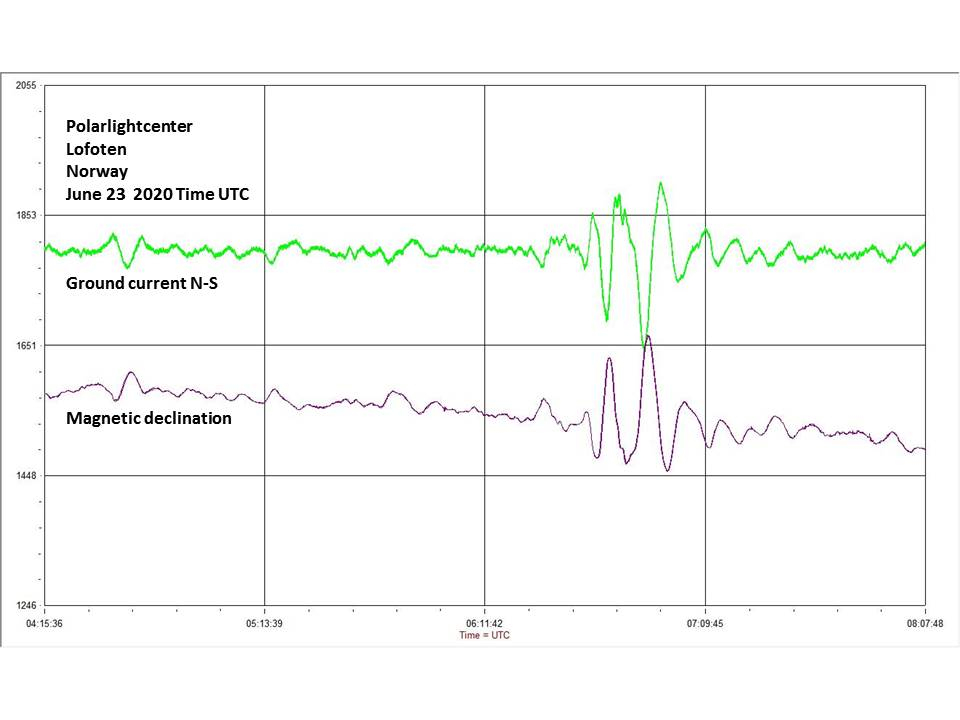
What happened? Space physicists call this phenomenon a "pulsation continuous" or "Pc" for short. Imagine blowing across a piece of paper, making it flutter with your breath. Solar wind can have a similar effect on magnetic fields. Pc waves are essentially flutters propagating down the flanks of Earth's magnetosphere excited by the breath of the sun. During more active phases of the solar cycle, these flutters are easily lost in the noise of rambunctious geomagnetic activity. But during the extreme quiet of Solar Minimum, such waves can make themselves "heard" like a pin dropping in an silent room.

Earth's magnetic field was so quiet on June 23rd, the ripple was heard all around the world. INTERMAGNET's global network of magnetic observatories picked up wave activity at the same time from Hawaii to China to the Arctic Circle. There's even a hint of it in Antarctica (note Scott Base in the plot, above).
Pc waves are classified into 5 types depending on their period. The 10-minute wave on June 23rd falls into category Pc5. Slow Pc5 waves have been linked to a loss of particles from the van Allen radiation belts. Energetic electrons surf these waves down into Earth’s atmosphere, where they dissipate harmlessly.
With Solar Minimum in full swing, there’s never been a better time to study these waves. Keep quiet … and stay tuned for more.
Realtime Space Weather Photo Gallery
Free: Spaceweather.com Newsletter
ARCTIC WOLF PENDANT: This wolf glows in the dark--and it's been to space. The students of Earth to Sky Calculus launched this special pendant to the stratosphere on April 15, 2020, on board a high-altitude cosmic ray balloon. The payload of radiation sensors (and lupine jewelry) traveled 107,611 feet above Earth's surface:

You can have it for $99.95. The students are selling these pendants to support their cosmic ray ballooning program. Each one comes with a greeting card showing the wolf in flight and describing its journey to the stratosphere and back again.
Far Out Gifts: Earth to Sky Store
All sales support hands-on STEM education
Realtime Aurora Photo Gallery
Free: Spaceweather.com Newsletter