A TREMOR IN EARTH'S MAGNETIC FIELD: On June 23rd, Earth's quiet magnetic field was unexpectedly disturbed by a wave of magnetism that rippled around much of the globe. There was no solar storm or geomagnetic storm to cause the disturbance. What was it? Find out here.
SPACE STATION TRANSITS THE SUN: Theirry Legault is not an easy person to surprise. Over the years, the celebrated French astrophotographer has taken some incredible pictures of the International Space Station (ISS), routinely capturing details previously thought impossible. Nevertheless, on June 25th, "I was surprised," he says. "I photographed the ISS passing in front of the sun and saw the station's robotic arm."

To appreciate this achievement, consider the following: The space station flies around Earth at 17,000 mph, and it only takes a split second to cross the entire solar disk. Meanwhile, the slender Canadarm2 is only 35 cm wide. How do you focus, catch, and freeze-frame such a narrow object racing across a blindingly-bright star?
"It helped that my camera is extremely fast; it works at 1/32,000s," explains Legault. "The ISS moves only 24 cm during that time, less than the width of the arm. The burst on the camera is very high (60 fps in raw mode) but very short: 0.8s. I have to use a special module, receiving the time signal from a GPS antenna and triggering the camera at the moment of transit indicated by Calsky."

Click to view a movie of Legault's observations on June 24-25, 2020
Solar Minimum adds an extra layer of difficulty. "Focusing is not easy because there are no sunspots," says Legault. "Before the ISS arrived, I had to focus on the solar limb. This requires extreme care."
"This is the very first time the Canadarm2 has been photographed during a transit of the sun," says Legault. "In 2011, I photographed the arm during a nighttime passage of the ISS. It was holding astronaut Steve Bowen while he repaired an ammonia pump. This time was much more difficult."
Realtime Space Weather Photo Gallery
Free: Spaceweather.com Newsletter
ARCTIC WOLF PENDANT: This wolf glows in the dark--and it's been to space. The students of Earth to Sky Calculus launched this special pendant to the stratosphere on April 15, 2020, on board a high-altitude cosmic ray balloon. The payload of radiation sensors (and lupine jewelry) traveled 107,611 feet above Earth's surface:
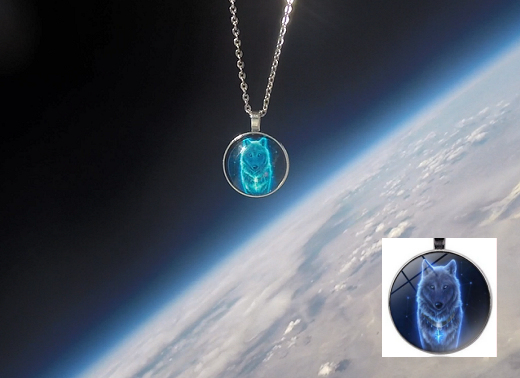
You can have it for $99.95. The students are selling these pendants to support their cosmic ray ballooning program. Each one comes with a greeting card showing the wolf in flight and describing its journey to the stratosphere and back again.
Far Out Gifts: Earth to Sky Store
All sales support hands-on STEM education
Realtime Aurora Photo Gallery
Free: Spaceweather.com Newsletter