SOLAR WIND, INCOMING: Minor geomagnetic unrest is possible on June 30th and July 1st when a stream of solar wind gently buffets Earth's magnetic field. The gaseous material is flowing from a small hole in the sun's atmosphere. Antarctic sky watchers should be alert for auroras in austral winter darkness. Aurora alerts: SMS text.
3D NOCTILUCENT CLOUDS (UPDATED): Noctilucent clouds (NLCs) have been studied for almost 200 years, yet much about them remains unknown. Seeded by meteoroids, they float near the edge of space in a layer no more than a few kilometers thick. How are the clouds arranged inside that narrow layer? Two German photographers decided to find out. During a bright display of NLCs on June 7th, Michael Theusner and Maciej Libert photographed the same clouds from two cities 120 km apart:
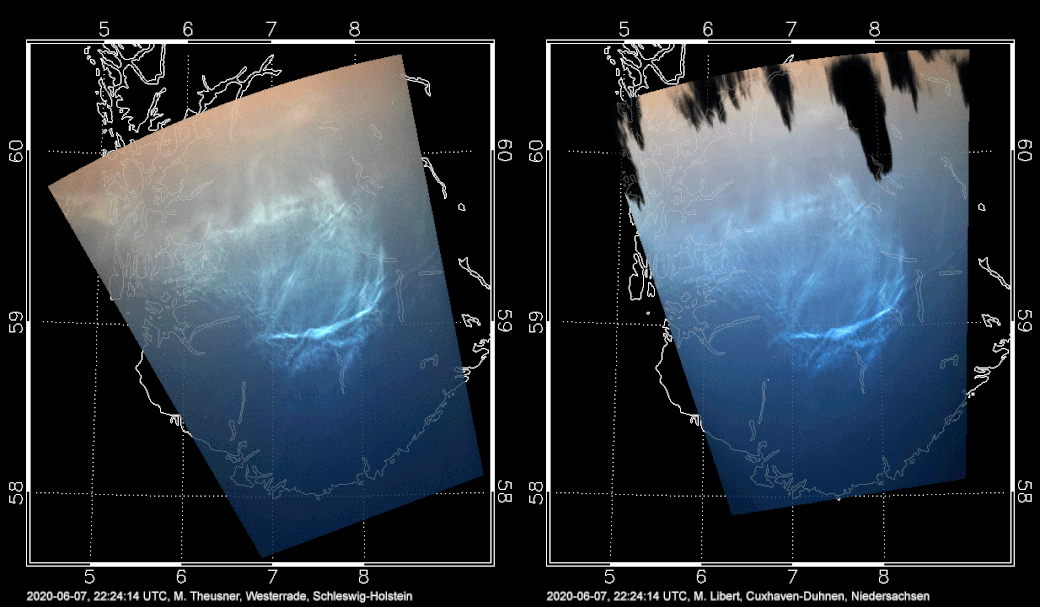
"The long baseline of 120 km allowed us to construct a real 3D image of that cloud," says Theusner. "First, we re-projected the images onto the ground. Then, we created an anaglyph from the undistorted images. Here it is. Using red/cyan glasses, you can see the true 3D structure of the cloud."
Many readers won't have 3D glasses. For them, Hanno Falk, an independent expert in 3D imaging, created a no-glasses version. Cross your eyes to merge the two images, shown below, and relax your stare into infinity to see the cloud's 3D structure.


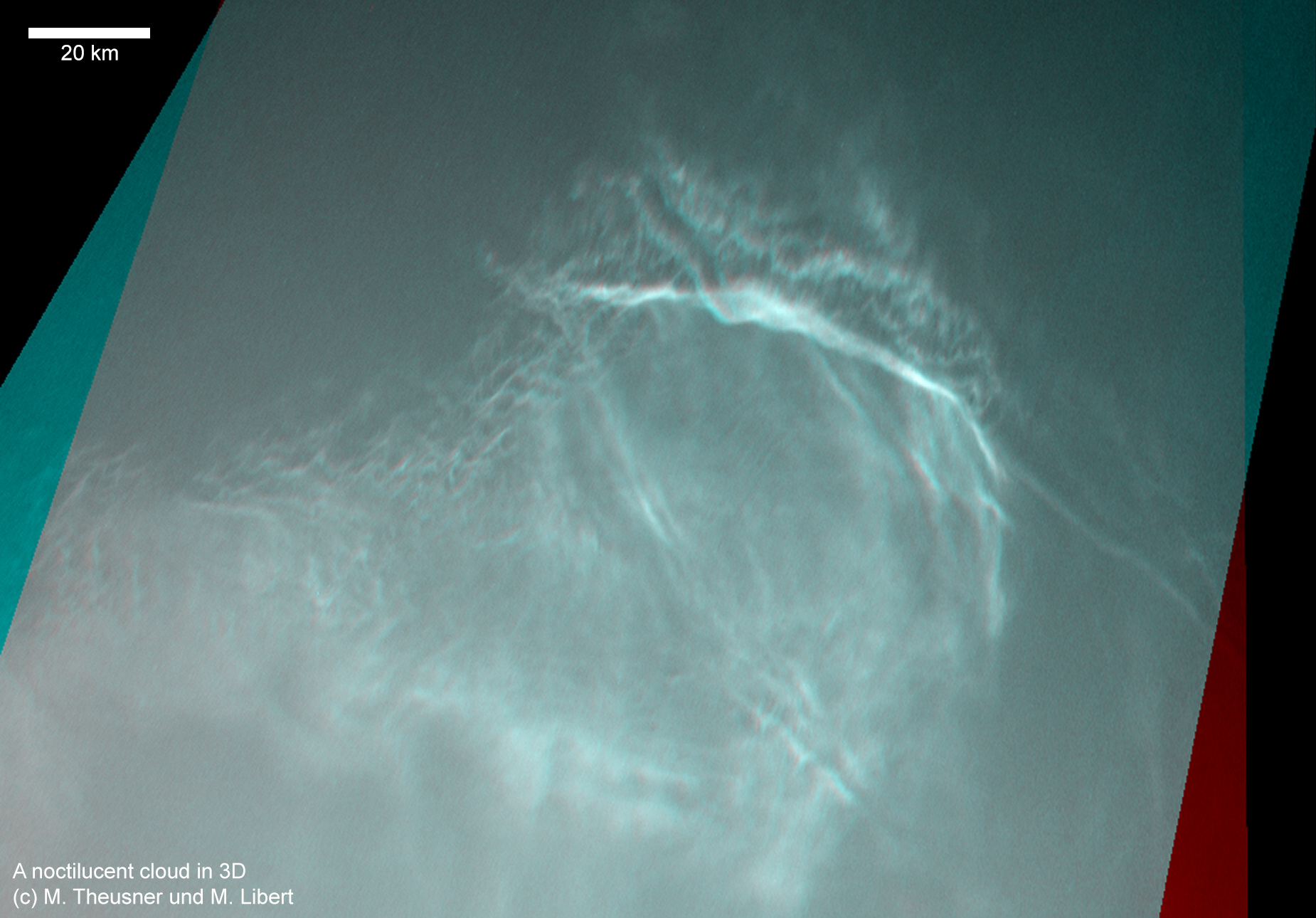
The most striking feature of the 3D view is a fold in the cloud. In a wide arc across the bottom of the image, one layer of frosted meteor smoke is clearly floating atop another. The depth of the cloud is no more than 2 km.
"From the images and their geolocation, we deduced the average altitude of the cloud: 84 km," says Theusner. "Its lowest parts were at 83 km and its highest at 85 km--a very narrow layer, indeed."
Realtime Noctilucent Cloud Photo Gallery
Free: Spaceweather.com Newsletter
ARCTIC WOLF PENDANT: This wolf glows in the dark--and it's been to space. The students of Earth to Sky Calculus launched this special pendant to the stratosphere on April 15, 2020, on board a high-altitude cosmic ray balloon. The payload of radiation sensors (and lupine jewelry) traveled 107,611 feet above Earth's surface:

You can have it for $99.95. The students are selling these pendants to support their cosmic ray ballooning program. Each one comes with a greeting card showing the wolf in flight and describing its journey to the stratosphere and back again.
Far Out Gifts: Earth to Sky Store
All sales support hands-on STEM education
Realtime Space Weather Photo Gallery
Free: Spaceweather.com Newsletter
Realtime Aurora Photo Gallery
Free: Spaceweather.com Newsletter