COMET NEOWISE SIGHTING: Comet NEOWISE (C/2020 F3) is brightening rapidly as it passes by the sun. This morning, Ray Brooks of the Arizona Sky Village near Tucson saw the comet just before sunrise, and he sends this report:
"Wow - very bright," he says. "It would have been a spectacular naked eye sight in dark skies at a decent elevation. At the moment, though, it is near the sun (12 degrees away this morning) and must be observed low in the glowing pre-dawn sky."
Using binoculars, Brooks first spotted the comet at an incredibly-low altitude of 0.6 degrees. "The comet brightened as it rose above a very slight haze," he says. "Peak contrast against the ever brightening sky was at 04:35 MST at an alltitude of 2.9 deg. I kept it in view through 04:45 (4.8 deg alt) and then checked my watch. When I looked back in the eyepiece I lost it!"
Brooks estimated the magnitude of the comet as 0 to +1. If those numbers hold, or improve, other skilled amateurs will be seeing and perhaps photographing Comet NEOWISE in the mornings ahead. Stay tuned!
Realtime Space Weather Photo Gallery
Free: Spaceweather.com Newsletter
WHY ARE NOCTILUCENT CLOUDS SO WAVY? Anyone who's seen noctilucent clouds would agree. They are extraordinarily wavy--much more so than ordinary clouds near the surface of the Earth. Consider this example photographed by Marek Nikodem of Szubin, Poland:

"On the morning of June 30th, an exceptionally bright and beautiful display was visible," says Nikodem. "Even random people who went to work in the morning stopped and admired the electric-blue ripples."
What makes noctilucent clouds so wavy? The answer lies in the lower atmosphere. Powerful storm systems and other disturbances near Earth's surface send ripples of temperature and pressure up into the sky. These ripples are called "gravity waves." Gravity waves can propagate all the way up to the mesosphere, where they imprint themselves on the forms of noctilucent clouds.
Often, gravity waves break in the noctilucent zone (82-85 km above Earth's surface), dumping their energy and momentum there. Radar studies of noctilucent wave structures can trace this energy and tell researchers a great deal about upper atmospheric circulation.
Realtime Noctilucent Cloud Photo Gallery
Free: Spaceweather.com Newsletter
A GIFT FOR STAR WARS FANS: A good bounty hunter will go just about anywhere. On Jun 13, 2020, the Mandalorian hitched a ride to the stratosphere onboard an Earth to Sky Calculus cosmic ray balloon. Here he is, floating 113,189 feet above the Sierra Nevada mountains of central California:
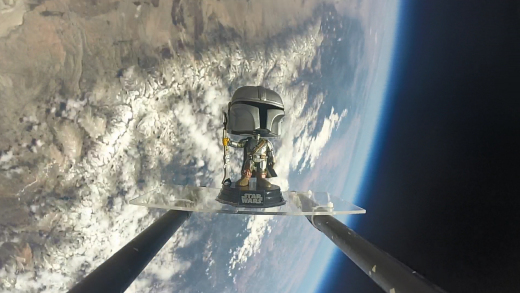
You can have him for $114.95. The students of Earth to Sky are selling Mandalorian bobbleheads to raise money for their cosmic ray ballooning program. Each figurine comes with a greeting card showing the bounty hunter in flight and telling the story of his journey to the edge of space and back again. They make great gifts for Star Wars fans.
Far Out Gifts: Earth to Sky Store
All sales support hands-on STEM education
Realtime Aurora Photo Gallery
Free: Spaceweather.com Newsletter