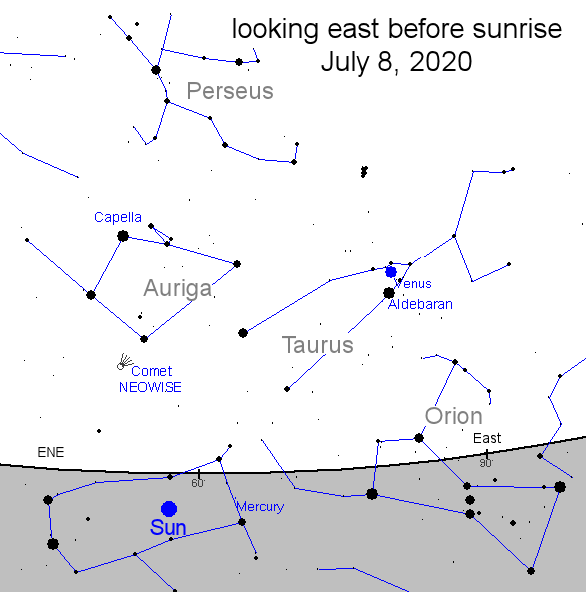
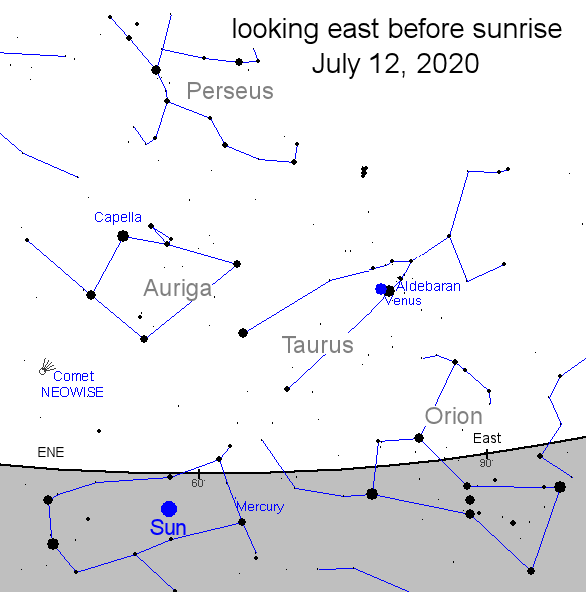
VENUS AT MAXIMUM BRIGHTNESS: If you can wake up before sunrise only once this month, make it July 10th. On Friday morning, Venus will be at its maximum brightness, magnitude -4.7. That's 30 times berighter than Sirius, the brightest star in the sky. Bonus: Venus will be less than 2 degrees from red giant star Aldebaran. Bonus #2: Comet NEOWISE is nearby, too. Sky maps: July 9, 10, 11.
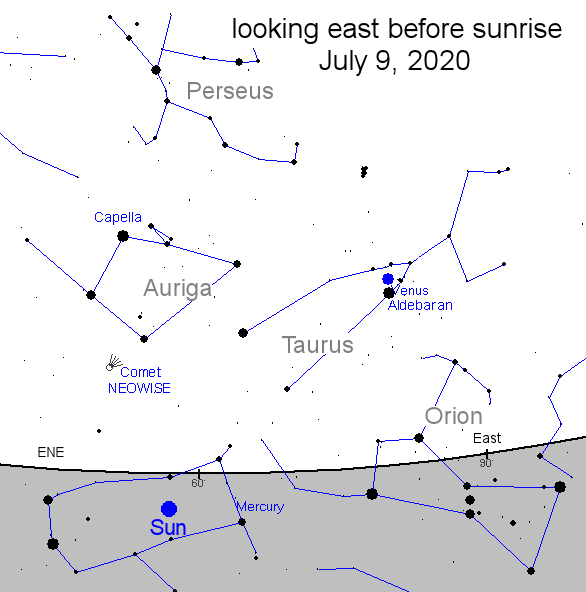
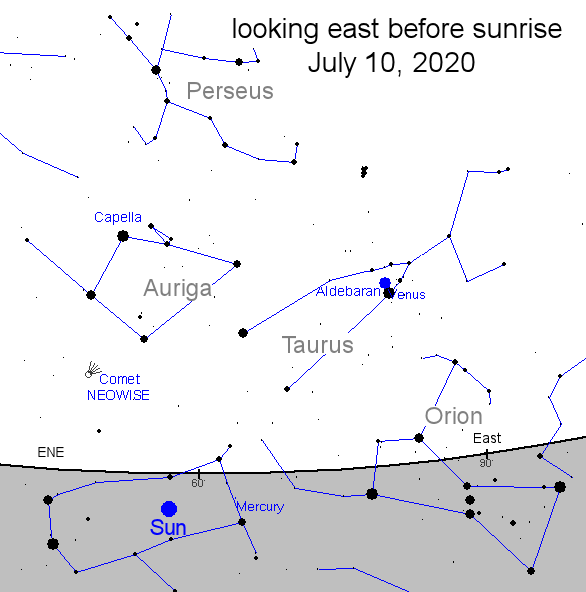
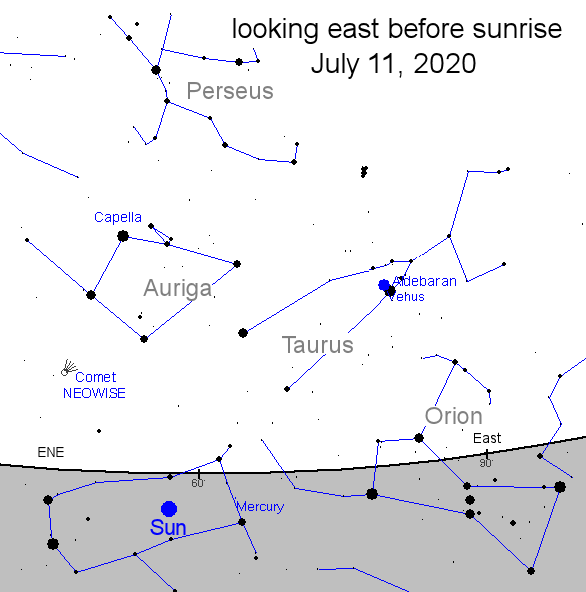
A REALLY GOOD COMET: Comet NEOWISE (C/2020 F3) is not yet a Great Comet. It is, however, Really Good. Rising just before the sun, NEOWISE is visible to the naked eye and has a tail at least 5 degrees long. Jeremy Perez sends this picture from Merriam Crater east of Flagstaff, Arizona:

"On any given morning, this old cinder cone is perfect," says Perez. "Catching it sharing the horizon with this graceful comet gets kind of goosebumpy for me."
Comet NEOWISE is currently shining about as brightly as a 2nd magnitude star. Its core and part of its tail are easy naked-eye objects from dark, clear sites. Framed by the colors of sunrise, it is arguably the most beautiful comet in many years. But...
The last truly Great Comet was Hale-Bopp in 1997. Shining 10 times brighter than Comet NEOWISE does now, Hale-Bopp was visible to the unaided eye for an astonishing 18 months, and its tail stretched as much as 45 degrees across the sky. Comet NEOWISE doesn't come close to those thresholds of splendor.
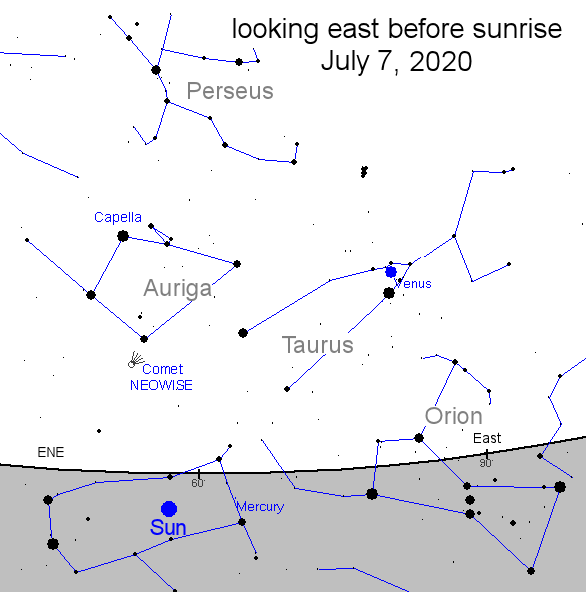
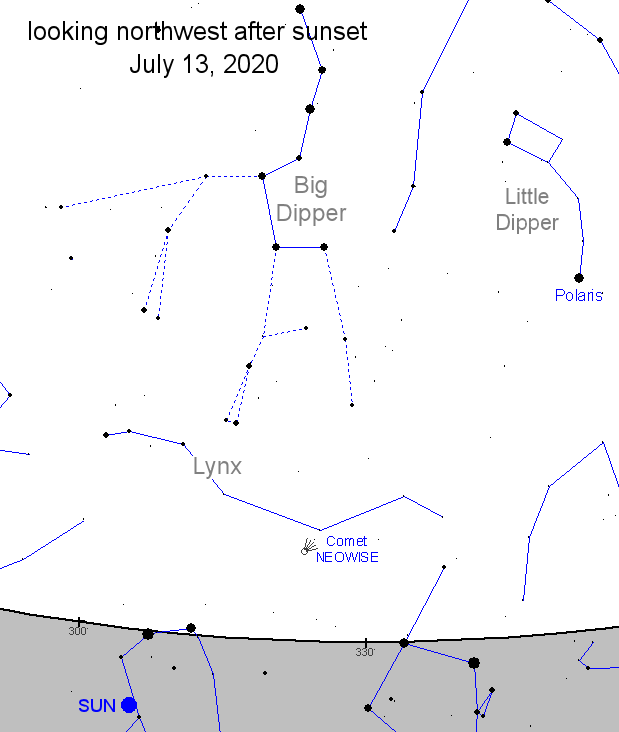
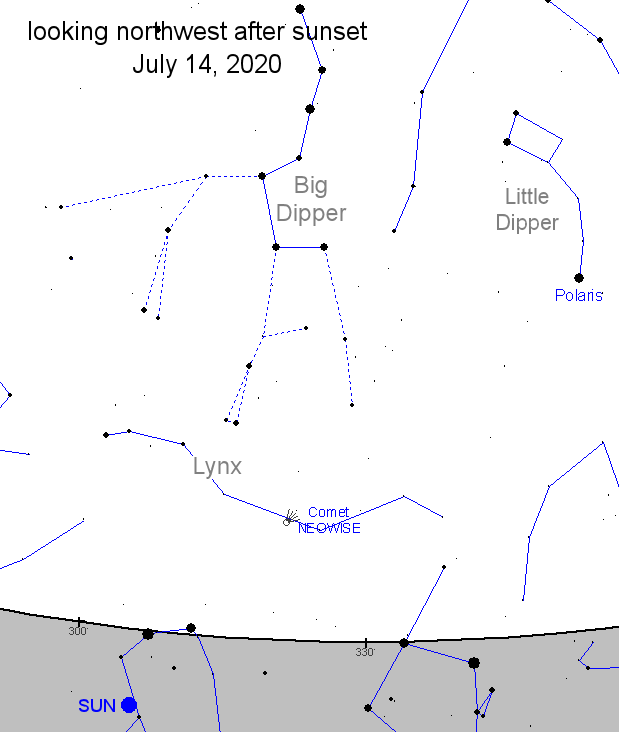
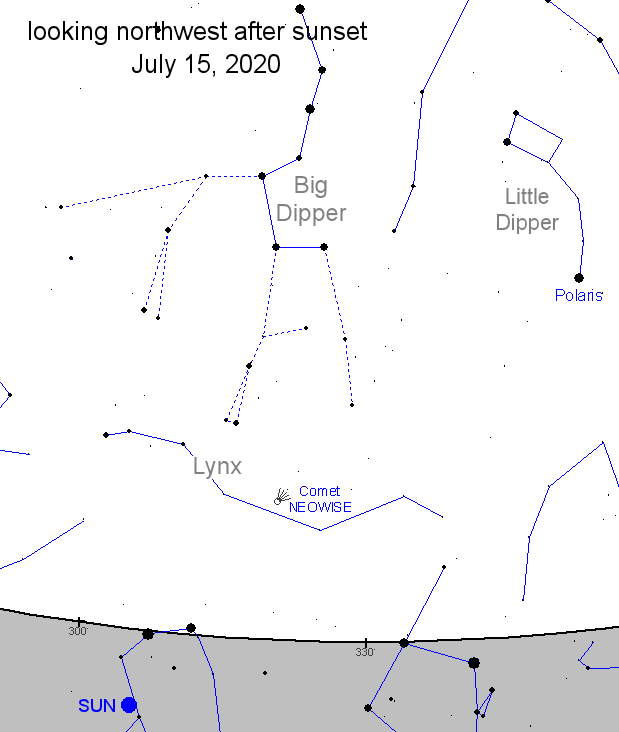
Sometimes, though, a Really Good Comet is enough. Wake up before sunrise and take a look. Sky maps: July 7, 8, 9, 10, 11, 12, 13, 14, 15.
Realtime Comet NEOWISE Photo Gallery
Free: Spaceweather.com Newsletter
NOCTILUCENT COMET: Is it possible to take a once-in-a-lifetime picture three days in a row? On July 6th, Europeans woke up to a spectacular display of noctilucent clouds (NLCs). Many onlookers photographed the rare clouds surrounding Comet NEOWISE--a "once in a lifetime photo-op," we called it. Three days later, it's still happening:

Laura Kranich took this picture on July 8th from Bühl, Baden-Württemberg, Germany. "Together with the ~1200 year-old castle on the mountain it was just a breathtaking spectacle," she says. "About 1° of the comet's tail could be seen with the naked eye, despite being embedded in the brightly-glowing noctilucent clouds."
NLCs are Earth’s highest clouds. Seeded by meteoroids, they float at the edge of space 83 km above the ground. The clouds form during summer when wisps of water vapor rise up to the mesosphere, allowing water to crystallize around specks of meteor smoke. This summer, record cold temperatures in the mesosphere are boosting their production.
The surge in noctilucent clouds is coinciding with the appearance of a decade-class comet to produce some rare shots, indeed. Tomorrow morning might be "once-in-a-lifetime," too. Stay tuned.
Realtime Noctilucent Cloud Photo Gallery
Free: Spaceweather.com Newsletter
THE INFINITY BLACK PEARL: It came from Tahiti--and now it's been to the edge of space. On April 15, 2020, this genuine Black Tahitian South Sea Cultured Pearl flew to the stratosphere onboard an Earth to Sky Calculus cosmic ray balloon, soaring 107,611 feet above the Sierra Nevada mountains of central California:
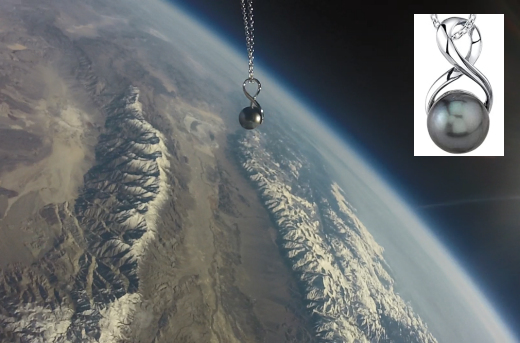
You can have it for $249.95. The students of Earth to Sky Calculus are selling these exotic space pearls to fund their cosmic ray monitoring program.
Measuring 9 mm in diameter, the pearl is mounted on a 925 sterling silver infinity twist and suspended on a matching 17 inch long sterling silver chain. Each pearl comes with a greeting card showing the pendant in flight and telling the story of its journey to the edge of space.
Far Out Gifts: Earth to Sky Store
All sales support hands-on STEM education
Realtime Space Weather Photo Gallery
Free: Spaceweather.com Newsletter