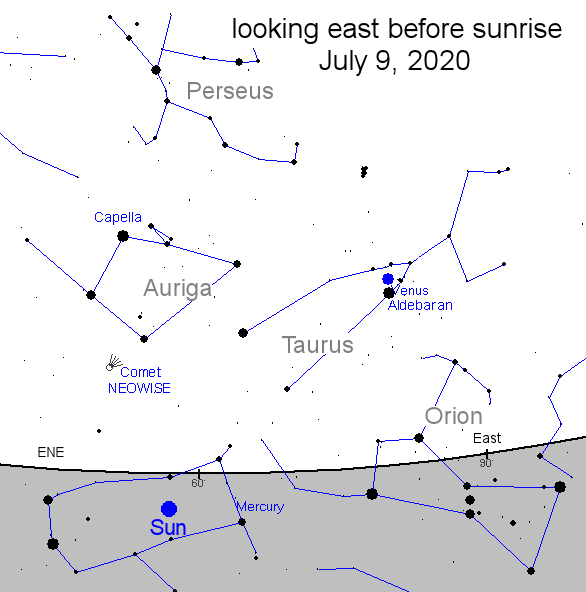
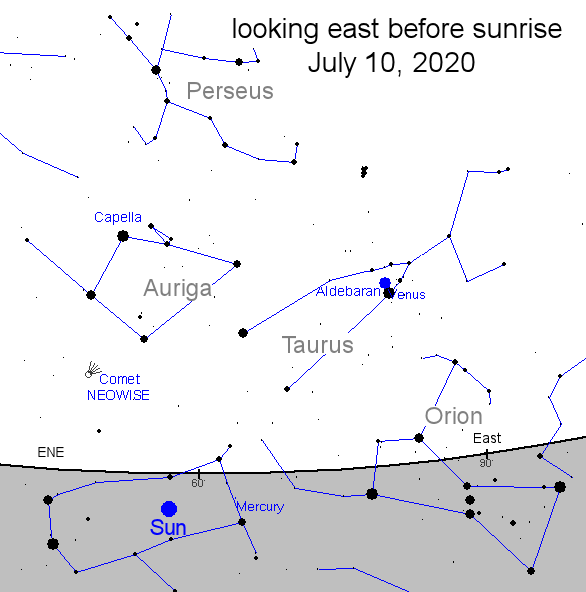
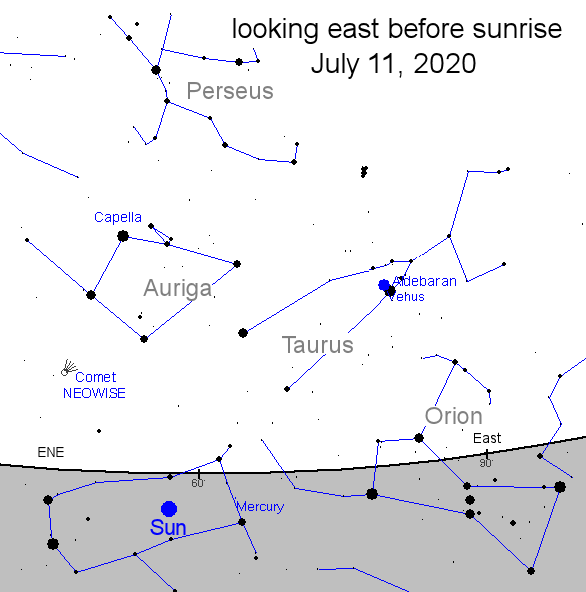
VENUS AT MAXIMUM BRIGHTNESS: If you can wake up before sunrise only once this month, make it July 10th. On Friday morning, Venus will be at its maximum brightness, magnitude -4.7. That's 30 times berighter than Sirius, the brightest star in the sky. Bonus: Venus will be less than 2 degrees from red giant star Aldebaran. Bonus #2: Comet NEOWISE is nearby, too. Set your alarm for dawn! Sky maps: July 9, 10, 11.
COMET NEOWISE SPROUTS ANOTHER TAIL: Comet NEOWISE just keeps getting better. Not only is it visible to the naked eye in morning twilight, but also, now, it has two tails. Sebastian Voltmer photographed them over the village church of Spicheren, France:

The brighter of the two is the dust tail, made of dusty-rocky grains sprinkled like crumbs along the comet's curved orbit. Just above it is the faint ion tail, made of gas shoved straight away from the sun by the solar wind.
"The ion tail is relatively dim," says Voltmer. "To record it, I had to stack 63 frames captured with my Nikon D800 digital camera (ISO 320)."
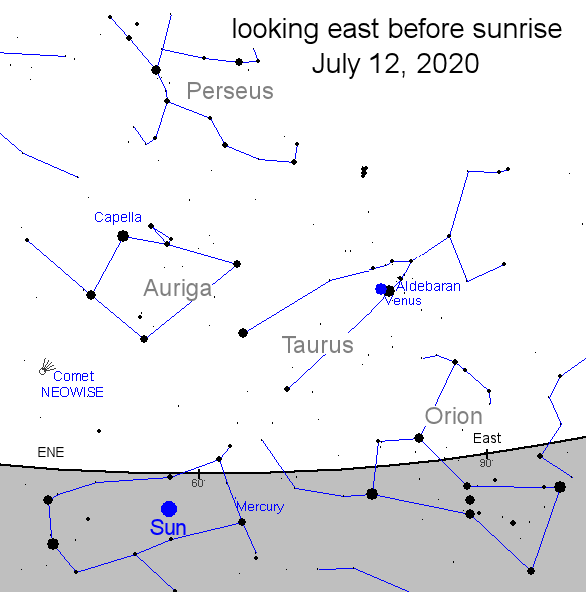
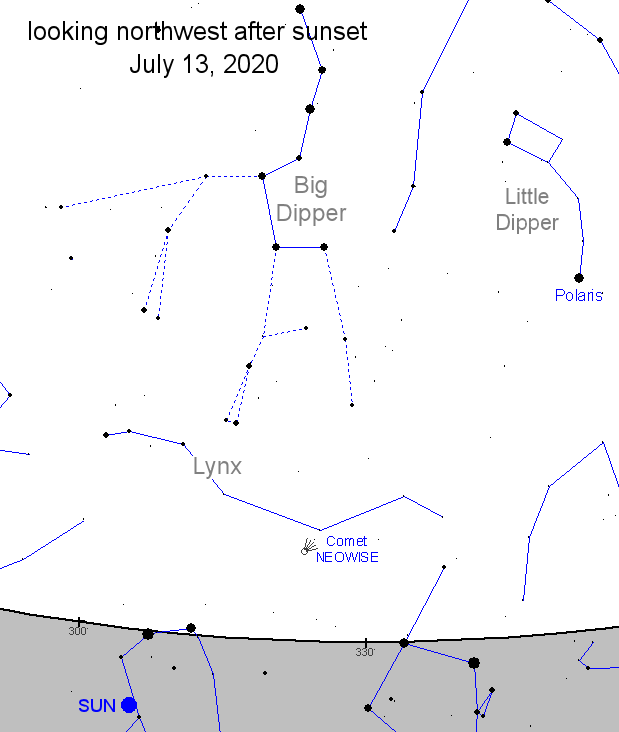
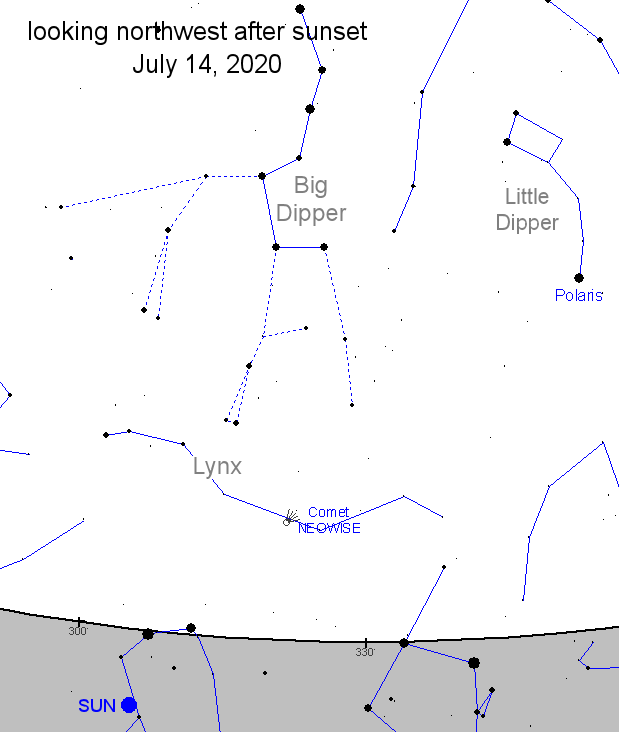
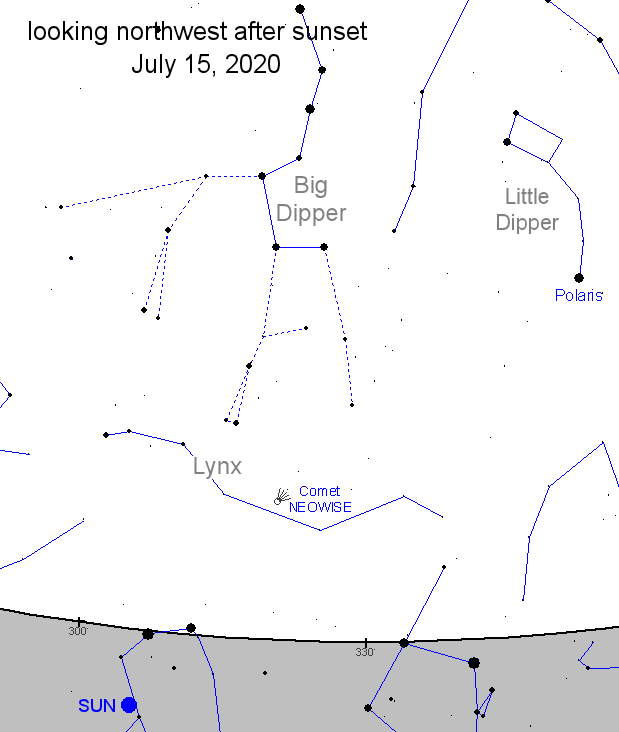
Look carefully at the ion tail; it's blue. This makes it tricky to see against a backdrop of blue twilight. Visibility will improve in the days ahead as the comet moves into darker skies farther from the sun. Stay tuned! Sky maps: July 9, 10, 11, 12, 13, 14, 15.
Realtime Comet NEOWISE Photo Gallery
Free: Spaceweather.com Newsletter
THE MESOSPHERE IS STILL COLD: Noctilucent clouds (NLCs) have been extra-abundant this summer. Nearly half of all photos of Comet NEOWISE taken from Europe in the past few mornings have caught the comet surfing waves of electric blue. The reason: It's cold in the mesosphere. Very Cold. These data from NASA's Microwave Limb Sounder show how the temperature has cratered 83 km above Earth where NLCs form:

Lynn Harvey of the University of Colorado's Laboratory for Atmospheric and Space Physics made the plot, which spans 14 years. 2020 is traced in red. "Conditions continue to be extremely cold with temperatures setting cold records on some days," she says.
For noctilucent clouds, cold is good. NLCs form when summertime wisps of water vapor rise up to the mesosphere, allowing water to crystallize around specks of meteor smoke. Low temperatures help the ice crystals form.
In addition to a major outbreak in Europe, the clouds have spread across the USA to southern California. Everyone should be watching for them. The best time to look for NLCs is during the hours after sunset (or before sunrise) when the sun is more than 6 degrees below the horizon: diagram. If you see electric-blue tendrils spreading across the sky, take a picture and submit it here.

Realtime Noctilucent Cloud Photo Gallery
Free: Spaceweather.com Newsletter
THE INFINITY BLACK PEARL: It came from Tahiti--and now it's been to the edge of space. On April 15, 2020, this genuine Black Tahitian South Sea Cultured Pearl flew to the stratosphere onboard an Earth to Sky Calculus cosmic ray balloon, soaring 107,611 feet above the Sierra Nevada mountains of central California:
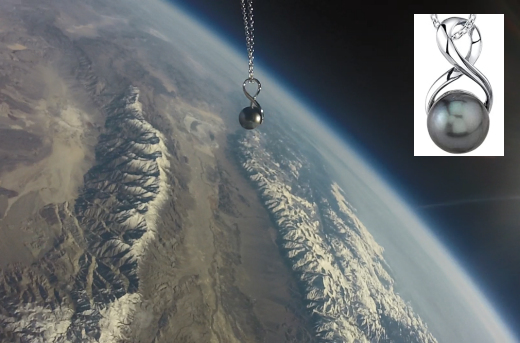
You can have it for $249.95. The students of Earth to Sky Calculus are selling these exotic space pearls to fund their cosmic ray monitoring program.
Measuring approximately 9 mm in diameter, the pearl is mounted on a 925 sterling silver infinity twist and suspended on a matching 17 inch long sterling silver chain. Each pearl comes with a greeting card showing the pendant in flight and telling the story of its journey to the edge of space.
Far Out Gifts: Earth to Sky Store
All sales support hands-on STEM education
Realtime Space Weather Photo Gallery
Free: Spaceweather.com Newsletter