WEAK IMPACT: Arriving earlier than expected, a slow-moving CME that left the sun on July 8th appears to have struck during the early hours of July 13th. The weak impact sparked auroras behind Comet NEOWISE over the US-Canadian border. Otherwise, however, the CME had little effect. Aurora alerts: SMS Text
COMET NEOWISE IN THE EVENING SKY: Observers of Comet NEOWISE (C/2020 F3), by far the finest comet in years, have had just one complaint. You have to wake up at the crack of dawn to see it. Not anymore. NEOWISE is now visible in the evening sky, too. Petr Horálek photographed it after sunset on July 12th from Seč, Czech Republic:

"That's me in the boat," says Horálek. "While my camera was shooting on shore, I rowed out onto the water. I was so amazed by the comet's beauty that I didn't notice I had drifted into the camera's field of view!"
Chris Cook of Cape Cod, Massachusetts, also saw the comet at sunset on July 12th. "The comet's altitude at the time of this photo was only 3° above the horizon," he says.

"I found the comet low in the NNW with 7x50 binoculars at 9:25pm EDT," he says. "Conditions were very good. This shot is a 40 x 2.5 second exposure at ISO6400 using my Canon 6D camera."
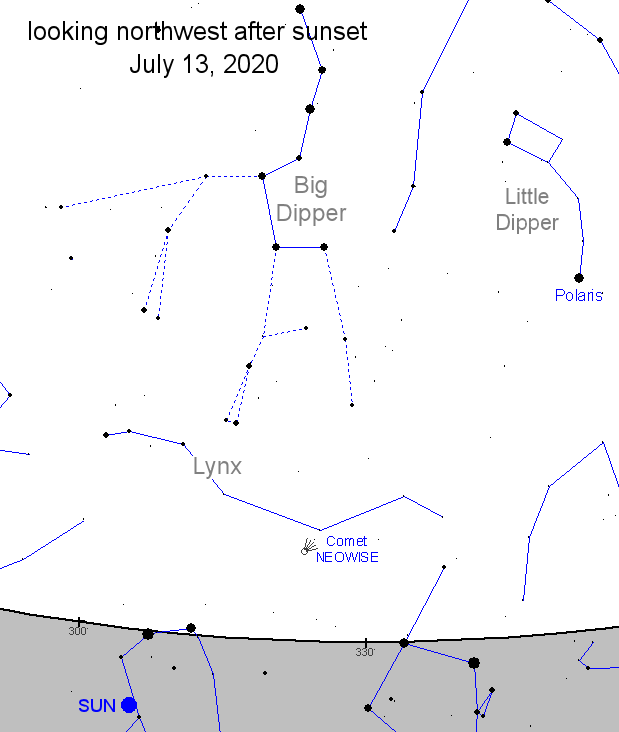
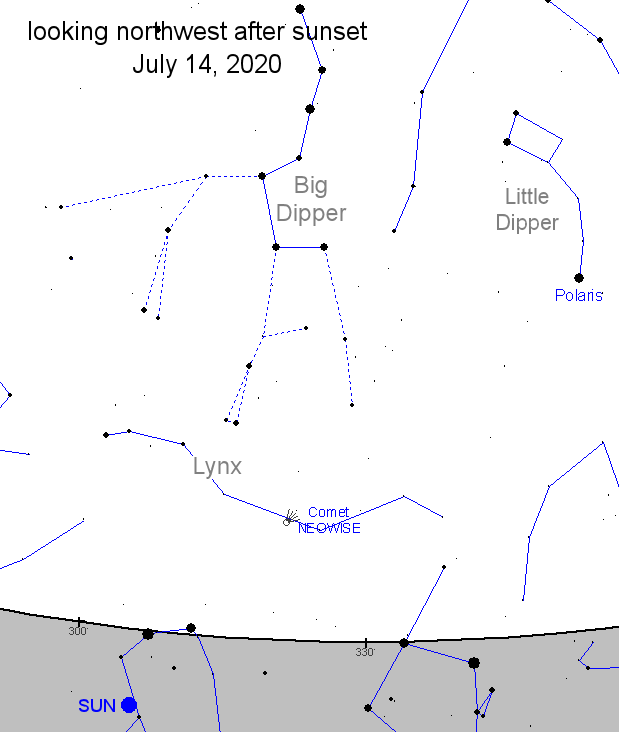
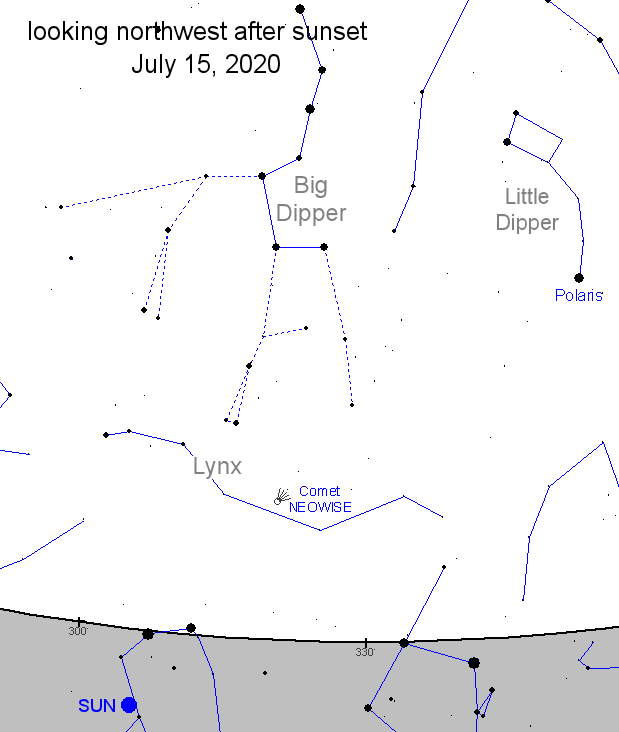
Comet NEOWISE is now visible at both ends of the day. When should you look? For the rest of this week, it's a toss-up. Morning and evening are about equally good times to see the comet. Next week, however, sharply favors the evening as the comet rockets north toward the Big Dipper. Morning sky maps: July 13, 14, 15, 16, 17; Evening sky maps: July 13, 14, 15, 16, 17.




Realtime Comet NEOWISE Photo Gallery
Free: Spaceweather.com Newsletter
ARCTIC WOLF PENDANT: This wolf glows in the dark--and it's been to space. The students of Earth to Sky Calculus launched this special pendant to the stratosphere on April 15, 2020, on board a high-altitude cosmic ray balloon. The payload of radiation sensors (and lupine jewelry) traveled 107,611 feet above Earth's surface:

You can have it for $99.95. The students are selling these pendants to support their cosmic ray ballooning program. Each one comes with a greeting card showing the wolf in flight and describing its journey to the stratosphere and back again.
Far Out Gifts: Earth to Sky Store
All sales support hands-on STEM education
Realtime Space Weather Photo Gallery
Free: Spaceweather.com Newsletter
Realtime Noctilucent Cloud Photo Gallery
Free: Spaceweather.com Newsletter