JUPITER AT OPPOSITION: Tonight, Jupiter it at opposition---that is, opposite the sun and making its closest approach to Earth. The giant planet rises at sunset and stays up all night long. Look for it right beside Saturn in the midnight sky. [sky map]


COMET NEOWISE MEETS THE NORTHERN LIGHTS: On July 13th, a slow-moving CME hit Earth's magnetic field. Its impact was barely felt, but the slight ripples it sent through the geomagnetic field were enough to spark auroras along the US-Canadian border. Heidi Pinkerton caught the display from Babbitt, Minnesota:

"It was thrilling to see the sunset, the comet, and northern lights all in the same image," says Pinkerton.
Pinkerton and her husband had gone out at sunset on July 12th (July 13th UTC) to photograph Comet NEOWISE (C/2020 F3). The auroras were a surprise. A CME launched toward Earth on July 8th by the eruption of a magnetic filament on the sun was supposed to arrive on July 14th. Instead it hit a day early--just as the Pinkertons were stepping out for a comet-shoot. "Perfect timing!" she says.
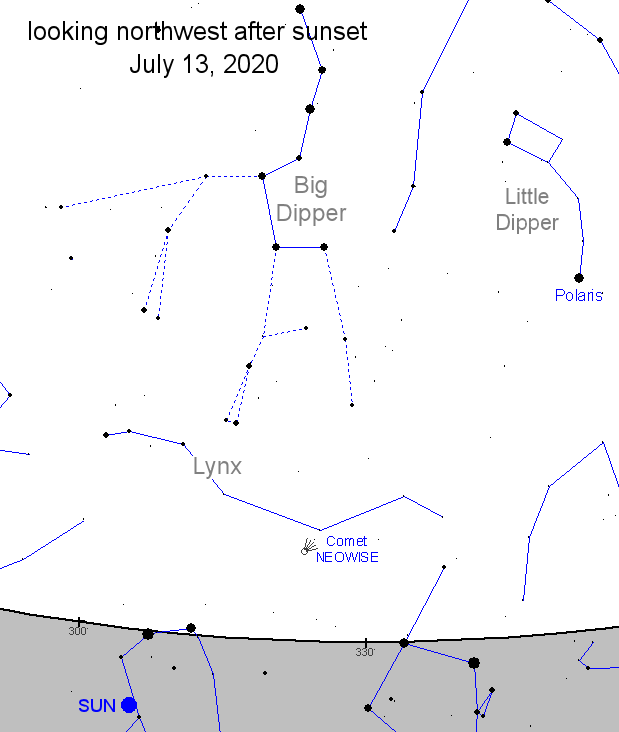
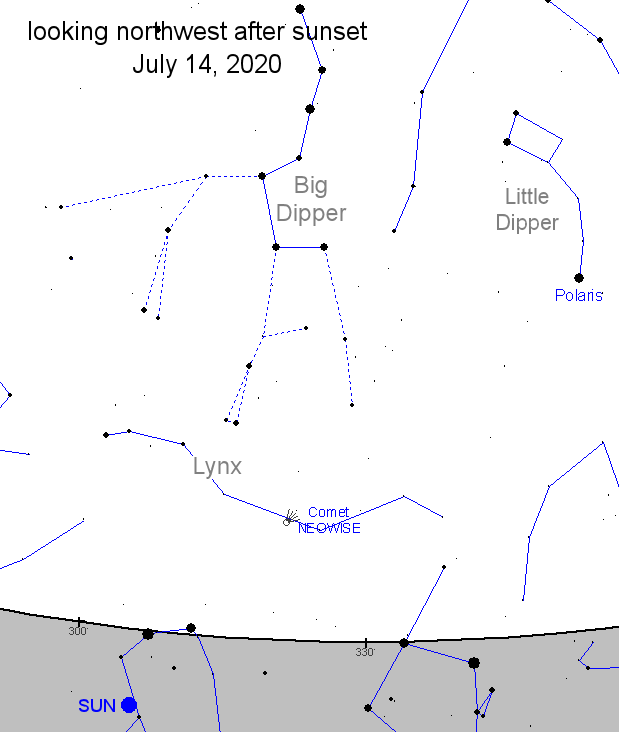
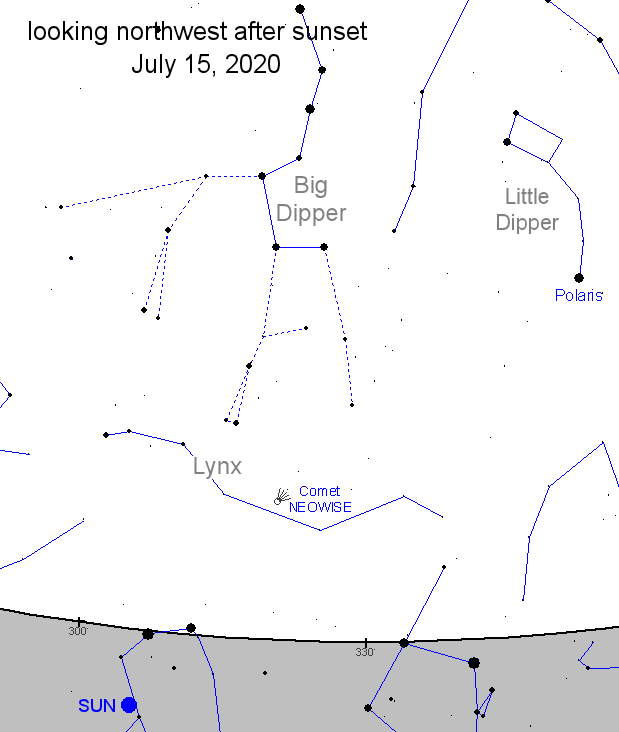
Comet NEOWISE is now visible in the morning sky and the evening sky. This doubles the odds that photographers will catch the comet alongside auroras, meteors, fireballs, spaceships, and noctilucent clouds. For best results, make a wish.
Morning sky maps: July 13, 14, 15, 16, 17; Evening sky maps: July 13, 14, 15, 16, 17.




Realtime Comet NEOWISE Photo Gallery
Free: Spaceweather.com Newsletter
COMET NEOWISE VS. THE SOLAR WIND: On July 12th, two of the best comet photographers in the world, Michael Jaeger and Gerald Rhemann, traveled to the Hochkar Ski Resort in Austria for a good long look at Comet NEOWISE. "The ski resort is over 1400 meters above sea level and has a perfect horizon view to north," explains Jaeger. "From there, we could expose the comet as deeply as possible." This is what they saw:

Rhemann's color photo is inset in Jaeger's high-resolution black and white image. They both reveal the comet's spectacular double tail. The brighter of the two is the dust tail, made of dusty-rocky grains sprinkled like crumbs along the comet's curved orbit. Just above it is the blue ion tail, made of gas shoved straight away from the sun by the solar wind.
Well ... not quite straight. Take a closer look at the ion tail. It is filled with kinks, curlicues, and other discontinuities. These are signs of turbulence in the solar wind. As gusts buffet the ion tail, irregularities ripple downstream from the comet, adding a dash of complicated beauty to an already gorgeous object.
Stay tuned for even longer exposures as Comet NEOWISE climbs higher in the evening sky.
Realtime Comet NEOWISE Photo Gallery
Free: Spaceweather.com Newsletter
ARCTIC WOLF PENDANT: This wolf glows in the dark--and it's been to space. The students of Earth to Sky Calculus launched this special pendant to the stratosphere on April 15, 2020, on board a high-altitude cosmic ray balloon. The payload of radiation sensors (and lupine jewelry) traveled 107,611 feet above Earth's surface:

You can have it for $99.95. The students are selling these pendants to support their cosmic ray ballooning program. Each one comes with a greeting card showing the wolf in flight and describing its journey to the stratosphere and back again.
Far Out Gifts: Earth to Sky Store
All sales support hands-on STEM education
Realtime Space Weather Photo Gallery
Free: Spaceweather.com Newsletter
Realtime Noctilucent Cloud Photo Gallery
Free: Spaceweather.com Newsletter