SOLAR CYCLE UPDATE: Solar Minimum is here, and it's a deep one--a century-class lull in solar activity. At the same time, the next solar cycle is showing signs of life. A recent profusion of reversed-polarity sunspots, plus a big solar flare in May, herald the coming of Solar Cycle 25. Despite the recent quiet, Solar Maximum could be only a few years away. FULL STORY.
A SURPRISE VISIT FROM STEVE: Even STEVE wants to see Comet NEOWISE. On July 14th, the geomagnetic phenomenon appeared over Canada, streaking the sky with mauve ribbons of light. Harlan Thomas of Calgary, Alberta, reports: "I was out shooting the comet when I noticed a mauve-looking cloud. Wow!" I thought. "STEVE has come to visit NEOWISE. How cool is that?"

STEVE is a recent discovery. It looks like an aurora, but it is not. The purple glow is caused by hot (3000°C) ribbons of gas flowing through Earth's magnetosphere at speeds exceeding 6 km/s (13,000 mph). It appears during some geomagnetic storms, often alongside a type of green aurora known as the "picket fence," also shown in Thomas's photo.
Statistics suggest that STEVE appears most often in spring and fall. What summoned STEVE in mid-summer? It may have been a CME that grazed Earth's magnetic field on July 13th. As our planet passed through the CME's magnetized wake on July 14th, hot currents and plasma waves rippled through Earth's magnetosphere. STEVE was the result.
Christy Turner saw it too:

"I was shooting the comet outside Calgary when STEVE started to form," she says. "It was a huge purple pillar--a total delight!"
Many observers across western Canada witnessed the display. During a normal summer, STEVE might have been overlooked, but with Comet NEOWISE drawing photographers outdoors, his visit was well documented. "Summertime STEVE" might be more common than previously thought.
Realtime STEVE Photo Gallery
Free: Spaceweather.com Newsletter
COMET NEOWISE, HALE-BOPP'S "MINI-ME": Comet NEOWISE (C/2020 F3) may not be a Great Comet--but it certainly resembles one. "It looks like a clone of Comet Hale-Bopp," says Alan Dyer of Alberta, Canada, who sends this picture from Dinosaur Provincial Park:

"We've had a marvelous couple of nights in Alberta with Comet NEOWISE in the sky alongside auroras and noctilucent clouds," he says. "The comet's ion tail is easily 15° to 20° long in images, while the dust tail is at least 12° long."
To see why Comet NEOWISE reminds observers of the Great Comet of 1997, just look at this 23-year-old picture of Comet Hale-Bopp. The two comets are doppelgangers. However, NEOWISE is more of a "Mini-Me" than a true clone. Comet Hale-Bopp was bigger and brighter, with tails twice as long as those of NEOWISE, and an icy nucleus more than 10 times wider than NEOWISE's.
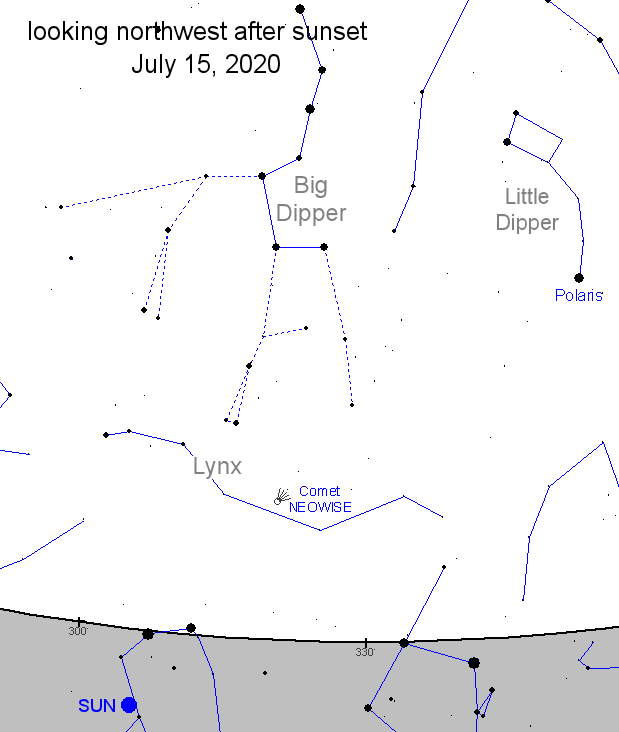
Comet NEOWISE will be closest to Earth on July 23rd. Between now and then, you can find the comet in the sunset sky approaching the Big Dipper from below. It is visible to the naked-eye from dark sky sites and extra-beautiful through binoculars. Sky maps: July 15, 16, 17.


Realtime Comet NEOWISE Photo Gallery
Free: Spaceweather.com Newsletter
NORTHERN LIGHTS PENDANT: Nothing says "I Love You" like a Northern Lights pendant from the Arctic stratosphere. On Jan. 22, 2020, the students of Earth to Sky Calculus traveled to northern Sweden and launched a cosmic ray balloon. This pendant hitched a ride, floating more than 75,000 feet above the frozen terrain of the Arctic Circle:

You can have it for $139.95. The students are selling these pendants to support their cosmic ray ballooning program. Each one comes with a greeting card showing the pendant in flight and telling the story of its journey to the edge of space and back again. They make great birthday and anniversary gifts.
Far Out Gifts: Earth to Sky Store
All sales support hands-on STEM education
Realtime Noctilucent Cloud Photo Gallery
Free: Spaceweather.com Newsletter