DOGS CAN SENSE MAGNETIC FIELDS: Add dogs to the list of lifeforms that can use magnetic fields to navigate. New research summarized in today's issue of Science magazine shows that at least some hunting dogs take shortcuts along N-S magnetic field lines--a strategy that helps them navigate unfamiliar terrain. This means dogs may be sensitive to the disturbing effects of space weather. FULL STORY.
THE SYNCHRONIC BANDS OF COMET NEOWISE: Comet NEOWISE (C/2020 F3) is doing something usually reserved for Great Comets. It has sprouted synchronic bands. Also known as "striae," these bands divide the comet's dust tail into linear regions of greater and lesser density. Chris Cook of Cape Cod, MA, captured the phenomenon on the evening of July 15th:

"Comet NEOWISE is now in its full glory for northern hemisphere observers," says Cook. "This image is a stack of thirty 25s exposures at ISO1600. It clearly shows the formation of synchronic bands within the dust tail."
Synchronic bands have been seen in comet tails for centuries, yet only recently have astronomers begun to understand what they are. The turning point came in 2007 when European and NASA spacecraft observed the formation of striae in Comet McNaught (C/2006 P1). Apparently, the process starts when a chunk of comet detaches itself from the nucleus. Boulder-sized chunks fragment into smaller and smaller pieces, a cascading process shaped into dusty striations by solar radiation pressure.

A few years ago, then-PhD student Ollie Price of University College London’s Mullard Space Science Laboratory was looking at old pictures of McNaught's striae and noticed some "weird goings-on." The bands were occasionally being bent and disrupted by some invisible force. "So I set out to investigate what might have happened to create this weird effect," he recalls.
Price and colleagues ultimately found the answer. The disruptions occured when Comet McNaught crossed the heliospheric current sheet (HCS)--a vast wavy structure in interplanetary space separating regions of opposite magnetic polarity. "It appears the dust may be electrically charged, and gets rearranged as it crosses the HCS boundary," says Karl Battams of the Naval Research Lab, a co-author of their 2018 paper.
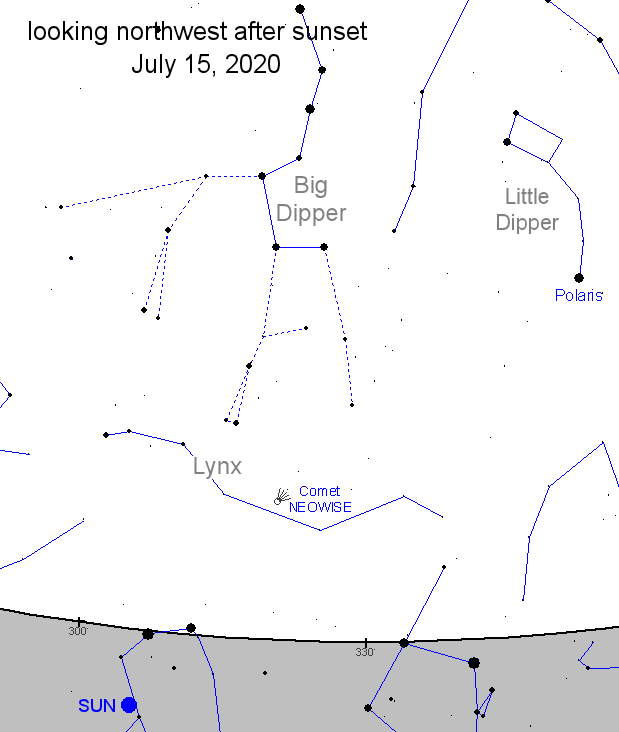
Could the same thing happen to Comet NEOWISE? It's possible. Photographers monitoring NEOWISE are encouraged to keep a sharp eye on the striae. Changes may be in the offing. Sky maps: July 15, 16, 17.


Realtime Comet NEOWISE Photo Gallery
Free: Spaceweather.com Newsletter
A SURPRISE VISIT FROM STEVE: Even STEVE wants to see Comet NEOWISE. On July 14th, the geomagnetic phenomenon appeared over Canada, streaking the sky with mauve ribbons of light. Harlan Thomas of Calgary, Alberta, reports: "I was out shooting the comet when I noticed a mauve-looking cloud. Wow!" I thought. "STEVE has come to visit NEOWISE. How cool is that?"

STEVE is a recent discovery. It looks like an aurora, but it is not. The purple glow is caused by hot (3000°C) ribbons of gas flowing through Earth's magnetosphere at speeds exceeding 6 km/s (13,000 mph). It appears during some geomagnetic storms, often alongside a type of green aurora known as the "picket fence," also shown in Thomas's photo.
Statistics suggest that STEVE appears most often in spring and fall. What summoned STEVE in mid-summer? It may have been a CME that grazed Earth's magnetic field on July 13th. As our planet passed through the CME's magnetized wake on July 14th, hot currents and plasma waves rippled through Earth's magnetosphere. STEVE was the result.
Christy Turner saw it too:

"I was shooting the comet outside Calgary when STEVE started to form," she says. "It was a huge purple pillar--a total delight!"
Many observers across western Canada witnessed the display. During a normal summer, STEVE might have been overlooked, but with Comet NEOWISE drawing photographers outdoors, his visit was well documented. "Summertime STEVE" might be more common than previously thought.
Realtime STEVE Photo Gallery
Free: Spaceweather.com Newsletter
A FAR-OUT GIFT FOR TREKKIES: Mr. Sulu has been to the stratosphere. The helmsman of the starship Enterprise (NCC-1701) hitched a ride onboard an Earth to Sky Calculus cosmic ray balloon on May 21st. Here he is, floating 107,611 feet above the Sierra Nevada mountains of central California:

You can have him for $119.95. The students of Earth to Sky are selling Sulu bobbleheads to support their cosmic ray ballooning program. Each one comes with a greeting card showing Sulu in flight and telling the story of his journey to the edge of space and back again. This makes a great anniversary or birthday gift for fans of Star Trek.
Far Out Gifts: Earth to Sky Store
All sales support hands-on STEM education
Realtime Noctilucent Cloud Photo Gallery
Free: Spaceweather.com Newsletter