SOLAR WIND, INCOMING: A stream of solar wind might hit Earth's magnetic field on July 23-24. The gaseous material is flowing from an equatorial hole in the sun's atmosphere. It's not a major hole, but the emerging gas might be enough to spark high-latitude auroras when it reaches Earth later this week. Aurora alerts: SMS Text.

NOCTILUCENT CLOUDS SWALLOW COMET NEOWISE: There's a comet in this image. Can you find it? "Yesterday we had the brightest display of noctilucent clouds (NLCs) that I have ever witnessed, and fading Comet NEOWISE was hard to find in the bright night sky here up in the north," reports photographer Peter Rosén of Stockholm, Sweden.


"Comet NEOWISE is no longer stealing the show, but the display of NLCs was out of this world!" he says.
NLCs are Earth's highest clouds. Seeded by meteoroids, they float at the edge of space 83 km above the ground. The clouds form during summer when wisps of water vapor rise up to the mesosphere, allowing water to crystallize around specks of meteor smoke.
Often NLCs begin to fade in the second half of July, but this year they are still going strong--likely boosted by record cold temperatures in the mesosphere. High latitude sky watchers should remain alert for electric-blue.
Realtime Noctilucent Cloud Photo Gallery
Free: Spaceweather.com Newsletter
3 1/2 MINUTES WITH COMET NEOWISE: Comet NEOWISE is beginning to dim. Many observers, especially in cities, are having trouble finding the comet in the evening sky. Nevertheless, it is there. Yesterday, James W. Young pointed his camera just below the Big Dipper and let it stare for 3 1/2 minutes. This is what it saw

"A 30 degree ion tail!" he exclaims. "I shot the comet from southeast Washington State near Deep River. This is a 3 1/2 minute exposure (ISO 400) using my Canon 1Dx Mark II camera with a 50 mm lens at f/2.8 on a Losmandy tracker."
Although the comet is fading, it is still a marvelous sight through binoculars and an easy target for high-end digital cameras. People in dark-sky sites can see the tail with the naked eye. It looks like a narrow cloud-like smudge in the evening twilight tipped by a star-like nucleus of 3rd magnitude. Take a look! Sky maps: July 18, 19, 20.


Realtime Comet NEOWISE Photo Gallery
Free: Spaceweather.com Newsletter
ARCTIC WOLF PENDANT: This wolf glows in the dark--and it's been to space. The students of Earth to Sky Calculus launched this special pendant to the stratosphere on April 15, 2020, on board a high-altitude cosmic ray balloon. The payload of radiation sensors (and lupine jewelry) traveled 107,611 feet above Earth's surface:
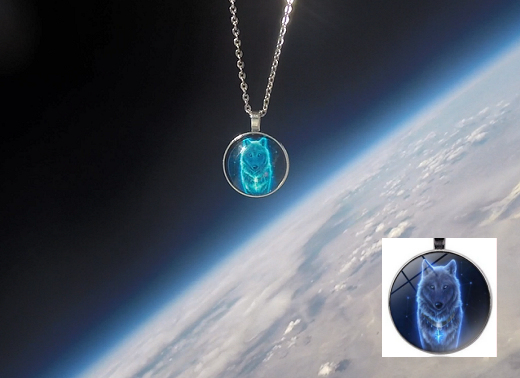
You can have it for $99.95. The students are selling these pendants to support their cosmic ray ballooning program. Each one comes with a greeting card showing the wolf in flight and describing its journey to the stratosphere and back again.
Far Out Gifts: Earth to Sky Store
All sales support hands-on STEM education
Realtime Noctilucent Cloud Photo Gallery
Free: Spaceweather.com Newsletter