A NEW SUNSPOT? A sunspot may be turning to face Earth. Its towering magnetic canopy is rising over the sun's southeastern limb, right here. If it is a sunspot, its high southern latitude suggests it would be a member of new Solar Cycle 25. The active region should reveal inself in the next 24-48 hours. Stay tuned! Aurora alerts: SMS Text.

NOT BAD FOR A 'DIM' COMET: Comet NEOWISE is beginning to dim, with many urban observers reporting trouble when they try to find the comet in the evening sky. On the other hand--"The comet has a long way to dim before it isn't worth photographing," says Mike Hollingshead. Making his point, he took this picture on July 18th from the Badlands of South Dakota:

"This was just 3 frames tracked and stacked at 1600 ISO with 1 minute exposures on a cheap Canon T5 crop body (Sigma 85mm F1.4 Art)," says Hollingshead. "All while the comet was on the horizon with clouds drifting by!"
"I would say the comet's tail is at least as bright as the Milky Way," adds Hollingshead. "From a dark-sky site, that level of brightness is just amazing to look at."
Hollingshead's brief exposure also captured a beautiful display of airglow. Note the red and green bands in the background. They look like auroras, but they are not. Airglow is caused by a complex assortment of chemical reactions in the upper atmosphere. These reactions get started during daylight hours when the atmosphere is bathed in strong UV radiation from the sun. At night we see the afterglow, colored green by oxygen atoms 90-100 km high and red by hydroxyl ions 86-87 km high.
Whether or not you can see Comet NEOWISE with your unaided eye, it is relatively easy to find in the evening sky. The comet is in the constellation Ursa Major, so you can use the stars of the Big Dipper as a guide. Sky maps: July 20, 21, 22.


Realtime Comet NEOWISE Photo Gallery
Free: Spaceweather.com Newsletter
COMET NEOWISE AT 35,000 FEET: Being a pilot has its benefits. On July 8th, Bruce Hildewig looked out the cockpit window of a Boeing 777 flying from Narita, Japan, to Dallas/Ft Worth. "I saw what I first thought was a contrail from another aircraft," he says. "But then I realized it was Comet NEOWISE!" He took this picture from 35,000 feet:

Located over the far-north Pacific Ocean, the plane was in viewing range of noctilucent clouds (NLCs). A bank of the meteoritic clouds floated just below the comet. "I wished I had brought a longer lens to get a closer image of the comet, but I really like how this came out with the NLCs and morning twilight."
How do you take such a picture from a bumpy platform flying 500 mph? "I used an Olympus OMD EM5 MKiii Micro Four Thirds Camera with a Laowa 17mm f1.8 lens. The Olympus Camera has incredible stabilization which has allowed me to be able to take many sharp images from the cockpit over the years," says Hildewig.
Realtime Noctilucent Cloud Photo Gallery
Free: Spaceweather.com Newsletter
ARCTIC WOLF PENDANT: This wolf glows in the dark--and it's been to space. The students of Earth to Sky Calculus launched this special pendant to the stratosphere on April 15, 2020, on board a high-altitude cosmic ray balloon. The payload of radiation sensors (and lupine jewelry) traveled 107,611 feet above Earth's surface:
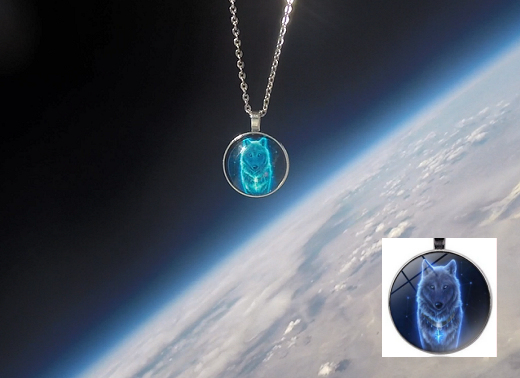
You can have it for $99.95. The students are selling these pendants to support their cosmic ray ballooning program. Each one comes with a greeting card showing the wolf in flight and describing its journey to the stratosphere and back again.
Far Out Gifts: Earth to Sky Store
All sales support hands-on STEM education
Realtime Noctilucent Cloud Photo Gallery
Free: Spaceweather.com Newsletter