CME IMPACT POSSIBLE THIS WEEK: On July 19th, a faint, slow-moving CME left the sun. NOAA analysts believe the plasma cloud could graze Earth's magnetic field on July 24th or 25th. A similar slow-moving CME hit Earth on July 13th, causing high-latitude auroras and a surprise visit from STEVE. Aurora alerts: SMS Text.
A NEW SUNSPOT: A sunspot has appeared and, according to its magnetic polarity, it is a member of new Solar Cycle 25. The sunspot's Earth-sized dark core is inset in this magnetic map from NASA's Solar Dynamics Observatory:

This new spot is another sign of life from strengthening Solar Cycle 25. So far this year there have been 13 sunspots--ten of them (77%) coming from the new solar cycle. This compares to only 17% in 2019 and 0% in 2018. The sun is clearly tipping from one solar cycle to the next.
It is too soon to know if this new sunspot will become a source of solar flares. That depends on its magnetic complexity, which will reveal itself in the days ahead as the sunspot turns toward Earth. Stay tuned!
Realtime Space Weather Photo Gallery
Free: Spaceweather.com Newsletter
COMET NEOWISE ABOVE A FLORIDA THUNDERSTORM: "Comet NEOWISE is still visible to the unaided eye," reports University of Florida astronomy professor emeritus Howard Cohen. He took this photo on July 19th, recording the comet easily despite Gaineville's light pollution, evening twilight, and flashes of lightning:

"This is a 5 second exposure at ISO 400," he says. "I took it about 55 minutes after local sunset. I'd say that the comet's nucleus is about as bright as a star of magnitude +3.6, and at least 5 degrees of tail was visible in my 12x binoculars."
Comet NEOWISE is now in the constellation Ursa Major. To find it, look north-northwest after sunset and let the stars of the Big Dipper be your guide. Sky maps: July 20, 21, 22.


Realtime Comet NEOWISE Photo Gallery
Free: Spaceweather.com Newsletter
ARCTIC WOLF PENDANT: This wolf glows in the dark--and it's been to space. The students of Earth to Sky Calculus launched this special pendant to the stratosphere on April 15, 2020, on board a high-altitude cosmic ray balloon. The payload of radiation sensors (and lupine jewelry) traveled 107,611 feet above Earth's surface:
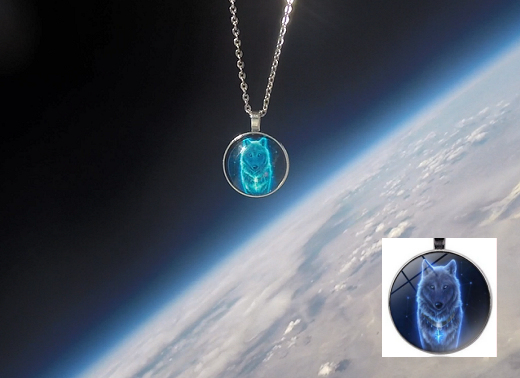
You can have it for $99.95. The students are selling these pendants to support their cosmic ray ballooning program. Each one comes with a greeting card showing the wolf in flight and describing its journey to the stratosphere and back again.
Far Out Gifts: Earth to Sky Store
All sales support hands-on STEM education
Realtime Noctilucent Cloud Photo Gallery
Free: Spaceweather.com Newsletter