STEALTHY CME IMPACT: A slow-moving CME that left the sun on July 19th hit Earth yesterday, July 24th. It arrived embedded in a solar wind stream, and made itself known by its magnetic field, which was stronger than that of normal solar wind plasma. Subscribers to our space weather alert service (Pro Plan) received a series of text messages about magnetic disturbances as the CME passed by.
In Ely, Minnesota, photographer Greg Ash caught the afterglow of the CME:

"I went out to shoot the sunset," says Ash. "After the sun went down I could immediately see a green arch. It continued to build until this 'pillar peak' (a vertical fan of colored rays) appeared at 11:15 thru 11:30. I've noticed that the pillar peak ALWAYS coincides with loons screaming on the lake. How fun is that!"
Earth is now passing through the turbulent wake of the CME. High-latitude sky watchers should remain alert tonight for faint auroras--and maybe even STEVE. Aurora alerts: SMS Text.
Realtime Space Weather Photo Gallery
Free: Spaceweather.com Newsletter
THE COLORS OF COMET NEOWISE: On July 23rd, Comet NEOWISE (C/2020 F3) made its closest approach to Earth for the next 6,800 years. Michael Jaeger of Martinsberg, Austria, took advantage of the comet's proximity for a close-up photo, and he found some marvelous colors:

Now we can take a color-coded tour of Comet NEOWISE:
The comet's head is green. This is a sign of diatomic carbon, C2, a gas which emits a verdant glow in the near-vacuum of interplanetary space.
The comet's ion tail is blue. Once again, carbon is involved. One of the most abundant gases in comets is carbon monoxide (CO). When CO flows away from a comet's nucleus, it is ionized by solar UV radiation. Carbon monoxide ions (CO+) glow blue when they recapture electrons from the solar wind.
The comet's dust tail is wan yellow. It is, simply, the color of sunlight reflected from comet dust.
The two tails are nicely separated, revealing their individual colors, because they are guided by different forces. The gaseous ion tail is shoved directly away from the sun by solar wind; it acts as a kind of interplanetary windsock. The heavier dust trail, however, isn't so easily pushed around. Specks of dust are like bread crumbs dropped on the comet's orbit; they curve away from the ion tail, tracing the comet's "footsteps" instead of the local breeze.
Realtime Comet NEOWISE Photo Gallery
Free: Spaceweather.com Newsletter
THE INFINITY BLACK PEARL: It came from Tahiti--and now it's been to the edge of space. On April 15, 2020, this genuine Black Tahitian South Sea Cultured Pearl flew to the stratosphere onboard an Earth to Sky Calculus cosmic ray balloon, soaring 107,611 feet above the Sierra Nevada mountains of central California:
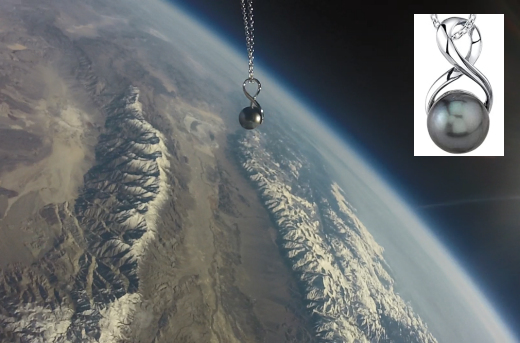
You can have it for $249.95. The students of Earth to Sky Calculus are selling these exotic space pearls to fund their cosmic ray monitoring program.
Measuring 9 mm in diameter, the pearl is mounted on a 925 sterling silver infinity twist and suspended on a matching 17 inch long sterling silver chain. Each pearl comes with a greeting card showing the pendant in flight and telling the story of its journey to the edge of space.
Far Out Gifts: Earth to Sky Store
All sales support hands-on STEM education
Realtime Noctilucent Cloud Photo Gallery
Free: Spaceweather.com Newsletter