SOUTHERN DELTA AQUARIID METEOR SHOWER: Earth has entered a stream of debris from Comet 96P/Machholz, probable source of the annual Southern Delta Aquariid (SDA) meteor shower. So far this weekend, NASA's network of all-sky meteor cameras has detected 8 SDA fireballs over the USA. If forecasters are correct, this minor shower will peak on the nights of July 28th and 29th with 10 to 20 meteors per hour. FULL STORY.
A SUNSPOT IN THE OFFING: Today there is one sunspot facing Earth. Soon there could be two. A new sunspot is about to rotate over the sun's northeastern limb, right here:

The sunspot's approach is heralded by its towering magnetic canopy. NASA's SDO photographed the plasma-filled structure on July 26th. Look for a dark core to emerge sometime in the next 24 to 48 hours, doubling the number of Solar Cycle 25 active regions on the solar disk. Sunspot alerts: SMS Text.
Realtime Space Weather Photo Gallery
Free: Spaceweather.com Newsletter
COMET NEOWISE AND THE AURORA BOREALIS: A slow-moving CME grazed Earth's magnetic field on July 24th. The storm cloud's weak impact did not spark a full-fledged geomagnetic storm, but it did make a nice backdrop for this parting shot of Comet NEOWISE:

"The Kp index was only 4, not quite a geomagnetic storm," says photographer Beth Colyear. "We were lucky that clouds had not moved in, so we were able to get the comet and the aurora in that brief moment it was active at our location outside Duluth, Minnesota."
Comet NEOWISE has faded dramatically since its close approach to Earth on July 23rd. Now it is nearly impossible to see with the unaided eye. Relatively short exposures with nighttime digital cameras, however, are still able to record the comet's tail near the Big Dipper after sunset. Browse the gallery for more examples.
Realtime Comet NEOWISE Photo Gallery
Free: Spaceweather.com Newsletter
THE INFINITY BLACK PEARL: It came from Tahiti--and now it's been to the edge of space. On April 15, 2020, this genuine Black Tahitian South Sea Cultured Pearl flew to the stratosphere onboard an Earth to Sky Calculus cosmic ray balloon, soaring 107,611 feet above the Sierra Nevada mountains of central California:
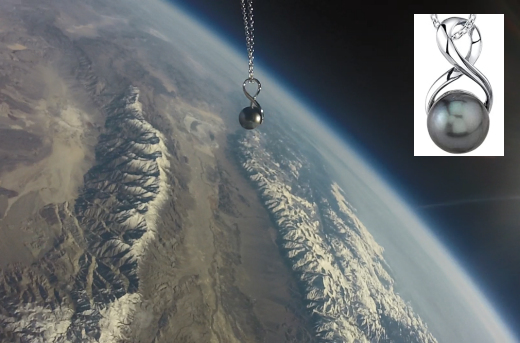
You can have it for $249.95. The students of Earth to Sky Calculus are selling these exotic space pearls to fund their cosmic ray monitoring program.
Measuring 9 mm in diameter, the pearl is mounted on a 925 sterling silver infinity twist and suspended on a matching 17 inch long sterling silver chain. Each pearl comes with a greeting card showing the pendant in flight and telling the story of its journey to the edge of space.
Far Out Gifts: Earth to Sky Store
All sales support hands-on STEM education
Realtime Noctilucent Cloud Photo Gallery
Free: Spaceweather.com Newsletter