A DOUBLE MINOR METEOR SHOWER: Tonight, July 28-29, Earth is passing through streams of debris from two comets: 96P/Machholz and 169P/NEAT. Naturally, this is causing two meteor showers: the Southern Delta Aquarids and the alpha Capricornids. Added together, they produce 10 to 20 meteors per hour--a relatively minor display. The best time to look is during the dark hours between midnight and sunrise. Browse: Meteor Photo Gallery.
RARE RED NOCTILUCENT CLOUDS: Noctilucent clouds (NLCs) are supposed to be electric blue. This past weekend in Sweden, photographer P-M Hedén saw a different color: Dark Red. "My 17 year-old son was out with friends and he texted me the message 'Noctilucent!' I looked out and didn't really understand what I saw. The tops of the clouds were red."
Above: Red NLCs over Vallentuna, Sweden. July 25, 2020. Credit: P-M Hedén
Hedén hopped in his car and drove to a clear site for a better look. The movie he made, above, shows the dynamics of the clouds and the development of their amber crown. "This all happened around local midnight," he says.
NLCs are Earth’s highest clouds. Seeded by meteoroids, they float at the edge of space 83 km above the ground. Hedén's video shows ordinary clouds scudding dark and low across the Swedish landscape. NLCs float high overhead, catching the rays of the sun, which is still "up" at their extremely high altitude.
This isn't the first time people have seen red noctilucent clouds. There was a significant outbreak of red NLCs over Europe on June 21, 2019. However, they are rare and not fully understood.

Above: Red NLCs over Piwnice, Poland. June 21, 2019. Credit: Piotr Majewski
To understand what makes NLCs red, first we have to ask What makes them blue? The answer is ozone. Research in the 1970s revealed that much of the sunlight hitting noctilucent clouds first passes through Earth's ozone layer. Ozone absorbs red light, while allowing blue to pass. This filtered light gives NLCs an azure hue.
The origin of red is less certain. One idea, probably the best, comes from a 1988 paper in the Journal of Atmospheric and Terrestrial Physics entitled "The coloured edge of noctilucent clouds." The authors note that "Noctilucent clouds are illuminated by sunlight which passes obliquely through the atmosphere. The lowest rays may pass only a few kilometres above sea level." These low rays are strongly reddened (like sunsets) and bent by refraction; some of them may be redirected to the tops of NLCs.
Is that right? Even many specialists in NLC research aren't sure, which means every sighting is a bit of a mystery. Northern sky watchers, if you're seeing red, submit your photos here.
Realtime Noctilucent Cloud Photo Gallery
Free: Spaceweather.com Newsletter
THE INFINITY BLACK PEARL: It came from Tahiti--and now it's been to the edge of space. On April 15, 2020, this genuine Black Tahitian South Sea Cultured Pearl flew to the stratosphere onboard an Earth to Sky Calculus cosmic ray balloon, soaring 107,611 feet above the Sierra Nevada mountains of central California:
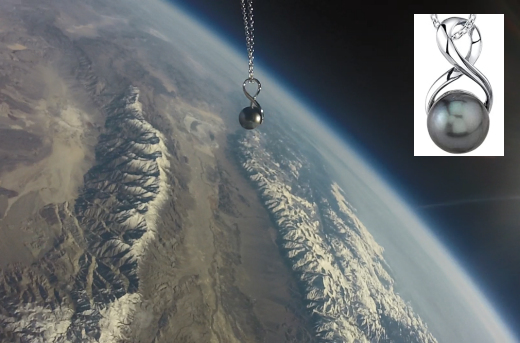
You can have it for $249.95. The students of Earth to Sky Calculus are selling these exotic space pearls to fund their cosmic ray monitoring program.
Measuring 9 mm in diameter, the pearl is mounted on a 925 sterling silver infinity twist and suspended on a matching 17 inch long sterling silver chain. Each pearl comes with a greeting card showing the pendant in flight and telling the story of its journey to the edge of space.
Far Out Gifts: Earth to Sky Store
All sales support hands-on STEM education
Realtime Space Weather Photo Gallery
Free: Spaceweather.com Newsletter
Realtime Comet NEOWISE Photo Gallery
Free: Spaceweather.com Newsletter