NEW-CYCLE SUNSPOT ACTIVITY: Solar Cycle 25 is gaining strength. Today there are two new-cycle sunspots on the solar disk: AR2767 and AR2768. Both have magnetic polarities that identify them as members of Solar Cycle 25. Neither appears to pose a threat for strong solar flares, though, so the quiet of Solar Minimum continues. Aurora alerts: SMS Text.
FAREWELL, COMET NEOWISE: Comet NEOWISE has faded dramatically since its close approach to Earth on July 23rd, dimming more than 10-fold. It's no longer visible to the naked eye and won't swing around the sun again for another 6,800 years. To say "farewell," Dennis Mammana of Borrego Springs, California, created this montage of the comet gliding across the evening sky:

"I hope everyone got to see Comet NEOWISE during its recent visit," says Mammana. "It became bright enough to see easily with the unaided eye from dark rural locations but now, unfortunately, has faded into the realm of large binoculars and telescopes. I photographed it each night from July 18th to 27th. In this sequence you can see the comet changing its size and brightness as it first approaches Earth and then recedes back into the depths of our solar system, not to return to our neighborhood for nearly 68 centuries."
Despite its fade, NEOWISE remains a good target for photographers with telescopes and/or sensitive digital cameras. Here's an example of what can still be seen. For more parting shots, many of them wonderful, browse the NEOWISE photo gallery:
Realtime Comet NEOWISE Photo Gallery
Free: Spaceweather.com Newsletter
NOCTILUCENT CLOUDS, GOING STRONG: In a typical year, noctilucent clouds begin to fade in late July. But 2020 is not typical. "The season is still going strong," reports Robbin Gälliner, who sends this picture from Frösön, Sweden:

"Last night (July 28th) we had a great display," says Gälliner. "I could even see the clouds reflecting in the shallow water."
"My camera also picked up some faint greens and red in the northern twilight--maybe a faint aurora or just airglow," adds Gälliner. "I'm looking forward to the skies finally getting darker so aurora season can begin as well."
If 2020 continues apace, Arctic sky watchers will soon be seeing auroras and NLCs side by side. Stay tuned for green mixed with electric blue--and maybe a dash of red!
Realtime Noctilucent Cloud Photo Gallery
Free: Spaceweather.com Newsletter
THE INFINITY BLACK PEARL: It came from Tahiti--and now it's been to the edge of space. On April 15, 2020, this genuine Black Tahitian South Sea Cultured Pearl flew to the stratosphere onboard an Earth to Sky Calculus cosmic ray balloon, soaring 107,611 feet above the Sierra Nevada mountains of central California:
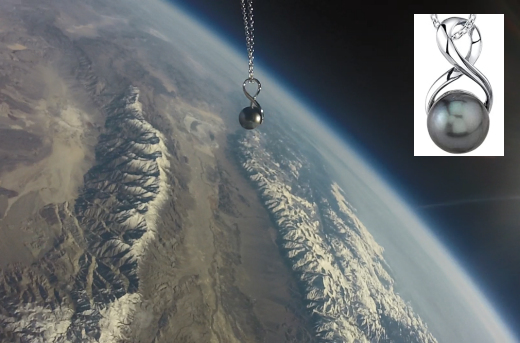
You can have it for $249.95. The students of Earth to Sky Calculus are selling these exotic space pearls to fund their cosmic ray monitoring program.
Measuring 9 mm in diameter, the pearl is mounted on a 925 sterling silver infinity twist and suspended on a matching 17 inch long sterling silver chain. Each pearl comes with a greeting card showing the pendant in flight and telling the story of its journey to the edge of space.
Far Out Gifts: Earth to Sky Store
All sales support hands-on STEM education
Realtime Space Weather Photo Gallery
Free: Spaceweather.com Newsletter