NEW-CYCLE SUNSPOT FACES EARTH: Solar Cycle 25 sunspot AR2770 is facing Earth. If it flares, the explosion will almost certainly be geoeffective. But will it flare? AR2770 has a relatively simple magnetic field that poses little threat for strong explosions. A solar minimum superstorm seems unlikely at this time. Solar flare alerts: SMS Text.
THE 2020 PERSEID METEOR SHOWER: Earth is entering a stream of debris from giant comet 109P/Swift-Tuttle, source of the annual Perseid meteor shower. If forecasters are correct, the display will peak on the nights of Aug. 11th through Aug. 13th with dozens of meteors per hour.
Ian Webster created this interactive visualization of Swift-Tuttle's debris stream cutting across Earth's orbit.
Activity is already picking up; last night NASA's network of all-sky meteor cameras recorded 16 Perseid fireballs over the USA. A fireball is a very bright meteor, at least as bright as the planets Jupiter or Venus.
No other comet produces fireballs like 109P/Swift-Tuttle--probably a result of its oversized nucleus. The comet's core is 26 km in diameter, and naturally crumbles into fireball-sized chunks. Since 2008, NASA has counted more fireballs from the Perseids than any other shower:
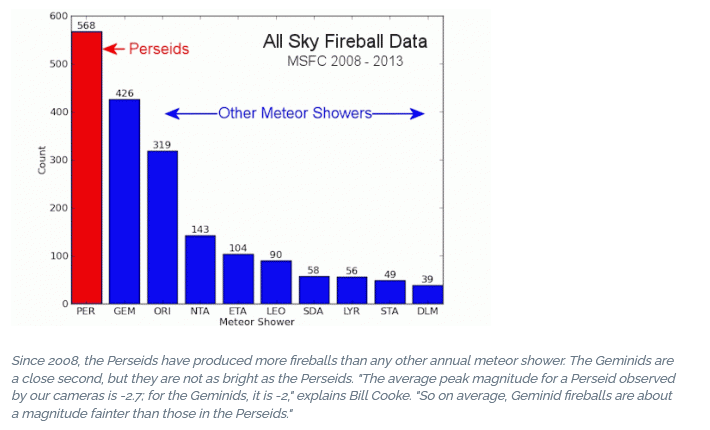
When should you look? Perseids may be seen at any time after ~10 pm. However, the best time is during the hours just before sunrise when the constellation Perseus is high in the sky. For best results, lie down in a dark place with a wide view of the heavens. Venus, Mars, and the Moon will be there, too. Enjoy the show! Sky maps: Aug. 11, 12, 13.


Realtime Perseid Photo Gallery
Free: Spaceweather.com Newsletter
NOCTILUCENT CLOUDS ARE IN RETREAT: The northern season for noctilucent clouds (NLCs) is coming to an end. New data from NASA's AIM spacecraft show the electric-blue ring around the Arctic Circle in sharp retreat. The bulk of the clouds are now contained inside 70 degrees N latitude:
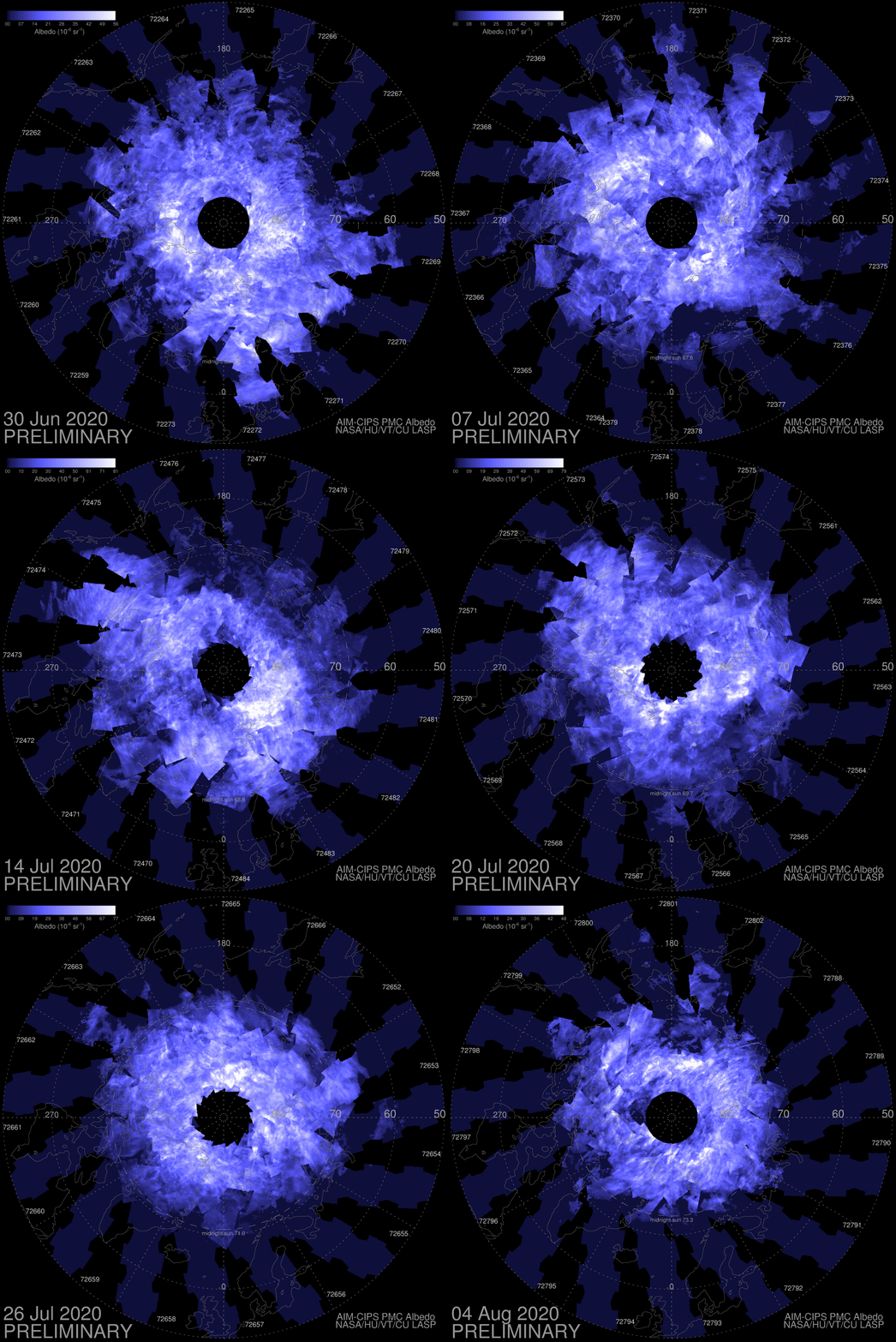
Above: This 5 week animation from AIM's CIPS instrument shows NLCs retreating north.
This is normal. NLCs form every year when summertime wisps of water vapor rise to the edge of space, crystallizing around specks of meteor smoke. The clouds are always strongest in June and July, then naturally begin to fade in August. Late-season sightings are still possible from, e.g., Scandinavia, northern Canada and Siberia. But the days of NLCs in California are done ... for this summer at least.
Realtime Noctilucent Cloud Photo Gallery
Free: Spaceweather.com Newsletter
A KILLER GIFT FROM THE EDGE OF SPACE: It's the ultimate gift for a Star Wars fan--a Killer Droid from the edge of space. On July 23rd, this bounty-hunting bobblehead namd "IG-11" hitched a ride to the stratosphere onboard an Earth to Sky Calculus cosmic ray balloon. Here he is floating 117,454 feet above the Sierra Nevada mountains of California:

You can have him for $111.11. The students of Earth to Sky are selling IG-11 to support their cosmic ray ballooning program. Each bobblehead comes with a card showing it floating through the stratosphere, and telling the story of its journey to the edge of space and back again.
Far Out Gifts: Earth to Sky Store
All sales support hands-on STEM education
Realtime Space Weather Photo Gallery
Free: Spaceweather.com Newsletter
Realtime Noctilucent Cloud Photo Gallery
Free: Spaceweather.com Newsletter