THE PERSEID METEOR SHOWER IS INTENSIFYING: Last night, NASA all-sky cameras recorded 30 Perseid fireballs over the USA. This is a sign that Earth is moving deeper into the debris stream of comet 109P/Swift-Tuttle. The meteor shower is expected to peak during the next 3 days, Aug. 11th - 13th, with rates several times higher than last night's. The best time to look is during the hours before local sunrise when the constellation Perseus is high in the sky. Sky maps: Aug. 11, 12, 13. Browse: Perseid Photo Gallery.


SEETHING SUNSPOT: Solar Cycle 25 is coming to life. If you don't believe it, just look at this picture. It shows new-cycle sunspot AR2770 seething with magnetic activity:

Christian Viladrich took the picture just a few days ago using a 12-inch telescope in St Véran, France. Clearly, "the 'quiet sun' is turning active!" he says.
Viladrich photographed the sunspot through a 'Calcium K' (CaK) filter, which passes violet-colored light from singly-ionized calcium atoms in the sun's atmosphere. CaK filters are excellent detectors of magnetic froth--the bubbly, turbulent sea of magnetism that surrounds many active sunspot groups. AR2770 is very frothy indeed.
Shortly after his photo, AR2770 produced a C1.5-class solar flare, followed by a minor wave of ionization in Earth's upper atmosphere. C-flares are not considered to be major events; in the context of the sun's recent deep quiet, however, the eruption was noteworthy. AR2770 is now in decay, but more sunspots are in the offing, so stay tuned. Solar flare alerts: SMS Text.


Realtime Space Weather Photo Gallery
Free: Spaceweather.com Newsletter
A BLACK PEARL IN THE STRATOSPHERE: It came from Tahiti--and now it's been to the edge of space. On Feb. 27, 2020, this genuine Black Tahitian South Sea Cultured Pearl flew to the stratosphere onboard an Earth to Sky Calculus cosmic ray balloon, soaring more than 100,000 feet above the Sierra Nevada mountains of central California:
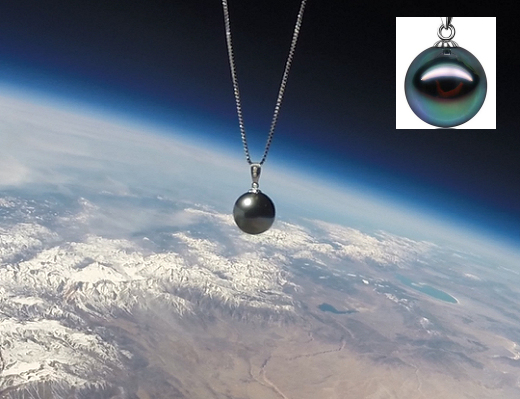
You can have it for $199.95. The students are selling these exotic space pearls to fund their cosmic ray monitoring program. Measuring 10 mm in diameter, the pearl has an 18K white gold clasp and is suspended from a matching 925 Sterling Silver chain. Each pearl comes with a greeting card showing the pendant in flight and telling the story of its journey to the edge of space.
Far Out Gifts: Earth to Sky Store
All sales support hands-on STEM education
Realtime Space Weather Photo Gallery
Free: Spaceweather.com Newsletter
Realtime Noctilucent Cloud Photo Gallery
Free: Spaceweather.com Newsletter