PERSEID METEOR SHOWER: The Perseid meteor shower is peaking now. Worldwide observers are counting as many as 50 per hour, with even more possible tonight. Perseid meteors can appear at any local time after about 10 pm, but the best time to look is during the hours before sunrise when the constellation Perseus is high in the sky. Sky maps: Aug. 11, 12, 13. Browse: Perseid Photo Gallery.


SOLAR CYCLE 25 ACTIVE REGIONS: The sun's southern hemisphere is undergoing an outbreak of Solar Cycle 25 active regions. Take a look at this Aug. 12th magnetic map of the sun from NASA's Solar Dynamics Observatory:

Each patch of yellow and green is a place where magnetic fields are intensifying, creating islands of magnetism on the sun’s surface. In one case (AR2771), the fields have intensified enough to form a cluster of dark sunspots. The other two are still weakly-organized regions of magnetic froth. They might turn into sunspots, but haven't yet.
We know that all of these regions belong to Solar Cycle 25 because of their +/- polarity. See Hale's Law for details. Their emergence is yet another sign that Solar Cycle 25 is coming to life. Solar flare alerts: SMS Text.
Realtime Space Weather Photo Gallery
Free: Spaceweather.com Newsletter
SDO ECLIPSE SEASON IS UNDERWAY: Yesterday, Aug. 11th, just before 0700 UT, half of the the sun vanished. NASA's Solar Dynamics Observatory (SDO) recorded the event from geosynchronous orbit 22,000 miles above Earth:

This strange image means SDO eclipse season is underway. Every year around this time, the body of the Earth can pass directly between SDO and the sun, producing eclipses of unusual beauty. The alignment happens every day around 0700 UT and can last for up to 72 minutes.
The ongoing eclipse season will end in approximately 10 days. Between now and then, stay tuned for some rare blackouts.
Realtime Space Weather Photo Gallery
Free: Spaceweather.com Newsletter
A BLACK PEARL IN THE STRATOSPHERE: It came from Tahiti--and now it's been to the edge of space. On Feb. 27, 2020, this genuine Black Tahitian South Sea Cultured Pearl flew to the stratosphere onboard an Earth to Sky Calculus cosmic ray balloon, soaring more than 100,000 feet above the Sierra Nevada mountains of central California:
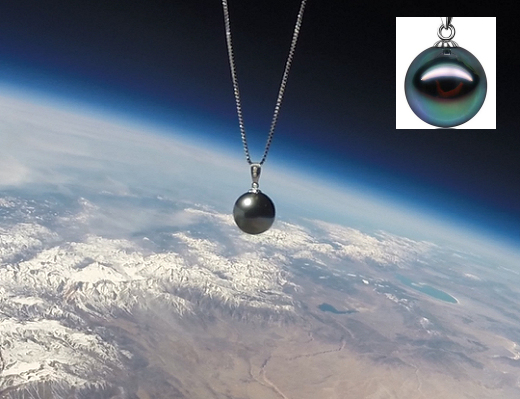
You can have it for $199.95. The students are selling these exotic space pearls to fund their cosmic ray monitoring program. Measuring 10 mm in diameter, the pearl has an 18K white gold clasp and is suspended from a matching 925 Sterling Silver chain. Each pearl comes with a greeting card showing the pendant in flight and telling the story of its journey to the edge of space.
Far Out Gifts: Earth to Sky Store
All sales support hands-on STEM education
Realtime Space Weather Photo Gallery
Free: Spaceweather.com Newsletter
Realtime Noctilucent Cloud Photo Gallery
Free: Spaceweather.com Newsletter