PERSEID METEOR SHOWER--UPDATE: Preliminary counts by members of the International Meteor Organization suggest that the Perseid meteor shower peaked on August 12th with ~100 meteors per hour. Now, activity is decreasing as Earth exits the debris stream of comet 109P/Swift-Tuttle. The shower will continue at reduced rates for several nights, finally stopping sometime early next week. Browse: Perseid Photo Gallery.
SOMETHING UNUSUAL JUST FLEW PAST THE SUN: On August 7th, an unusual object flew past the sun. (Spoiler Alert: It's not an alien armada.) "It was a triple comet," says Karl Battams of the Naval Research Lab in Washington DC, who made this animation using coronagraph images from the Solar and Heliospheric Observatory (SOHO):

"The two main components are easy to spot, with the third, a very faint, diffuse fragment following alongside the leading piece," he says.
SOHO finds comets all the time. Most are Kreutz sungrazers, fragments of a giant comet that broke up more than 1000 years ago. Since the observatory was launched in 1995, SOHO has discovered more than 3000 members of the Kreutz family dive-bombing the sun.
And that's what makes this comet unusual. "It is not a member of the Kreutz family," says Battams. "Its orbit doesn't match. We're not yet sure where it came from."

Shortly after the comet cluster showed up in SOHO images, a rumor began to spread on social media: Spaceships are sling-shotting around the sun. "No," says Battams. "It's a comet. If it waddles like a duck, and quacks like a duck... chances are it's a duck! This object shows all the classic signs of being a comet: diffuse, elongated, has a tail, and follows a path that is clearly dominated by the sun's gravity."
The triple comet is now receding from the sun, fading rapidly from view. There's a slim chance that large ground-based telescopes might be able to track it. If so, they could find clues to its make-up and origin.
"Unfortunately, the prognosis for small fragmenting comets like this is not good," says Battams. "This was probably this comet's first and last pass by the sun, as it has likely now crumbled away entirely. But SOHO will continue to keep watching the sun, and waiting for our next special cometary offering to come along." Stay tuned!
Realtime Comet Photo Gallery
Free: Spaceweather.com Newsletter
SOLAR CYCLE 25 ACTIVE REGIONS: The sun's southern hemisphere is undergoing an outbreak of Solar Cycle 25 active regions. Take a look at this Aug. 12th magnetic map of the sun from NASA's Solar Dynamics Observatory:

Each patch of yellow and green is a place where magnetic fields are intensifying, creating islands of magnetism on the sun’s surface. In one case (AR2771), the fields have intensified enough to form a cluster of dark sunspots. The other two are still weakly-organized regions of magnetic froth. They might turn into sunspots, but haven't yet.
We know that all of these regions belong to Solar Cycle 25 because of their +/- polarity. See Hale's Law for details. Their emergence is yet another sign that Solar Cycle 25 is coming to life. Solar flare alerts: SMS Text.
Realtime Space Weather Photo Gallery
Free: Spaceweather.com Newsletter
A BLACK PEARL IN THE STRATOSPHERE: It came from Tahiti--and now it's been to the edge of space. On Feb. 27, 2020, this genuine Black Tahitian South Sea Cultured Pearl flew to the stratosphere onboard an Earth to Sky Calculus cosmic ray balloon, soaring more than 100,000 feet above the Sierra Nevada mountains of central California:
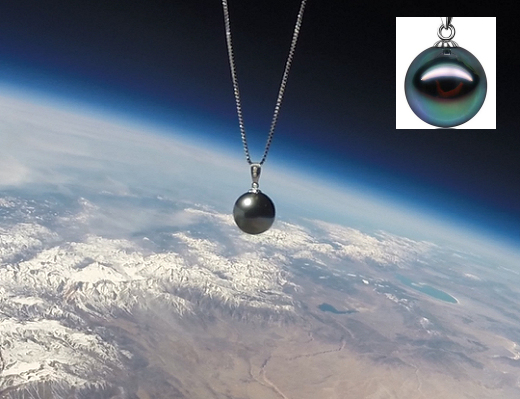
You can have it for $199.95. The students are selling these exotic space pearls to fund their cosmic ray monitoring program. Measuring 10 mm in diameter, the pearl has an 18K white gold clasp and is suspended from a matching 925 Sterling Silver chain. Each pearl comes with a greeting card showing the pendant in flight and telling the story of its journey to the edge of space.
Far Out Gifts: Earth to Sky Store
All sales support hands-on STEM education
Realtime Space Weather Photo Gallery
Free: Spaceweather.com Newsletter
Realtime Noctilucent Cloud Photo Gallery
Free: Spaceweather.com Newsletter