LONG-DURATION SOLAR FLARE: A very interesting solar flare is underway now. It's a B1-class flare from a spotless region in the sun's southern hemisphere. Although the amplitude of the flare is relatively low, it has been going on for a long time--more than 90 minutes. The slowly-unfolding explosion has sent a blast wave through the sun's atmosphere and will probably produce a CME. Stay tuned for updates. Aurora alerts: SMS Text.

ACTIVE STARSCAPE: "The sun is giving us 'astronuts' a good reason to get up, get outside and look up...," reports amateur astronomer Alan Friedman, who sends this portrait of an active starscape photographed from his backyard in Buffalo, New York:

"A lovely large group of prominences is calling attention to the solar limb as a Solar Cycle 25 active region rotates on the face of the sun nearby," he says. "Beautiful and compelling stuff!"
That Solar Cycle 25 active region is AR2770, the corpse of a recently decayed sunspot. Proving that even sunspot corpses have vitality, yesterday AR2770 produced a C2-class solar flare and a shortwave radio brownout over Asia.
Realtime Space Weather Photo Gallery
Free: Spaceweather.com Newsletter
LIGHTNING DANCES ON THE EIFFEL TOWER: Lightning appears and vanishes again in mere milliseconds, which poses a thorny question for photographers: How do you catch the elusive bolts? Last week in Paris, photographer Bertrand Kulik managed it more than once:

"During a storm on Aug. 11th, I saw lightning strike the Eiffel tower once, twice, three times," says Kulik. "A rare moment, it was absolutely fantastic!"
"For catching these bolts I used my Canon EOS 5DMIII digita camera," he continues. "A lightning sensor made by Walt Laroche was in control of the shutter." The device uses an optical sensor to look for surges within a storm cloud. When the brightness starts to increase, heralding a lightning strike, the sensor triggers the camera. With a lag of only 1.6 microseconds, it freezes lightning in its tracks, making exposures relatively easy for photographers.
Even so, three bolts in one session is a lot. Says Kulik, "Soon, I hope to catch even more."
Realtime Lightning Photo Gallery
Free: Spaceweather.com Newsletter
ARCTIC WOLF PENDANT: This wolf glows in the dark--and it's been to space. The students of Earth to Sky Calculus launched this special pendant to the stratosphere on April 15, 2020, on board a high-altitude cosmic ray balloon. The payload of radiation sensors (and lupine jewelry) traveled 107,611 feet above Earth's surface:
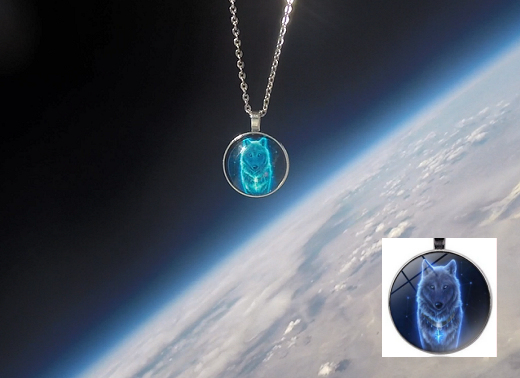
You can have it for $99.95. The students are selling these pendants to support their cosmic ray ballooning program. Each one comes with a greeting card showing the wolf in flight and describing its journey to the stratosphere and back again.
Far Out Gifts: Earth to Sky Store
All sales support hands-on STEM education
Realtime Space Weather Photo Gallery
Free: Spaceweather.com Newsletter
Realtime Noctilucent Cloud Photo Gallery
Free: Spaceweather.com Newsletter