A CME IS COMING: High-latitude sky watchers should be alert for auroras on Aug. 20th when a CME (coronal mass ejection) is expected to graze Earth's magnetic field. Launched into space on Aug. 16th by a slow-motion solar flare, the CME is not heading directly for Earth. Nevertheless, NOAA models of the CME suggest that a glancing blow is likely. Storm levels could reach category G1. Aurora alerts: SMS Text


A NEW SUNSPOT: A new sunspot is growing in the sun's northern hemisphere. Provisionally numbered AR2772, it is inset in this magnetic map of the sun's surface from NASA's Solar Dynamics Observatory:

Like every other recent sunspot, AR2772 is a member of new Solar Cycle 25. We know this because of its magnetic polarity: -/+. (See Hale's Law for details.) The sunspot's 4 rapidly-developing dark cores are each about the size of the Moon, making the entire group an easy target for amateur astronomers with solar telescopes. Monitoring is encouraged.
Realtime Space Weather Photo Gallery
Free: Spaceweather.com Newsletter
AN EXPLOSION OVER CHINA: Every night, the Chinese Meteor Monitoring Organization (CMMO) runs an automated camera in Shandong Province, monitoring meteor activity above the coast of the Yellow Sea. On Aug. 16th, it caught the brightest fireball in years. A space rock exploded in the atmosphere over the city of Linyi, turning the midnight sky blue:

"The meteor illuminated the whole earth and shook the landscape with a loud sound," reports CMMO staff member Zhou Kun. "The flash of light, which peaked at 22:59 pm local time, was widely observed across the Shandong and Jiangsu provinces of China."
Kun estimates the astronomical magnitude of the flash to be -20, more than 900 times brighter than a full Moon (albeit not as bright as the sun). If so, that would make it a rare fireball indeed. According to a NASA computer model of Earth's meteoroid environment, a fireball of that magnitude could be a decade class event.
More information about this event (including a possible meteorite debris zone) may become available as the CMMO team analyzes "a large number of eye-witness reports," says Kun. Stay tuned.
Realtime Space Weather Photo Gallery
Free: Spaceweather.com Newsletter
THE NORTHERN LIGHTS PENDANT: On Dec. 6, 2019, the students of Earth to Sky Calculus launched a cosmic ray balloon to the stratosphere. This Northern Lights pendant went along for the ride, flying more than 107,612 feet above the rugged Sierra Nevada mountains of central California:
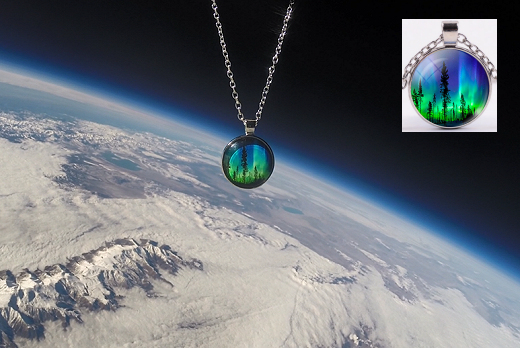
You can have it for $119.95. The students are selling these pendants to support their cosmic ray ballooning program. Each one comes with a greeting card showing the pendant in flight and telling the story of its journey to the edge of space. It makes an out-of-this-world birthday, anniversary, or Christmas gift!
Far Out Gifts: Earth to Sky Store
All sales support hands-on STEM education
Realtime Space Weather Photo Gallery
Free: Spaceweather.com Newsletter
Realtime Noctilucent Cloud Photo Gallery
Free: Spaceweather.com Newsletter