A CME IS COMING: High-latitude sky watchers should be alert for auroras on Aug. 20th when a CME (coronal mass ejection) is expected to graze Earth's magnetic field. Launched into space on Aug. 16th by a slow-motion solar flare, the CME is not heading directly for Earth. Nevertheless, NOAA models of the CME suggest that a glancing blow is likely. Storm levels could reach category G1. Aurora alerts: SMS Text


AURORA SEASON BEGINS: Around the Arctic Circle, sky watchers have been waiting months for the midnight sun to fade away--just enough to see auroras again. Last night it happened. "She's back! The first auroras of the season have appeared here in Oulu, Finland," reports Thomas Kast, who took this picture of the display:

"Every year I long for this moment after the bright summer and it is always so special," he says.
The display was caused by a minor stream of solar wind flowing from a southern hole in the sun's atmosphere. It brushed Earth's magnetic field during the late hours of Aug. 18th, sparking auroras at several locations around Finland. An incoming CME due on August 20th could spark the second auroras of the new season. Stay tuned. Aurora alerts: SMS Text
Realtime Aurora Photo Gallery
Free: Spaceweather.com Newsletter
RESEARCHERS PREDICT A SURGE OF COSMIC RAYS: Cosmic rays are bad--and they're about to get worse. That's the conclusion of a new study just published in the research journal Space Weather.
"During the next solar cycle, we could see cosmic rays increase by as much as 75%," says lead author Fatemeh Rahmanifard of the University of New Hampshire's Space Science Center. "This will limit the amount of time astronauts can work safely in interplanetary space."

Cosmic rays are the bane of astronauts. They come from deep space, energetic particles hurled in all directions by supernova explosions and other violent events. No amount of spacecraft shielding can stop the most energetic cosmic rays, leaving astronauts exposed whenever they leave the Earth-Moon system.
Back in the 1990s, astronauts could travel through space for as much as 1000 days before they hit NASA radiation safety limits. Not anymore. According to the new research, cosmic rays could limit trips to as little as 290 days for 45-year old male astronauts, and 204 days for females. (Men and women have different limits because of unequal dangers to reproductive organs.)
Why are cosmic rays growing stronger? Blame the sun. The sun's magnetic field wraps the entire solar system in a protective bubble, normally shielding us from cosmic rays. In recent decades, however, that shield has weakened--a result of the sputtering solar cycle.

Above: The sunspot cycle has been trending weaker since the 1950s. [More]
Solar activity isn't what it used to be. In the 1950s through 1990s, the sun routinely produced intense Solar Maxima with lots of sunspots and strong solar magnetic fields. Now look at the plot, above. Since the heyday of the late 20th century, the 11-year solar cycle has weakened, and the sun's magnetic field has weakened with it.
Rahmanifard and colleagues believe we could be entering a Grand Minimum--a long, slow dampening of the 11-year solar cycle, which can suppress sunspot counts for decades. The most famous example of a Grand Minimum is the Maunder Minimum of the 17th century when sunspots practically vanished for 70 years.
"We are not in a Maunder Minimum," stresses Rahmanifard. "The current situation more closely resembles the Dalton minimum of 1790-1830 or the Gleissberg minimum of 1890-1920." During those lesser Grand Minima, the solar cycle became weak, but didn't completely go away.

Above: Rahmanifard et al compare the Dalton and Gleissberg minima (top) to the current situation (bottom)
For years, researchers have been monitoring cosmic rays using CRaTER, a sensor orbiting the Moon onboard NASA's Lunar Reconnaissance Orbiter (LRO). Recent data show that cosmic rays have reached very high levels--the highest since LRO was launched in 2009. (See Figure 1 in their paper.)
"We took the latest readings from CRaTER and extrapolated them forward into Solar Cycle 25 (the next solar cycle)," says Rahmanifard. "We found that radiation doses will probably exceed already-high values by 34% for a Gleissberg-like minimum to 75% for a Dalton-like minimum."
For astronauts, it begs the question -- How much can you get done in 200 days? Cosmic rays could limit future space missions to only 6 or 7 months, probably too short for a Mars voyage. Lunar exploration could be safer because the body of the Moon itself blocks radiation. But in interplanetary space, the researchers caution, "the next decade or two may be more dangerous than previously realized."
A full and sharable version of this story may be found here.
Realtime Space Weather Photo Gallery
Free: Spaceweather.com Newsletter
THE NORTHERN LIGHTS PENDANT: On Dec. 6, 2019, the students of Earth to Sky Calculus launched a cosmic ray balloon to the stratosphere. This Northern Lights pendant went along for the ride, flying more than 107,612 feet above the rugged Sierra Nevada mountains of central California:
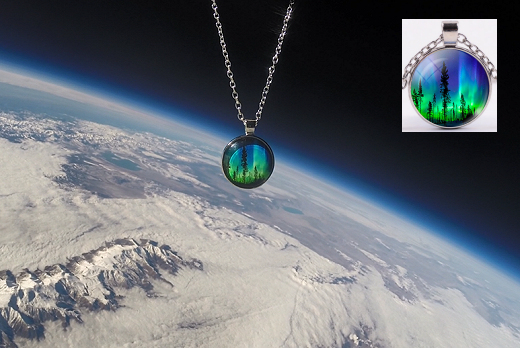
You can have it for $119.95. The students are selling these pendants to support their cosmic ray ballooning program. Each one comes with a greeting card showing the pendant in flight and telling the story of its journey to the edge of space. It makes an out-of-this-world birthday, anniversary, or Christmas gift!
Far Out Gifts: Earth to Sky Store
All sales support hands-on STEM education
Realtime Space Weather Photo Gallery
Free: Spaceweather.com Newsletter
Realtime Noctilucent Cloud Photo Gallery
Free: Spaceweather.com Newsletter