CME MISSES EARTH: There's still no sign of a CME expected to hit Earth yesterday, Aug. 20th. It probably missed. The CME did hit NASA's STEREO-A spacecraft. The geometry of the STEREO-A impact suggests that the storm cloud sailed wide of our planet. Maybe next time! Aurora alerts: SMS Text
APPROACHING MARS: By the time you finish reading this sentence, you'll be 40 km closer to Mars.
Earth and Mars are converging for a close encounter this Fall, one of the best since 2003, and their separation is rapidly shrinking--negative 8 km/s as of Aug. 21st. You are literally approaching the Red Planet. Just this week the brightness of Mars surpassed that of Sirius, the brightest star in the sky. Suddenly, Mars is almost bright enough to see in daylight and an easy target for backyard telescopes.
"Here is one hour of Mars rotating," says amateur astronomer Maximilian Teodorescu of Magurele, Romania, who animated a sequence of photos taken Aug 18th using his 14-inch Newtonian:
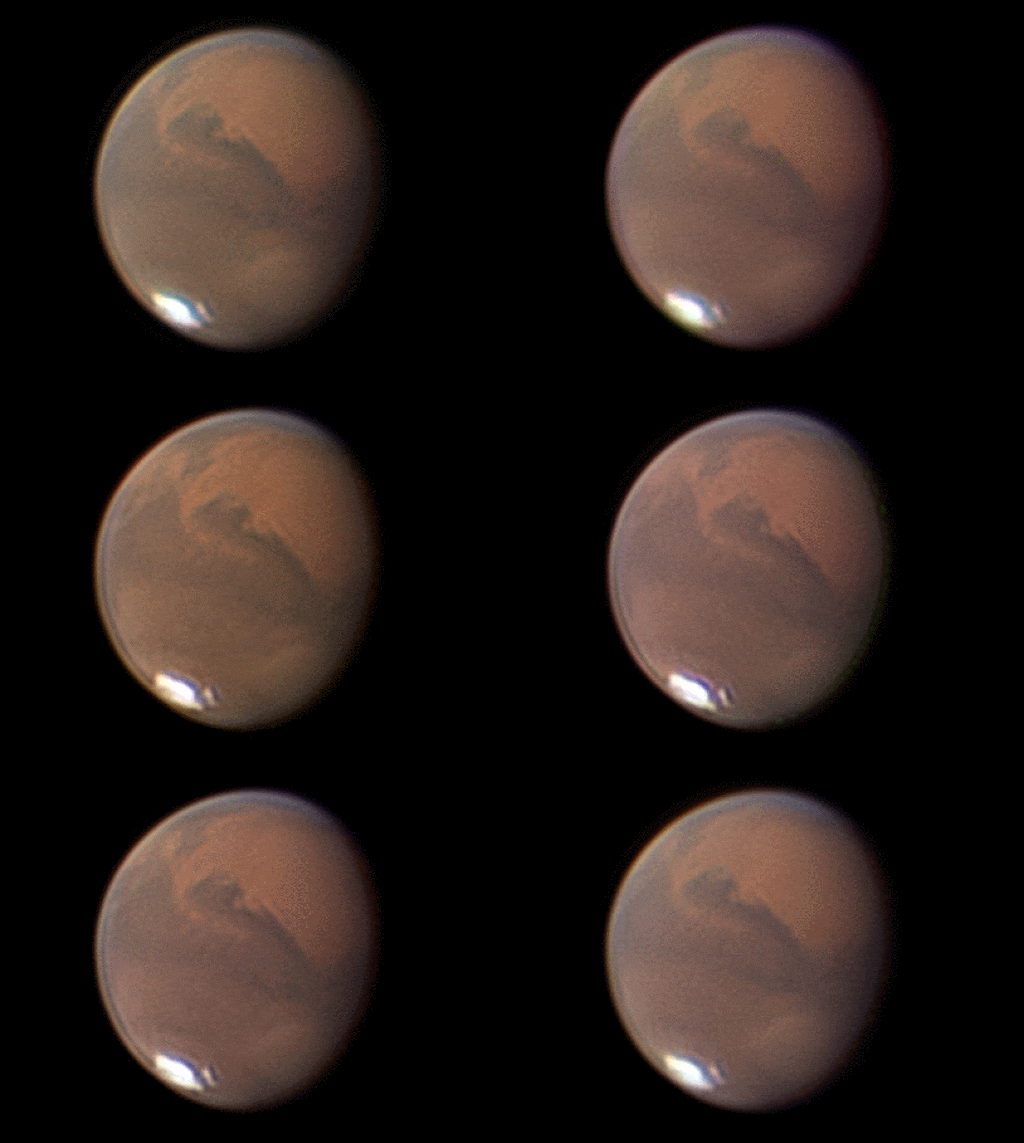
"Lots of features are visible," he says. "Note how the southern polar ice cap has contracted and broken--a result of it being late springtime on that side of Mars."
The best is yet to come. By the night of closest approach on Oct. 6th (0.4149 AU), Mars will more than double in brightness again, outshining everything in the night sky except Venus and the Moon. Throughout this apparition, the south pole will remain tilted toward Earth, giving observers a good view of the breakup of the ice cap as Martian spring turns into summer.
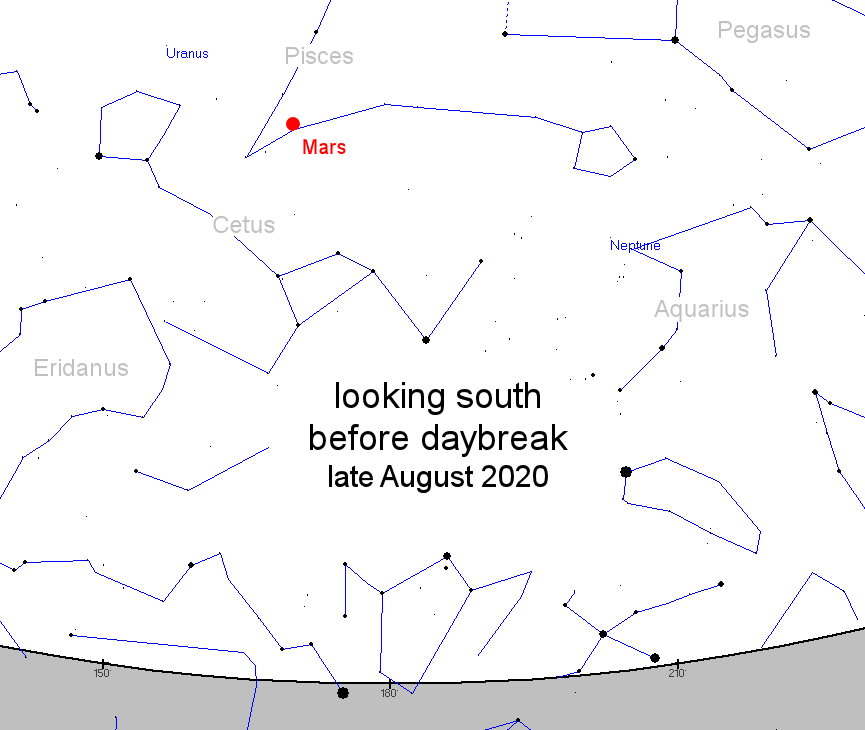
Can't wait? Right now, a good time to look is just before daybreak when Mars is high in the southern sky. Keep watching as twilight creeps up the sky. The planet's burnt orange hue looks beautiful when surrounded by the day's first hint of morning blue: sky map.
Congratulations, you're now almost 500 km closer to the planet Mars.
Realtime Mars Photo Gallery
Free: Spaceweather.com Newsletter
COSMIC RAY DATA--DELIVERED BY MULE: For the past 6 years, Spaceweather.com and the students of Earth to Sky Calculus have been launching balloons to the stratosphere, monitoring cosmic rays. Almost every data point we collect has a story behind it. This one involves a mule.
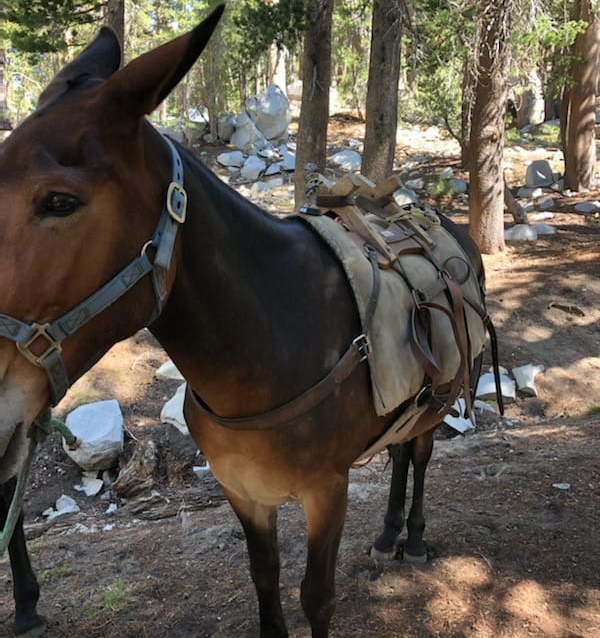
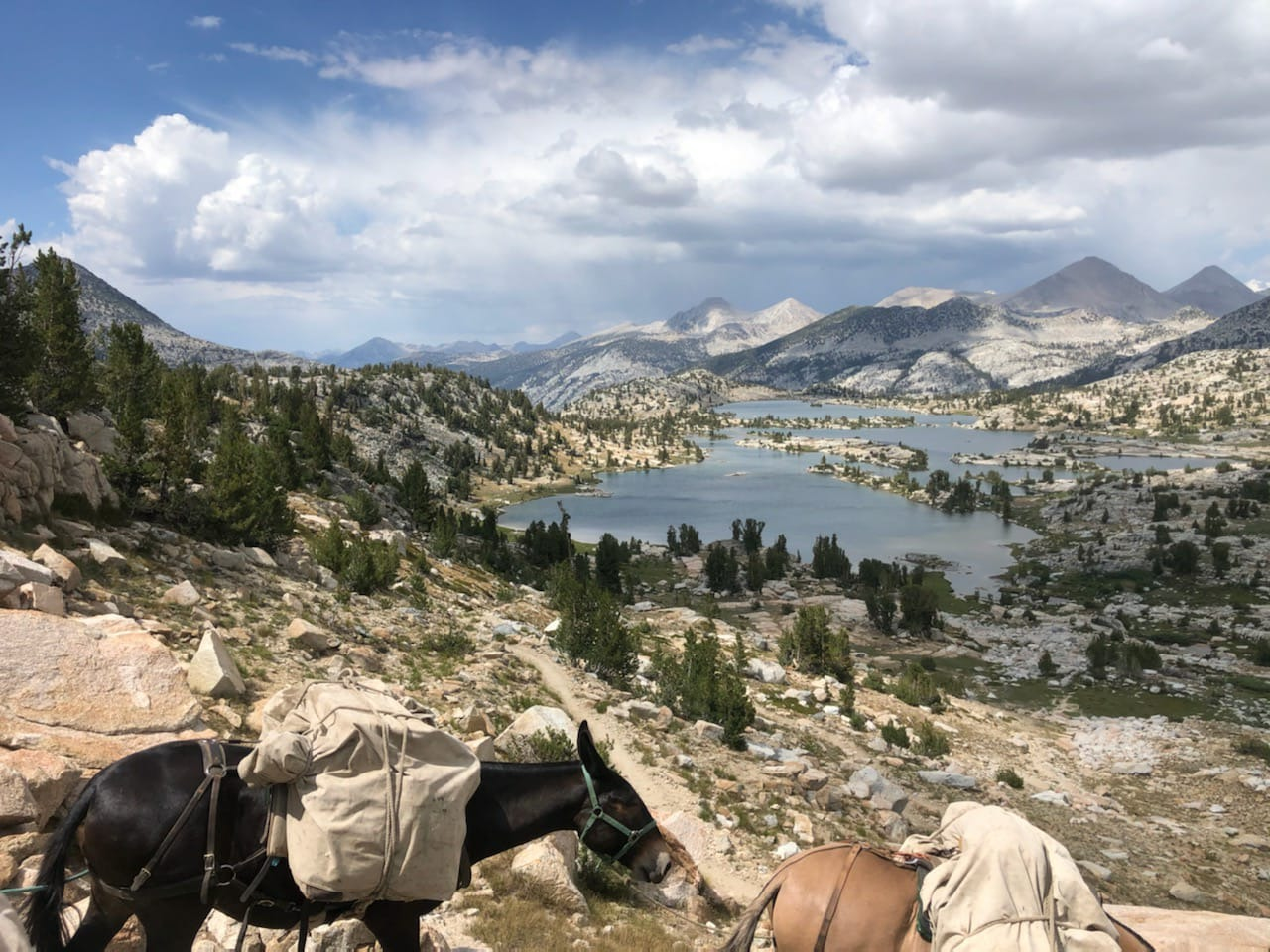
Above: The view from the landing site of our July 23, 2020, cosmic ray balloon.
On July 23rd, we launched a balloon as usual. It carried 4 cosmic ray sensors, GPS trackers, a flight computer, and a dozen pepper seeds (a student astrobiology project). The payload flew 35.8 km high--one of our highest flights ever. After the balloon popped, the adventure began. The payload hurtled downward briefly faster than 500 mph. The parachute opened, arresting its fall, and proceeded to guide the payload ... WAY OFF COURSE. The payload was supposed to land in the Buttermilks, a popular climbing area near Bishop, California, where we could easily retrieve it. Instead it touched down almost 40 miles away in the remote Sierra Nevada mountains.
As we began to make our plans to hike in and get it--a 2 day, 60 mile expedition-- something strange happened. The payload started moving again. Little did we know at the time, it was on the back of a mule.
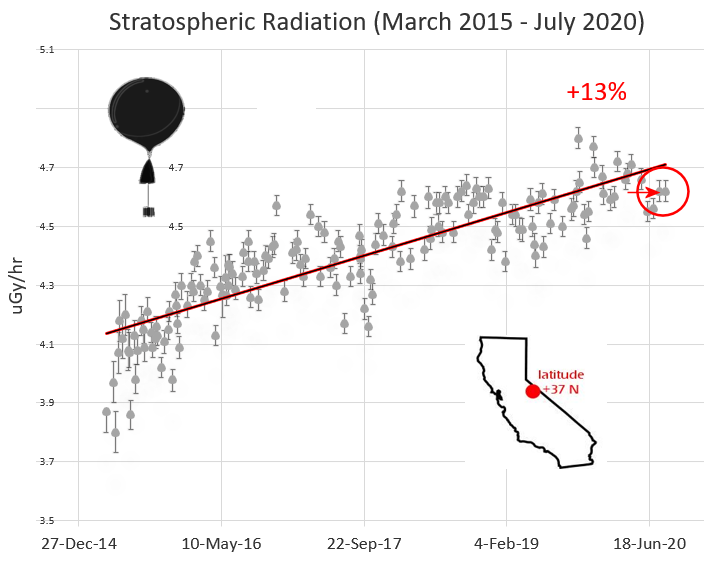
Above: The red circled data point was delivered by Mule Train
About 15 minutes after the payload came to rest in the Sierra backcountry, it was discovered by Will Ellis, a packer from Sierra Pack Station leading a train of mules along the John Muir trail. "It was only two feet from the trail," he says. "What are the odds?"
Will strapped the payload to the back of his lead mule, and proceeded to carry it almost 50 miles from the landing site to Red's Meadow, just outside Mammoth Lakes, California. From there, Will phoned Earth to Sky and returned the payload to some grateful young scientists.
Thank you Will Ellis and the Sierra Pack Station for helping us with our research!
MR. SPOCK IN THE STRATOSPHERE (COLLECTOR'S ITEM): If you would like to support the Earth to Sky Calculus cosmic ray ballooning program, there's a logical way to do it. Purchase Mr. Spock. Here is the green-blooded science officer floating 32.2 km (112,200 ft) above Death Valley National Park in central California:
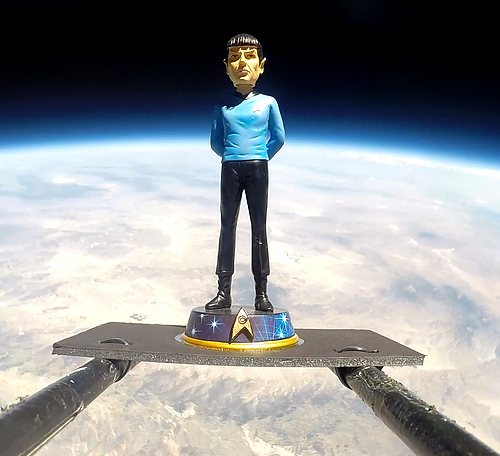
You can have him for $170.10. The price is the serial number of the Enterprise, NCC1701, divided by 10--a bargain on any planet! The students are selling Spock to buy more helium. He comes with a greeting card showing the high-quality resin bobblehead in flight and telling the story of his journey to the stratosphere and back again.
Far Out Gifts: Earth to Sky Store
All sales support hands-on STEM education
Realtime Aurora Photo Gallery
Free: Spaceweather.com Newsletter
Realtime Space Weather Photo Gallery
Free: Spaceweather.com Newsletter