SOLAR MINIMUM CONDITIONS ARE IN EFFECT: The solar disk has been blank (without sunspots) for 18 straight days. The sun's X-ray output has flatlined and geomagnetic activity is low. For now, Solar Minimum conditions are in effect. Aurora alerts: SMS Text.
HOW BRIGHT IS MARS? REALLY BRIGHT: Earth is approaching Mars for a decade-class close encounter on Oct. 6th. This is making the Red Planet bright. Really bright. Italian photographer Paolo Bardelli saw it at sunrise on Sept. 6th right beside the Moon:

"The Moon and Mars were beautifully close together in the dawn sky," says Bardelli. "A beautiful goblet-shaped cirrus cloud seemed to contain the striking conjunction."
Seeing Mars in blue sky alongside the gibbous Moon is sign of its growing luminosity. Mars is now shining with astronomical magnitude -2--that is, almost twice as bright as Sirius, the brightest star in the sky. It will grow even brighter in the weeks ahead, highlighted by a spectacular conjunction with the full Moon on Oct. 2nd. Mark your calendar!
Realtime Mars Photo Gallery
Free: Spaceweather.com Newsletter
NOCTILUCENT CLOUDS HAVE VANISHED: NASA's AIM spacecraft is monitoring Earth's north pole, and something is missing: Noctilucent clouds. For the first time since mid-May, NLCs are not circling the North Pole. They vanished on August 28th. This animation of AIM images shows the NLC season from beginning to end:

NLCs are Earth's highest clouds. Seeded by meteoroids, they float at the edge of space 83 km above the ground. The clouds form during summer when wisps of water vapor rise up to the mesosphere, allowing water to crystallize around specks of meteor smoke. This summer, record cold temperatures in the mesosphere boosted their production. There were spectacular displays over Europe and widespread sightings as far south as the latitude of Los Angeles, California.
In a few months, noctilucent clouds will appear again--this time over the South Pole. The southern season for NLCs typically stretches from November to February (austral spring to summer). Until then, Earth has no noctilucent clouds; our planet's electric-blue crown is missing. They'll be back.
Realtime Noctilucent Cloud Photo Gallery
Free: Spaceweather.com Newsletter
A BLACK PEARL IN THE STRATOSPHERE: It came from Tahiti--and now it's been to the edge of space. On Feb. 27, 2020, this genuine Black Tahitian South Sea Cultured Pearl flew to the stratosphere onboard an Earth to Sky Calculus cosmic ray balloon, soaring more than 100,000 feet above the Sierra Nevada mountains of central California:
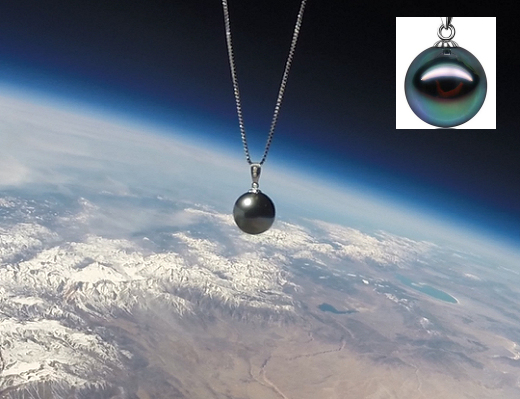
You can have it for $209.95. The students are selling these exotic space pearls to fund their cosmic ray monitoring program. Measuring 10 mm in diameter, the pearl has an 18K white gold clasp and is suspended from a matching 925 Sterling Silver chain. Each pearl comes with a greeting card showing the pendant in flight and telling the story of its journey to the edge of space.
Far Out Gifts: Earth to Sky Store
All sales support hands-on STEM education
Realtime Aurora Photo Gallery
Free: Spaceweather.com Newsletter.
Realtime Space Weather Photo Gallery
Free: Spaceweather.com Newsletter