SOLAR WIND FORECAST: A stream of solar wind could hit Earth's magnetic field on Sept. 14th. The gaseous material is flowing from a canyon-like hole in the sun's southern atmosphere, and could spark a brief episode of Arctic auroras when it arrives. Aurora alerts: SMS Text.

RETROGRADE MARS: For months, astronomers have been watching Mars creep eastward among the stars of Pisces. Today, Sept. 9th, Mars reversed course. Now the planet is moving westward. Astronomers call this "retrograde motion." It's a sign that Earth and Mars are about to have a close encounter.
The video, above, created by graphic artist Larry Koehn, shows why Mars "goes retrograde." Basically, Earth is lapping Mars in a two-way race around the sun. Our planet is faster, so Mars seems to go backwards during the weeks of closest approach.
On Oct. 6th, the date of closest approach, Earth and Mars will be only 62 million km apart--a small distance by interplanetary standards. In fact, its one of the finest encounters in years. Mars will be up all night long, outshining every star in the sky with a piercing burnt-orange hue.
Even now, Mars is a lovely sight. It is shining almost twice as bright as Sirius, the brightest star in the sky, and its disk has swollen so large that even backyard telescopes reveal astonishing details:

Amateur astronomer Maximilian Teodorescu of Romania took these pictures using a 14-inch telescope. "It is now possible to photograph craters on Mars as small as 150 km wide," says Teodorescu. Not bad for "amateur" astronomy.
No telescope? No problem. The red light of Mars is easy to see with the unaided eye. Simply step outside between midnight and dawn, and look south. You can't miss it! And remember... the best is yet to come.

Realtime Mars Photo Gallery
Free: Spaceweather.com Newsletter.
GIGANTIC JETS OVER PUERTO RICO: Tropical waves may not be the biggest storms in the Caribbean, but they produce some of the biggest lightning. On Sept. 5th, Frankie Lucena pointed his video camera at a tropical wave passing just south of Puerto Rico, and this is what he saw:
"I recorded some very impressive Gigantic Jet lightning events and clusters of sprites," he says. "They were huge."
For years, Lucena has been watching sprites and Gigantic Jets leap up from passing storms. Interestingly, he says, weaker systems often produce the strongest upward-directed lightning. "Based on my observations so far, I would say that intensifying tropical waves have the most sprites. Often these systems go on to become hurricanes."
Once a storm becomes a hurricane, however, sprite activity seems to subside. Lucena has surveyed many passing hurricanes; the tops of the great storms are strangely quiet. According to NASA, hurricanes produce less regular lightning, too. Swirling hurricanes typically lack the vertical winds required to charge up a storm and unleash powerful bolts. Perhaps sprites subside for the same reason.
Another tropical wave is forming near Africa, and it could potentially reach the Caribbean next week. Stay tuned for more Gigantic Jets.
Realtime Sprite Photo Gallery
Free: Spaceweather.com Newsletter
A BLACK PEARL IN THE STRATOSPHERE: It came from Tahiti--and now it's been to the edge of space. On Feb. 27, 2020, this genuine Black Tahitian South Sea Cultured Pearl flew to the stratosphere onboard an Earth to Sky Calculus cosmic ray balloon, soaring more than 100,000 feet above the Sierra Nevada mountains of central California:
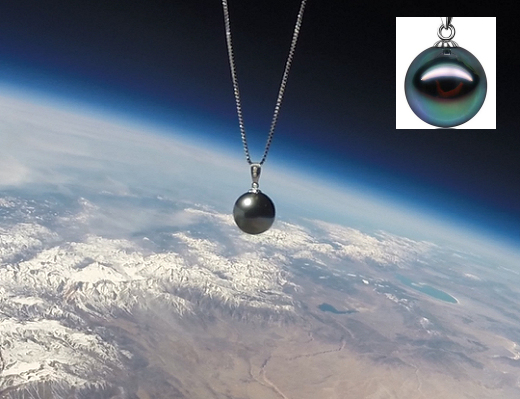
You can have it for $209.95. The students are selling these exotic space pearls to fund their cosmic ray monitoring program. Measuring 10 mm in diameter, the pearl has an 18K white gold clasp and is suspended from a matching 925 Sterling Silver chain. Each pearl comes with a greeting card showing the pendant in flight and telling the story of its journey to the edge of space.
Far Out Gifts: Earth to Sky Store
All sales support hands-on STEM education
Realtime Aurora Photo Gallery
Free: Spaceweather.com Newsletter.
Realtime Space Weather Photo Gallery
Free: Spaceweather.com Newsletter