A PROTO-SUNSPOT FROM SOLAR CYCLE 25: A proto-sunspot is growing in the sun's northern hemisphere. Its magnetic polarity marks it as a member of new Solar Cycle 25. The growing spot is not yet large enough to receive an official number, and might dissipate before lifting the daily sunspot number above zero. Sunspot alerts: SMS Text.

GREEN CLOUDS OVER SWEDEN: Last night, auroras unexpectedly exploded over Abisko, Sweden. "It was a great display," says Chad Blakley of local tour guide service Lights Over Lapland. "But it wasn't the auroras that caught our eye." It was the clouds:

They turned green. Eye-witness Bjorn Vardling of Abisko says "I've been working here for 2 years, and this is the first time I've seen auroras so intense that the clouds themselves were green. It was amazing!" The same phenomenon was sighted in northern Norway.
What happened? A crack opened in Earth's magnetic field. Solar wind poured in to fuel the display. Such cracks form often during weeks around equinoxes--a phenomenon known as the "Russell-McPherron effect." With the autumnal equinox only 1 week away, more green clouds are in the offing. Stay tuned.
Realtime Aurora Photo Gallery
Free: Spaceweather.com Newsletter
HEARING A PIN DROP IN THE MAGNETOSPHERE: Imagine sitting alone in a quiet room. The air is still and the silence is deep. Then, you drop a pin... Something like that just happened in Lofoten, Norway, where Rob Stammes heard a pin drop in the magnetosphere. "Earth's magnetic field was extremely quiet on Sept. 12th when my magnetometer picked up a faint but pure ringing signal," he says. "It lasted for more than an hour!"

"Outside my observatory, the local magnetic field swung back and forth by 0.12 degrees," says Stammes. "This was accompanied by a sinusoidal current in the soil, about 0.2 mV per meter in amplitude. These are very tiny signals which can only be detected during a time of extreme quiet."
Sept. 12th was such a time. The sun had been blank (no sunspots) for more than three weeks, and geomagnetic activity was very low. Stammes was essentially sitting alone in a quiet room, when the pin dropped.
The "pin," in this case, was a gentle gust of solar wind, which grazed the flanks of Earth's magnetosphere. A sinusoidal disturbance in the geomagnetic field rippled down to the Arctic where it moved the needle of Stamme's instrument. Researchers call such disturbances "pulsations continuous"--or Pc waves. Because they require quiet to make themselves heard, Pc waves are best studied during deep Solar Minima like the one we are experiencing now.
Stammes would rather watch auroras, but, he says, "these waves have a kind of beauty, too. It's always nice to see them."
Realtime Space Weather Photo Gallery
Free: Spaceweather.com Newsletter
NORTHERN LIGHTS PENDANT: Last December, the students of Earth to Sky Calculus launched a cosmic ray balloon to the stratosphere. This Northern Lights pendant went along for the ride, flying more than 107,612 feet above the rugged Sierra Nevada mountains of central California:
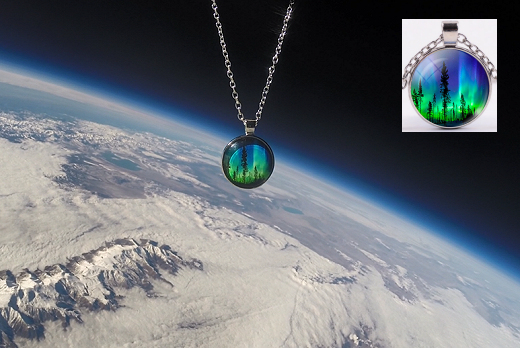
You can have it for $129.95. The students are selling these pendants to support their cosmic ray ballooning program. Each one comes with a greeting card showing the pendant in flight and telling the story of its journey to the edge of space. It makes an out-of-this-world birthday, anniversary, or Christmas gift!
Far Out Gifts: Earth to Sky Store
All sales support hands-on STEM education
Realtime Aurora Photo Gallery
Free: Spaceweather.com Newsletter