SOLAR CYCLE 25 HAS BEGUN: Solar Cycle 25 is officially underway. NASA and NOAA made the announcement during a media teleconference on Sept. 15th. An international panel of experts found that the sunspot number hit rock bottom in Dec. 2019. Since then, sunspot counts have been slowly increasing with Solar Max expected in 2025: Full Story.
NO, THIS IS NOT A SOLAR FLARE: Now that Solar Cycle 25 is underway, we can expect more solar flares. But that's not what this is:

Christopher Flores took the picture while watching the sunset from Phoenix, Arizona, on Sept. 13th. "Smoke from wildfires in California dimmed the sun so much that I could photograph it. Is that a solar flare?"
If only... The sun hasn't produced a significant solar flare in more than a month. In fact, the solar disk has been completely blank--without sunspots--for the past 27 days. Solar Minimum conditions are very much in effect.
The luminous plumes and splashes in Flores' excellent photo are caused by the turbulent exhaust of the passing airplane. Thermal irregularities in air behind the plane stretched and distorted the edge of the sun, creating apparent fireworks greater than any real solar flare in 2020.
Realtime Space Weather Photo Gallery
Free: Spaceweather.com Newsletter
ASH-COLORED RING AROUND THE SUN: Smoke from California's megawildfires has circled the globe. As a result, today, an ash-colored ring formed around the sun over Deventer, The Netherlands:

"We've been seeing these rings off and on since Sept. 11th," says photographer Peter Paul Hattinga Verschure. "They appear to be caused by very small particles in the upper atmosphere from distant wildfires."
Experts call this a "Bishop's Ring." First noted in 1883 after the eruption of Indonesian super-volcano Krakatoa, Bishop's Rings are caused by micron-sized specks of airborne ash and dust, which strongly scatter blue wavelengths of sunlight. (One micron equals one-millionth of a meter.) The phenomenon is often seen after volcanic eruptions including modern blasts such as Mt. Pinatubo in 1991. In this case, wildfires are mimicking volcanoes in terms of their effect on the atmosphere.
Realtime Space Weather Photo Gallery
Free: Spaceweather.com Newsletter
INFINITY BLACK PEARL: It came from Tahiti--and now it's been to the edge of space. On April 15, 2020, this genuine Black Tahitian South Sea Cultured Pearl flew to the stratosphere onboard an Earth to Sky Calculus cosmic ray balloon, soaring 107,611 feet above the Sierra Nevada mountains of central California:
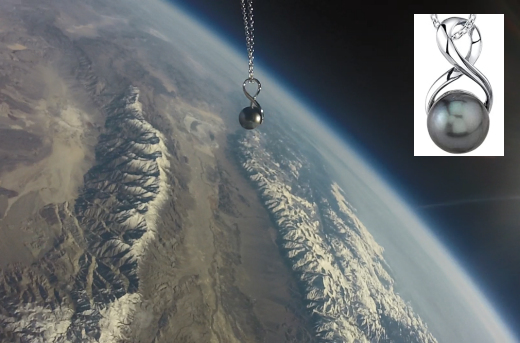
You can have it for $249.95. The students of Earth to Sky Calculus are selling these exotic space pearls to fund their cosmic ray monitoring program.
Measuring 8 mm in diameter, the pearl is mounted on a 925 sterling silver infinity twist and suspended on a matching 17 inch long sterling silver chain. Each pearl comes with a greeting card showing the pendant in flight and telling the story of its journey to the edge of space.
Far Out Gifts: Earth to Sky Store
All sales support hands-on STEM education
Realtime Aurora Photo Gallery
Free: Spaceweather.com Newsletter
Realtime Mars Photo Gallery
Free: Spaceweather.com Newsletter