THE SUN IS STRANGELY SPOTLESS: If Solar Cycle 25 has begun, then why is the sun so quiet? The solar disk has been blank--zero sunspots--for 28 straight days; and we haven't had a significant solar flare in more than a month. Strange? It only seems that way. The early months of new solar cycles are often interrupted by quiet spells, sometimes long ones. Solar Minimum doesn't give up easily, although, eventually, it will give up. Stay tuned. Aurora alerts: SMS text.
WILDFIRE THREATENS MT. WILSON: Astronomers are worried about Mt. Wilson Observatory, and this photo shows why. Last night, an automated webcam caught flames exploding from a hillside just below the 150-ft tall Solar Tower:

Photo Credit: High Performance Wireless Research and Education Network
The Bobcat Fire, which erupted on Sept. 6th in the Angeles National Forest, is out of control and threatening the historic observatory. On Tuesday afternoon, the blaze was within 500 feet of the facility. Firefighters saved it using a variety of tactics, including carving out lines by hand and with bulldozers, setting strategic backfires (indeed, the photo above might be a backfire), and dropping water from airplanes. After two harrowing nights of firefighting, the observatory still stands.
The impact of Mt. Wilson on astronomy can hardly be overstated. Edwin Hubble used the 100-in telescope, the largest telescope in the world from 1917 to 1949, to discover that the Universe is expanding. Fritz Zwicky found evidence for dark matter. And, working with the observatory's solar towers, George Ellery Hale showed that sunspots were giant islands of magnetism floating on the surface of the sun.
The observatory is still in peril. Best wishes to the firefighters who are working so hard to save it.
Realtime Space Weather Photo Gallery
Free: Spaceweather.com Newsletter
SPACE PLANE GLIDES BY VENUS: Did you know, there's a space plane orbiting Earth? It's the US Air Force's Boeing X-37 mini-shuttle. Kevin Fetter of Brockville, Ontario, video-recorded it last night passing by the planet Venus:
"The other satellite in the video is SAOCOM 1-B which passed above Venus," says Fetter.
The X-37 is a semi-secret robotic spacecraft with resembles NASA's old space shuttle. In fact, it started as a NASA project in 1999 before being transferred to the United States Department of Defense in 2004. The X-37 has been orbiting Earth off and on since April 2010, with some flights lasting as long as 780 days in orbit. The latest mission, the sixth, launched on an Atlas V rocket on May 17, 2020.
Earlier this month, China launched its own space plane, apparently to keep up with the X-37. The Chinese version also resembles NASA's retired space shuttle. It completed its first test flight, a 2-day trip into low-Earth orbit, on Sept. 6th when it landed somewhere in China.
Realtime Space Weather Photo Gallery
Free: Spaceweather.com Newsletter
INFINITY BLACK PEARL: It came from Tahiti--and now it's been to the edge of space. On April 15, 2020, this genuine Black Tahitian South Sea Cultured Pearl flew to the stratosphere onboard an Earth to Sky Calculus cosmic ray balloon, soaring 107,611 feet above the Sierra Nevada mountains of central California:
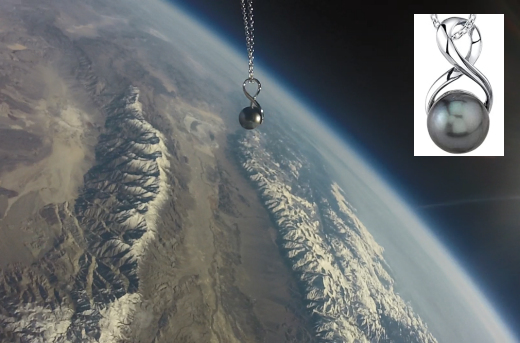
You can have it for $249.95. The students of Earth to Sky Calculus are selling these exotic space pearls to fund their cosmic ray monitoring program.
Measuring 8 mm in diameter, the pearl is mounted on a 925 sterling silver infinity twist and suspended on a matching 17 inch long sterling silver chain. Each pearl comes with a greeting card showing the pendant in flight and telling the story of its journey to the edge of space.
Far Out Gifts: Earth to Sky Store
All sales support hands-on STEM education
Realtime Aurora Photo Gallery
Free: Spaceweather.com Newsletter
Realtime Mars Photo Gallery
Free: Spaceweather.com Newsletter