A MONTH WITHOUT SUNSPOTS: The sun has been without sunspots for 31 straight days--a full month. This interval has pushed the current Solar Minimum into historic territory. Since 2016, there have been 825 spotless days. To find a lull in the solar cycle with more spotless days, you have to go back to the years around 1913 when the sun racked up 1023 spotless days. We are now experiencing a century-class Solar Minimum. Aurora alerts: SMS text.
SOLAR CYCLE 25 STRIKES BACK: The face of the sun is blank now, but it won't be blank for long. A new sunspot group is about to rotate over the eastern edge of the sun. Its magnetic canopy is visible in this image from NASA's Solar Dynamics Observatory:

As NASA and NOAA recently announced, Solar Cycle 25 has begun. But it's having trouble breaking the icy grip of Solar Minimum. The coming sunspot group could break the quiet. We'll find out by mid-week when it rotates into view. Stay tuned. Aurora alerts: SMS text.
Realtime Space Weather Photo Gallery
Free: Spaceweather.com Newsletter
WHAT IS 'OBJECT A'? China's new space plane returned to Earth on Sept. 6th. It left something behind in orbit, an item of unknown character called "Object A" by the US military. Last night in the Netherlands, Marco Langbroek tracked it across the sky using a hand-pointed video camera.
"It showed slow but marked brightness changes, between magnitude +4 and invisible (fainter than +7)," says Langbroek. "The light curve shows two brightness peaks, and two major fading episodes. Peak-to-peak period is about 80 seconds, so if this is due to a tumble, it is a slow tumble."

Object A is also a source of radio transmissions. Amateur radio operator Scott Tilley has detected it at 2280 MHz, and says that the radio signal waxes and wanes with a period near 80 seconds--akin to Langbroek's light curve.
What does it all mean? "Speculation is that Object A is either an inspector satellite used to inspect the outside of the Chinese space plane before landing; or maybe some jettisoned support module," notes Langbroek. In other words, no one knows: full story.
Realtime Space Weather Photo Gallery
Free: Spaceweather.com Newsletter
INFINITY BLACK PEARL: It came from Tahiti--and now it's been to the edge of space. On April 15, 2020, this genuine Black Tahitian South Sea Cultured Pearl flew to the stratosphere onboard an Earth to Sky Calculus cosmic ray balloon, soaring 107,611 feet above the Sierra Nevada mountains of central California:
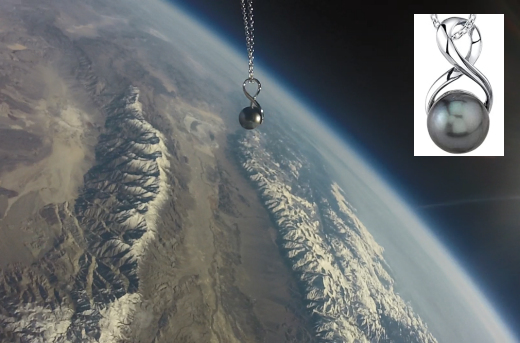
You can have it for $249.95. The students of Earth to Sky Calculus are selling these exotic space pearls to fund their cosmic ray monitoring program.
Measuring 8 mm in diameter, the pearl is mounted on a 925 sterling silver infinity twist and suspended on a matching 17 inch long sterling silver chain. Each pearl comes with a greeting card showing the pendant in flight and telling the story of its journey to the edge of space.
Far Out Gifts: Earth to Sky Store
All sales support hands-on STEM education
Realtime Aurora Photo Gallery
Free: Spaceweather.com Newsletter
Realtime Mars Photo Gallery
Free: Spaceweather.com Newsletter