ASTEROID FLYBY THIS THURSDAY: There's no danger of a collision. But asteroid 2020 SW will come very close to Earth on Thursday, Sept. 24th. At closest approach, the 5-meter wide space rock will be just 28,254 km above Australia and New Zealand, closer to Earth's surface than many satellites. Our planet's gravity will bend the asteroid's orbit and fling it harmlessly into space. Au revoir, 2020 SW.
AURORA COMETALIS: Imagine putting your thumb on a garden hose and sending a jet of water into the sky. At the apex of the stream, auroras form. It turns out, some comets can actually perform this trick.
In a paper published this week in Nature Astronomy, researchers described how Comet 67P/Churyumov-Gerasimenko turns vaporous jets of water into auroras.

Above: Comet 67P/Churyumov-Gerasimenko photographed by ESA's Rosetta spacecraft
The European Space Agency's Rosetta spacecraft observed the weird lights while it was orbiting Comet 67P in 2014-2016. At first researchers misunderstood what the glow was. It couldn't be auroras, could it? For one thing, the comet doesn't even have a magnetic field--a key ingredient of geomagnetic storms. Also, the lights of Comet 67P are invisible to the human eye. They shine primarily at far ultraviolet wavelengths, unlike the familiar red and green curtains that dance around Earth's poles.
"Nevertheless, they are auroras," says Marina Galand of Imperial College London, UK, lead author of the new study.
It took years for Galand and colleagues to figure out what was going on. Solving the mystery required data from five of Rosetta's sensors plus a physics model to calculate how the solar wind interacts with the comet's atmosphere.

Above: Electric fields in the comet's atmosphere. Credit: J. Deca, Nature Astronomy
They found that electric fields naturally occurring in the comet's atmosphere can grab electrons from the solar wind and hurl them inward. Those electrons rush headlong into water molecules spewing out of the comet's core. Debris from the collision--excited atoms of H and O--produce an ultraviolet glow: Aurora Cometalis.
Comet auroras respond to space weather much like Earth auroras do. Gusts of solar wind can rev them up, and a good coronal mass ejection (CME) can cause an outright auroral storm. Indeed, a CME that hit Comet 67P on Oct. 22, 2014, caused "a sharp intensification" of the UV brightness.
Galand says that "other comets should have these kind of auroras, too." The basic physics is universal. 67P/Churyumov-Gerasimenko's auroras are special only in the sense that the Rosetta spacecraft was there to observe them.

Thought experiment: Suppose you could see UV light. What would the auroras of 67P look like from the comet's surface?
"They would be diffuse, but not uniform," speculates Galand. "Some parts of the sky would be brighter than others--especially if a jet of water crossed your field of view!"
And here's the strangest part of all: The auroras would descend all the way down to the ground. "So you would be surrounded by the light," she says.
Yet another reason to visit a comet...
Realtime Space Weather Photo Gallery
Free: Spaceweather.com Newsletter
A BLACK PEARL IN THE STRATOSPHERE: It came from Tahiti--and now it's been to the edge of space. On Feb. 27, 2020, this genuine Black Tahitian South Sea Cultured Pearl flew to the stratosphere onboard an Earth to Sky Calculus cosmic ray balloon, soaring more than 100,000 feet above the Sierra Nevada mountains of central California:
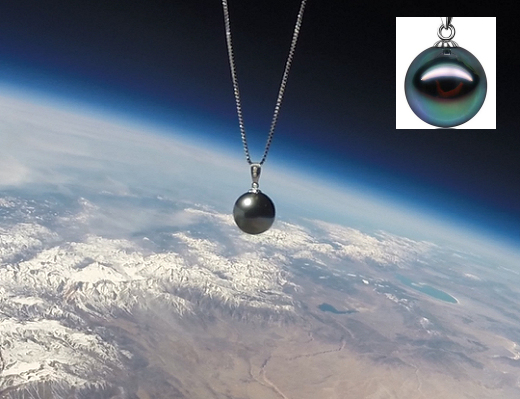
You can have it for $249.95. The students are selling these exotic space pearls to fund their cosmic ray monitoring program. Measuring 10 mm in diameter, the pearl has an 18K white gold clasp and is suspended from a matching 925 Sterling Silver chain. Each pearl comes with a greeting card showing the pendant in flight and telling the story of its journey to the edge of space.
Far Out Gifts: Earth to Sky Store
All sales support hands-on STEM education
Realtime Aurora Photo Gallery
Free: Spaceweather.com Newsletter
Realtime Mars Photo Gallery
Free: Spaceweather.com Newsletter