CHANCE OF MINOR STORMS TODAY: For the 3rd day in a row, Earth is inside a stream of solar wind flowing from a northern hole in the sun's atmosphere. First contact with the stream on Sept. 27th sparked a moderately strong G2-class geomagnetic storm. Since then, activity has subsided. Minor G1-class storms are possible today as Earth begins to exit the stream. Aurora alerts: SMS Text.



SOLAR WIND RATTLES EARTH'S MAGNETIC FIELD: There's more to a geomagnetic storm than auroras. Don't forget the squiggles. Stuart Green recorded these using a magnetometer in Preston, Lancashire, UK:

"Earth's magnetic field has been unsettled for days," reports Green. The squiggles in his chart represent changes in the local magnetic field caused by the buffeting of solar wind high overhead. They are the magnetic manifestation of auroras dancing at the same time around Arctic Circle.
Note the sudden onset of unrest during the late hours of Sept. 27th. That's when a solar wind stream hit Earth's magnetic field, sparking a G2-class geomagnetic storm. "The beautiful Arctic auroras showcased on Spaceweather.com were powered by this event," says Green. "My geomagnetic data show how our local magnetic field responded thousands of miles away in England."
Realtime Aurora Photo Gallery
Free: Spaceweather.com Newsletter
NO SUNSPOTS, ALL FROTH: There are no sunspots on the sun today, but there is a lot of magnetic froth. Philippe Tosi sends this picture from Nîmes, France:

"I inserted a picture of Earth for scale," says Tosi. "The active region is quite large."
The frothy sea of magnetism in Tosi's photo is called "plage"--French for beach. Bright plage often surrounds large sunspot groups. There was a sunspot at this location a few days ago, but it abruptly decayed after unleashing a C1-class solar flare. Only the froth remains.
Realtime Space Weather Photo Gallery
Free: Spaceweather.com Newsletter
THE PINK AURORA PEARL: Inspired by the color of rare pink auroras, Spaceweather.com and the students of Earth to Sky Calculus launched a pink pearl to the stratosphere on Sept. 25th. It hitched a ride onboard the students' cosmic ray balloon, and reached an altitude 112,205 feet above the Sierra Nevada mountains of central California:
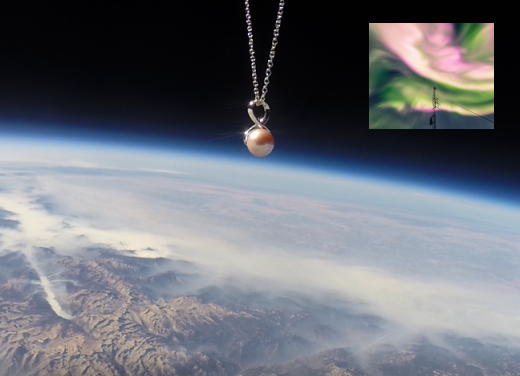
You can have it for $249.95. The students are selling space pearls to support their cosmic ray monitoring program. Measuring 9 mm in diameter, the Aurora Pearl is mounted on a 925 sterling silver infinity twist and suspended on a matching 17 inch long sterling silver chain. Each pearl comes with a greeting card showing the pendant in flight and telling the story of its journey to the edge of space.
Far Out Gifts: Earth to Sky Store
All sales support hands-on STEM education
Realtime Mars Photo Gallery
Free: Spaceweather.com Newsletter