THAT SUPER-BRIGHT RED STAR ... IT'S MARS: Today, Oct. 6th, Mars is having a close encounter with Earth. It won't pass this close (62 million km) again until Sept. 2035. The Red Planet rises in the east at sunset, shining almost three times brighter than Sirius, and stays up all night long. The view through a backyard telescope might remind you of Hubble. Don't miss it! Browse: Sky Map, Mars Photo Gallery.

AURORA SURPRISE: Auroras were not in the forecast for Oct. 5th. "We headed out with a small tour group with rather low expectations," says Markus Varik of Tromsø Norway. "Little did we know, we were about to get completely blown away." This is what they saw:

"The sky was filled with pinks, ripples, waves, dragons, angels, jellyfish, and more," says Varik. "Amazing evening and it lasted for at least a hour straight."
What happened? The forecast did not anticipate a crack in Earth's magnetic field. In the jargon of forecasters "BsubZ tipped south," opening a fissure through which solar wind flowed. The result was an aurora surprise.
Realtime Aurora Photo Gallery
Free: Spaceweather.com Newsletter
RADIO SIGNALS FROM MARS: How close is Mars? Close enough for radio reception. On Oct. 4th, amateur radio operator Scott Tilley picked up a carrier wave from NASA's Mars Reconnaissance Orbiter (MRO) circling the Red Planet. Turn up the volume and listen to the Martian Doppler shift:
Tilley is a leader in the field of satellite radio. Dead satellites, zombie satellites, spy satellites: He routinely finds and tracks them. "But this was a first for me," he says. "A satellite around Mars!"
It's not easy picking up radio signals from distant planets. NASA does it using the giant antennas of the Deep Space Network. Tilley uses a modest 60 cm dish in his backyard in Roberts Creek, BC. This week's close encounter with Mars set the stage for his detection.
"MRO's signal is weak, but it is one of the louder signals in Mars orbit," says Tilley. "The spacecraft has a large dish antenna it uses as a relay for other Mars missions. With the proximity of Mars these days, it was the perfect time to try."

Above: Scott Tilley's backyard dish antenna in Roberts Creek, BC
The signal Tilley picked up is a simple X-band carrier wave containing no data or telemetry. "Its purpose is to allow for Doppler tracking," he explains. "The rapid change in pitch of the signal is caused by the relative motion of the satellite and the observer. Using the Doppler shift, I was able to calculate the period and semi-major axis of MRO's orbit. MRO was about 274 km over Mars at the time of my observation, a result confirmed by JPL Horizons."
Now that Tilley has detected one Martian spacecraft, he's eager for more. "I'm improving my station to monitor objects in deep space," he says. "Mars is a busy place and I'm sure it will produce many more interesting observations during this close encounter." Stay tuned.
Realtime Mars Photo Gallery
Free: Spaceweather.com Newsletter
THE PINK AURORA PEARL: Inspired by the color of rare pink auroras, Spaceweather.com and the students of Earth to Sky Calculus launched a pink pearl to the stratosphere on Sept. 25th. It hitched a ride onboard the students' cosmic ray balloon, and reached an altitude 112,205 feet above the Sierra Nevada mountains of central California:
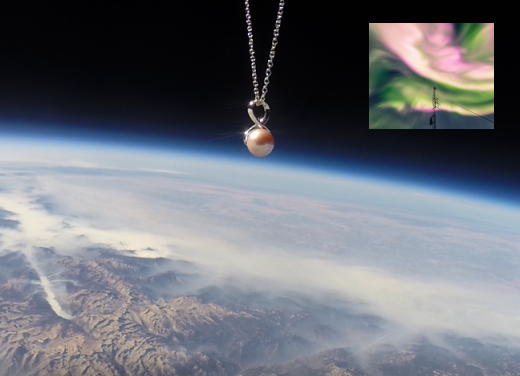
You can have it for $249.95. The students are selling space pearls to support their cosmic ray monitoring program. Measuring 9 mm in diameter, the Aurora Pearl is mounted on a 925 sterling silver infinity twist and suspended on a matching 17 inch long sterling silver chain. Each pearl comes with a greeting card showing the pendant in flight and telling the story of its journey to the edge of space.
Far Out Gifts: Earth to Sky Store
All sales support hands-on STEM education
Realtime Space Weather Photo Gallery
Free: Spaceweather.com Newsletter