DRACONID METEOR SHOWER--TONIGHT: Earth is passing through a stream of debris from Comet 21P/Giacobini-Zinner, source of the notoriously unpredictable Draconid meteor shower. Some years, a Draconid storm erupts when Earth passes through a dense clump. 2020 is not expected to be such a year. Northern sky watchers will probably see no more than ~10 meteors per hour after nightfall on Oct. 7-8: sky map.

SOLAR EXPLOSION MISSES EARTH: If only this had happened one week ago. A beautifully bright coronal mass ejection (CME) lumbered away from the sun on Oct. 6th, shown here in a movie from the Solar and Heliospheric Observatory (SOHO):

NOAA forecasters say the CME will miss Earth. However, if this same explosion had happened just one week ago when the blast site was facing Earth, we would now be declaring a geomagnetic storm warning. Maybe next time!
Realtime Aurora Photo Gallery
Free: Spaceweather.com Newsletter
FEAR AND DREAD AROUND MARS: The moons of Mars are so small, some astronomers believe they are captured asteroids. Named Phobos and Deimos (Fear and Dread), the diminutive satellites average 17 km in diameter and are rarely seen in pictures of the Red Planet. Last night was different. Dennis Simmons of Brisbane, Australia, captured both:

"On Tuesday, Oct. 6th, Mars had a close encounter with Earth, only 62 million km (38.6 million miles) from my back garden in Brisbane," says Simmons. The proximity not only boosted the apparent brightness of the tiny moons, but also increased their angular separation from Mars. "This made the photo possible."
The image above is actually a composite. Mars shines 242,000 times brighter than Phobos and 741,000 times brighter than Deimos. "I overlaid my LRGB image over the blown-out disc of Mars, which I had to grossly over-expose to record the much fainter moons," he explains.


Realtime Mars Photo Gallery
Free: Spaceweather.com Newsletter
THE PINK AURORA PEARL: Inspired by the color of rare pink auroras, Spaceweather.com and the students of Earth to Sky Calculus launched a pink pearl to the stratosphere on Sept. 25th. It hitched a ride onboard the students' cosmic ray balloon, and reached an altitude 112,205 feet above the Sierra Nevada mountains of central California:
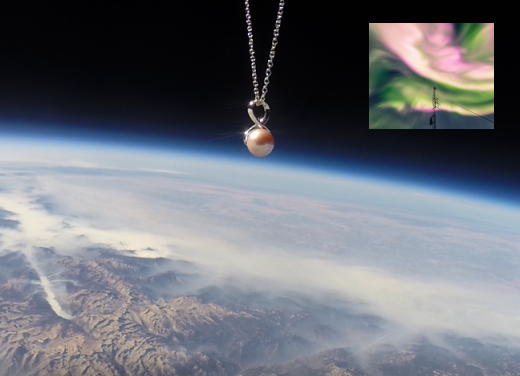
You can have it for $249.95. The students are selling space pearls to support their cosmic ray monitoring program. Measuring 9 mm in diameter, the Aurora Pearl is mounted on a 925 sterling silver infinity twist and suspended on a matching 17 inch long sterling silver chain. Each pearl comes with a greeting card showing the pendant in flight and telling the story of its journey to the edge of space.
Far Out Gifts: Earth to Sky Store
All sales support hands-on STEM education
Realtime Space Weather Photo Gallery
Free: Spaceweather.com Newsletter