SUNSPOT GENESIS: Two new sunspots are emerging in the sun's southern hemisphere. Both are small, but growing rapidly. Readers with safe solar telescopes, point your optics here to witness sunspot genesis. Sunspot alerts: SMS Text.

SOMETHING NEW IN THE REALM OF SPRITES: Frankie Lucena of Puerto Rica has made a discovery. Some jellyfish have feet. Jellyfish sprites, that is. "On Sept. 28th, I photographed an outburst of upward directed lightning over the Caribbean," he says. "Their jellyfish forms included something unusual. I call them 'feet.'" Note the bright endpoints at the bottom of the sprite's dangling tendrils:

"This feature in a sprite event hasn't been documented yet," says Lucena, who has spent years documenting sprites and gigantic jets above electrical storms near Puerto Rico. "After checking my database I was only able to find three others that have this feature, so I compiled all four into a single image. My best guess is that the electrons were only able to propagate downward to a certain point and they accumulated there, causing the tips of the tendrils to brighten."

Jellyfish with feet: Another reason to keep an eye on the tops of thunderstorms.

Realtime Sprite Photo Gallery
Free: Spaceweather.com Newsletter
SOLAR TRANSIT OF THE S.S. KALPANA CHAWLA: On Oct. 5th, a robotic arm on the International Space Station (ISS) reached out and grabbed the S.S. Kalpana Chawla--a cargo vessel full of supplies for the orbiting outpost. Shortly before docking, the two spacecraft passed in front of the sun over Iran where astrophotographer Amir Ehteshami recorded the transit:

"I was lucky to get this picture," says Ehteshami. "The cargo carrier is only 5.1 x 3.07 meters in size--barely a speck! And it was in front of the sun for just a fraction of a second."
"To capture the transit, I had hoped to set up my telescope in the industrial city of Shiraz, but could not get the required permission," he says. "With only 15 minutes left, I drove to the outskirts of the city and set everything up in a hurry."
Also known as "Cygnus NG-14," the Northrop Grumman cargo carrier is named after American astronaut Kalpana Chawla, the first woman of Indian descent to go to space. She died with six crewmates aboard space shuttle Columbia in February 2003.
Realtime Space Weather Photo Gallery
Free: Spaceweather.com Newsletter
THE PINK AURORA PEARL: Inspired by the color of rare pink auroras, Spaceweather.com and the students of Earth to Sky Calculus launched a pink pearl to the stratosphere on Sept. 25th. It hitched a ride onboard the students' cosmic ray balloon, and reached an altitude 112,205 feet above the Sierra Nevada mountains of central California:
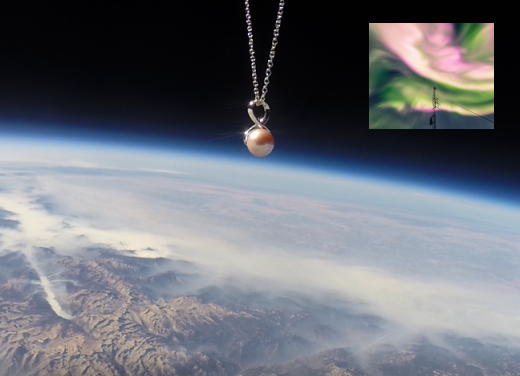
You can have it for $249.95. The students are selling space pearls to support their cosmic ray monitoring program. Measuring 9 mm in diameter, the Aurora Pearl is mounted on a 925 sterling silver infinity twist and suspended on a matching 17 inch long sterling silver chain. Each pearl comes with a greeting card showing the pendant in flight and telling the story of its journey to the edge of space.
Far Out Gifts: Earth to Sky Store
All sales support hands-on STEM education
Realtime Aurora Photo Gallery
Free: Spaceweather.com Newsletter
Realtime Mars Photo Gallery
Free: Spaceweather.com Newsletter