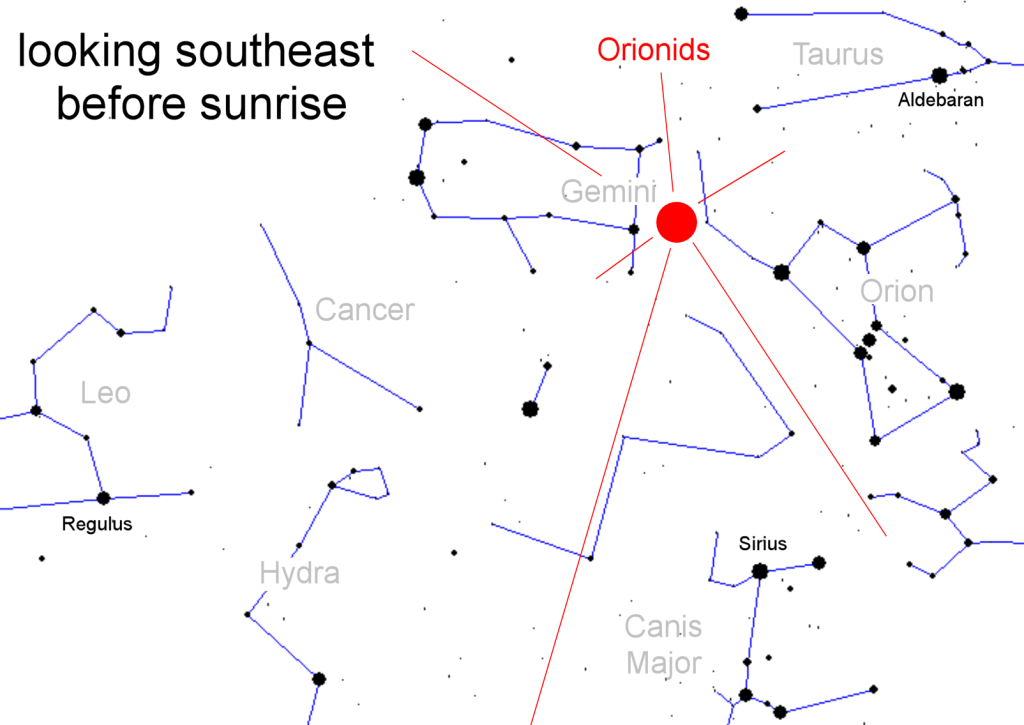
THE ORIONID METEOR SHOWER: This weekend, a small piece of Halley's Comet disintegrated over Florida. NASA all-sky cameras recorded the fireball. This is a sign that the Orionid meteor shower is about to begin. Forecasters expect the shower to peak on Oct. 20th when Earth passes through the heart of Halley's debris stream. As many as 20 meteors per hour are possible during the hours before dawn: sky map.

AURORAS WITHOUT A SOLAR STORM: Yesterday, there was no solar flare, no coronal mass ejection (CME), no solar activity of any kind. Then this happened:

"On Oct. 11th we saw this amazing outburst," reports Markus Varik of Tromsø Norway. "We headed out with a small group of adventurers on what seemed like Mission Impossible. There was no hope of finding auroras. But never say 'never.' We got the complete palette of colors."
There is an explanation: Just as Varik headed out, a crack opened in Earth's magnetic field. Slow-moving solar wind poured through the gap, sparking auroras. This kind of unpredictable display can happen at any time around the Arctic Circle, where magnetic cracks often surprise observers--no solar storm required. Aurora alerts: SMS Text.
Realtime Aurora Photo Gallery
Free: Spaceweather.com Newsletter
THE CLOUDS OF MARS: Mars is currently having its closest approach to Earth until 2035, and the view is amazing. Andrea Maniero sends this picture from Padova, Italy:

"Look at all the clouds," says Maniero. "They are visible in several locations around the planet."
Indeed, Maniero's photo, taken with a 14-inch telescope, shows orographic clouds over the Tharsis volcanoes, sunrise clouds over the planet's morning limb, and winter clouds over the Martian north pole. The only quadrant not covered by some clouds is the south pole. It is marked instead by a circular mass of bright white ice--the South Polar Cap. Click here for labels.

Realtime Space Weather Photo Gallery
Free: Spaceweather.com Newsletter
THE PINK AURORA PEARL: Inspired by the color of rare pink auroras, Spaceweather.com and the students of Earth to Sky Calculus launched a pink pearl to the stratosphere on Sept. 25th. It hitched a ride onboard the students' cosmic ray balloon, and reached an altitude 112,205 feet above the Sierra Nevada mountains of central California:
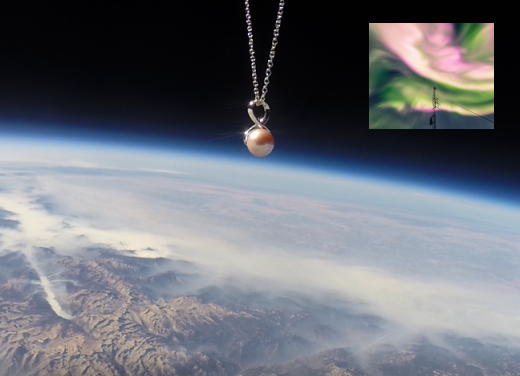
You can have it for $249.95. The students are selling space pearls to support their cosmic ray monitoring program. Measuring 9 mm in diameter, the Aurora Pearl is mounted on a 925 sterling silver infinity twist and suspended on a matching 17 inch long sterling silver chain. Each pearl comes with a greeting card showing the pendant in flight and telling the story of its journey to the edge of space.
Far Out Gifts: Earth to Sky Store
All sales support hands-on STEM education
Realtime Mars Photo Gallery
Free: Spaceweather.com Newsletter