MORNING SKY SHOW: Awake before sunrise? Go outside and look east. The crescent Moon is passing Venus on Oct. 13th and 14th. Try to catch them just before sunrise when the pair is framed by twilight blue. It's a great way to begin the day. From Sky&Telescope: Sky Map.

RARE RED AURORAS: Arctic photographer Rayann Elzein sees auroras all the time over Utsjoki, Finland. But the auroras he saw last night were different. "They were red," he says. "Almost only red."

"Rarely have I seen anything like this before," says Elzein. "I double-checked the white balance on my camera to make sure nothing was wrong. But it was the same color temperature as on all my other northern lights pictures."
"Later, we were treated to the usual swirls of green and even some pink nitrogen fringe," he says. "When the green swirls calmed down, the red returned."


Auroras are normally green--the verdant glow of oxygen atoms about 150 km above Earth's surface. Rare red auroras are also caused by oxygen atoms, but at higher altitudes between 150 km and 500 km. At those heights, the temperature and density of the atmosphere favors atomic transitions that emit red photons. Indeed, Elzein's photos show red stacked on top of green just as theory predicts.

For some reason, unknown to us, the solar wind on Oct. 12th excited oxygen at higher altitudes than usual, giving rare red auroras their chance to shine. Aurora alerts: SMS Text.
Realtime Aurora Photo Gallery
Free: Spaceweather.com Newsletter
MARS AT OPPOSITION: "Mars reached its nearest distance to Earth on Oct. 6th--the closest or brightest it will be until 2035," says University of Florida astronomy professor emeritus Howard Cohen. "Now, one week later, Mars reaches opposition--that is, it is opposite the Sun in the sky. It shines as a brilliant, golden jewel in early eastern skies and is up all night."


Above: Cohen took this picture of Mars at opposition, easily visible through the lights of a Gainesville, Florida, suburban street.
Realtime Mars Photo Gallery
Free: Spaceweather.com Newsletter
THE PINK AURORA PEARL: Inspired by the color of rare pink auroras, Spaceweather.com and the students of Earth to Sky Calculus launched a pink pearl to the stratosphere on Sept. 25th. It hitched a ride onboard the students' cosmic ray balloon, and reached an altitude 112,205 feet above the Sierra Nevada mountains of central California:
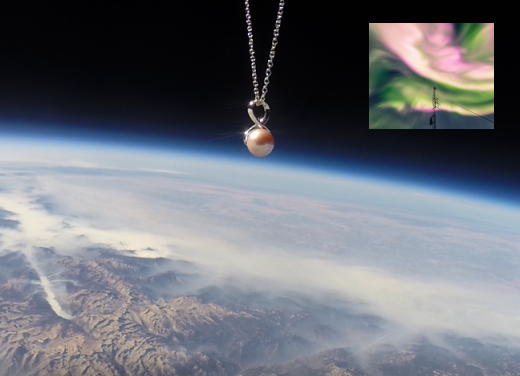
You can have it for $249.95. The students are selling space pearls to support their cosmic ray monitoring program. Measuring 9 mm in diameter, the Aurora Pearl is mounted on a 925 sterling silver infinity twist and suspended on a matching 17 inch long sterling silver chain. Each pearl comes with a greeting card showing the pendant in flight and telling the story of its journey to the edge of space.
Far Out Gifts: Earth to Sky Store
All sales support hands-on STEM education
Realtime Space Weather Photo Gallery
Free: Spaceweather.com Newsletter