NEW SUNSPOT ALERT: A new sunspot is emerging near the sun's southeastern limb. Its magnetic polarity marks it as a member of new Solar Cycle 25. Astronomers with safe solar telescopes can look for it here. Minor B-class solar flares are likely in the hours ahead. Aurora alerts: SMS Text.


MORE RED AURORAS: "Is this the new normal?" wonders Rayann Elzein of Utsjoki, Finland. "For the second night in a row, we have photographed red auroras--an extremely rare event."

"On the night of Oct. 13th, auroras appeared out of nowhere, and immediately, I noticed that the green layer was topped by a red layer!" says Elzein. "The same thing happened on Oct. 12th."
Normally, auroras are green--the verdant glow of oxygen atoms about 150 km above Earth's surface. Red auroras are also caused by oxygen atoms, but at higher altitudes between 150 km and 500 km. At those heights, the temperature and density of the atmosphere favors atomic transitions that emit red photons.
Elzein's photos show red stacked on top of green just as the theory predicts:

Mystery solved? Not quite. Red auroras are usually too faint to see or photograph. They come from an extremely rarefied layer of the atmosphere and, moreover, as Les Cowley explains, the very slow atomic transitions that produce red photons are easily interrupted. Even experienced observers rarely see them.
So what is causing this sudden riot of red over Finland? We don't know. Three nights in a row, anyone? Says Elzein, "I hope so!" Aurora alerts: SMS Text.
Realtime Aurora Photo Gallery
Free: Spaceweather.com Newsletter
A BLACK PEARL IN THE STRATOSPHERE: It came from Tahiti--and now it's been to the edge of space. On Feb. 27, 2020, this genuine Black Tahitian South Sea Cultured Pearl flew to the stratosphere onboard an Earth to Sky Calculus cosmic ray balloon, soaring more than 100,000 feet above the Sierra Nevada mountains of central California:
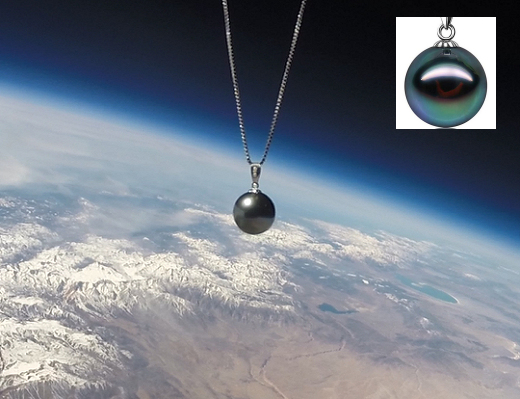
You can have it for $229.95. The students are selling these exotic space pearls to fund their cosmic ray monitoring program. Measuring 10 mm in diameter, the pearl has an 18K white gold clasp and is suspended from a matching 925 Sterling Silver chain. Each pearl comes with a greeting card showing the pendant in flight and telling the story of its journey to the edge of space.
Far Out Gifts: Earth to Sky Store
All sales support hands-on STEM education
Realtime Space Weather Photo Gallery
Free: Spaceweather.com Newsletter
Realtime Mars Photo Gallery
Free: Spaceweather.com Newsletter