NEW SUNSPOT ALERT: A new sunspot is growing near the sun's southwestern limb. Its magnetic polarity marks it as a member of new Solar Cycle 25. Readers, if you have a safe solar telescope, point it here to see sunspot genesis in action. Aurora alerts: SMS Text.

ELLERMAN BOMBS: Sunspot AR2776 isn't flaring. It's flashing. Solar photographer Philippe Tosi captured the outbursts of light scattered around the sunspot's magnetic canopy on Oct. 17th:

"This was the view through the eyepiece of my 9-inch refractor," says Tosi. "An H-alpha filter narrowly tuned to the glow of solar hydrogen made the sunspot safe to observe."
The flashes are "Ellerman bombs"--magnetic explosions about one-millionth as powerful as true solar flares. They are named after Ferdinand Ellerman who studied the tiny blasts in the early 20th century. Of course, "tiny" is relative. A single Ellerman bomb releases about 1026 ergs of energy--equal to about ten million atomic bombs.
In the image above, Tosi inserted a picture of Earth for comparison. Each Ellerman bomb is about the size of a US state! So much for the "quiet sun"...
Realtime Spaceweather Photo Gallery
Free: Spaceweather.com Newsletter
TADPOLE SUNSET: "Last Tuesday, I witnessed a very unusual sunset," reports Peter Lowenstein of Mutare, Zimbabwe. "The sun emerged from a parting raincloud and appeared to grow a tadpole tail before disappearing below the horizon."

This ranks as one of the most striking sunsets ever submitted to the Spaceweather Photo Gallery. What caused it? There's no mirage or other tricky atmospheric refraction in Lowenstein's photo. In fact, the explanation is quite simple.
"The sun is producing a 'silver lining' on the edges of clouds around it," says atmospheric optics expert Les Cowley. "This is a result of intense small angle scattering, and is frequently seen outlining sunlit clouds. At the same time, the solar disk is shining through irregular gaps in the cloud cover, masking the sun's circular outline to create a 'tadpole effect.'"
Simple, yet strange. "And," says Cowley, "a beautiful sight."
Realtime Aurora Photo Gallery
Free: Spaceweather.com Newsletter
A BLACK PEARL IN THE STRATOSPHERE: It came from Tahiti--and now it's been to the edge of space. On Feb. 27, 2020, this genuine Black Tahitian South Sea Cultured Pearl flew to the stratosphere onboard an Earth to Sky Calculus cosmic ray balloon, soaring more than 100,000 feet above the Sierra Nevada mountains of central California:
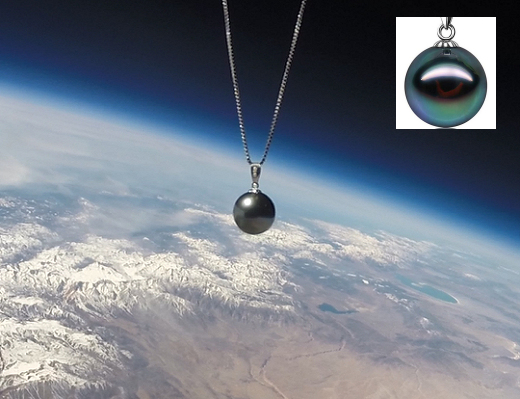
You can have it for $229.95. The students are selling these exotic space pearls to fund their cosmic ray monitoring program. Measuring 10 mm in diameter, the pearl has an 18K white gold clasp and is suspended from a matching 925 Sterling Silver chain. Each pearl comes with a greeting card showing the pendant in flight and telling the story of its journey to the edge of space.
Far Out Gifts: Earth to Sky Store
All sales support hands-on STEM education
Realtime Mars Photo Gallery
Free: Spaceweather.com Newsletter