SUNSET SKY SHOW: When the sun goes down tonight, step outside and look south. The Moon, Saturn and Jupiter have converged to form a bright triangle in the constellation Sagittarius. It's a great way to end the day: Sky map.

STRANGE RED AURORAS: Spoiler alert: We do not know the answer to this question. Where did all the red auroras come from? For much of mid-October, Earth's magnetic field has been very quiet. Extremely quiet. There should have been almost no auroras at all, yet around the Arctic Circle, photographers recorded scenes like this:

Rayann Elzein of Utsjoki, Finland, took the picture on Oct. 17th. "I saw red almost every night for a whole week with similar displays on Oct. 12th, 13th, 14th, and 15th," says Elzein. "On each occasion, geomagnetic activity was very low (with K-indices no greater than 0 or 1)."
Red auroras are rare. They form near the top of Earth's atmosphere when particles from space strike oxygen atoms 150 km to 500 km high--much higher than normal green auroras. As Les Cowley explains, at that high altitude, very slow atomic transitions which produce red photons are easily interrupted. Even experienced observers rarely see them.
Elzein has been chasing auroras in Finland for 10 years. He prides himself on going out in all conditions--even when geomagnetic activity is low. "I can't recall ever seeing so much red on top of the green layer before," he says.
In Tromsø, Norway, aurora tour guide Markus Varik had a similar experience. "Activity was extremely low on Oct. 17th when these pink and red colors appeared. After years of guiding, I have never seen anything like it."

"The auroras appeared milky-white to the naked eye, but on the camera they were vivid pink," says Varik.
The common denominator seems to be ... quiet. "The red was most apparent during the lowest geomagnetic activity--that is, when Bz was positive and the solar wind speed was slow (at or below 300 km/s)," notes Elzein. "The solar wind was also dense, with proton densities above 15 p/cm3."
It's a mystery. Aurora experts with bright (red) ideas may submit their explanations here.
Realtime Aurora Photo Gallery
Free: Spaceweather.com Newsletter
NORTHERN LIGHTS PENDANT: Last December, the students of Earth to Sky Calculus launched a cosmic ray balloon to the stratosphere. This Northern Lights pendant went along for the ride, flying more than 107,612 feet above the rugged Sierra Nevada mountains of central California:
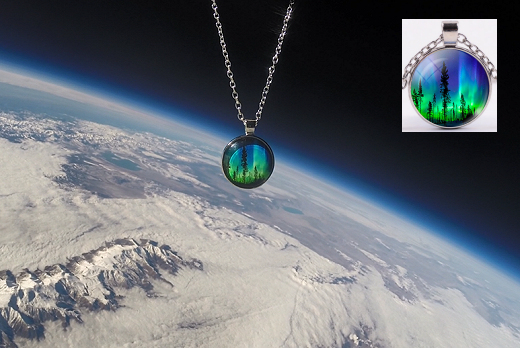
You can have it for $129.95. The students are selling these pendants to support their cosmic ray ballooning program. Each one comes with a greeting card showing the pendant in flight and telling the story of its journey to the edge of space. It makes an out-of-this-world Christmas gift!
Far Out Gifts: Earth to Sky Store
All sales support hands-on STEM education
Realtime Spaceweather Photo Gallery
Free: Spaceweather.com Newsletter