MINOR GEOMAGNETIC STORM PREDICTED: NOAA forecasters say that a minor G1-class geomagnetic storm is likely on Oct. 26th. That's when Earth will pass through a new stream of solar wind flowing from a northern hole in the sun's atmosphere. Bright auroras may be seen in Alaska, Canada, and the countries of Scandinavia. Aurora alerts: SMS Text.


BIG NEW SUNSPOT FACES EARTH: A sunspot has just materialized in the sun's southern hemisphere--and it's a big one. Newly-named AR2778 is inset in this magnetic map of the sun from NASA's Solar Dynamics Observatory:

The +/- polarity of the spot marks it as a member of new Solar Cycle 25. This continues a trend of intensifying new-cycle sunspot activity in 2020.
The primary dark core of AR2778 is about the size of Earth. Altogether, the sunspot group sprawls 90,000 km across the face of the sun, dimensions which make it an easy target for backyard solar telescopes. Amateur astronomers with safely-filtered optics are encouraged to monitor developments.
Realtime Spaceweather Photo Gallery
Free: Spaceweather.com Newsletter
WHEN THE OCEAN TURNS PINK: How do you know when the solar wind has arrived? "When the ocean turns pink!" says aurora tour guide Markus Varik, who took this picture from Tromsø, Norway, on Oct. 24th:

"Pink auroras in the sky were so vibrant, they turned the ocean pink, too!" he says. "Everyone was in awe, me included."
The pink ribbon Varik witnessed is also known as "the nitrogen fringe." Most auroras are green--the color of oxygen atoms being struck by energetic particles from space between 100 km and 300 km above Earth's surface. Pink appears when energetic particles descend lower than usual, striking nitrogen molecules at the 100 km level and below.
"Will there be more pink tomorrow night?" Varik wonders. It's possible. Earth is dipping in and out of a series of solar wind streams flowing from a ragged hole in the sun's atmosphere. Surges in the solar wind speed on Oct. 26th and 27th could very well turn the ocean pink again. Aurora alerts: SMS Text.
Realtime Aurora Photo Gallery
Free: Spaceweather.com Newsletter
NORTHERN LIGHTS PENDANT: Last December, the students of Earth to Sky Calculus launched a cosmic ray balloon to the stratosphere. This Northern Lights pendant went along for the ride, flying more than 107,612 feet above the rugged Sierra Nevada mountains of central California:
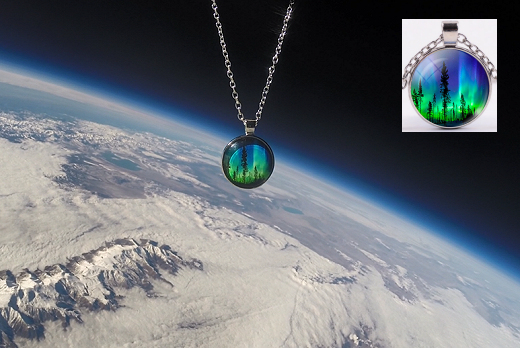
You can have it for $129.95. The students are selling these pendants to support their cosmic ray ballooning program. Each one comes with a greeting card showing the pendant in flight and telling the story of its journey to the edge of space. It makes an out-of-this-world Christmas gift!
Far Out Gifts: Earth to Sky Store
All sales support hands-on STEM education
Realtime Mars Photo Gallery
Free: Spaceweather.com Newsletter