INCOMING SOLAR STORM CLOUD: A slow-moving coronal mass ejection (CME) is heading for Earth. Sort of. Most of the storm cloud will miss our planet, but the flanks of the CME could graze Earth's magnetic field on Nov. 1st, sparking geomagnetic storms and bright auroras around the Arctic Circle. Aurora alerts: SMS Text.

LATE AFTERNOON AURORAS: At this time of year in Utsjoki, Finland, the sun goes down at 3:45 p.m.--which means aurora chasers get an early start. "Yesterday when I looked outside 5.00 p.m., there was already a nice green band in the sky," reports Rayann Elzein. "I immediately got dressed and rushed the the river bank, where the auroras exploded." This video shows the display in real-speed and real-color:
"The auroras were crazy pink with fast-moving purple fringes," he says. "After many days of clouds, this was a very welcome afternoon treat!"
The source of the display was a stream of solar wind flowing from a northern hole in the sun's atmosphere. Earth is exiting the stream now. It's still worth watching the late afternoon sky, though. A CME expected to graze Earth could bring more "crazy pink" to the Arctic on Nov. 1st.
Realtime Aurora Photo Gallery
Free: Spaceweather.com Newsletter
MULTIPLYING SUNSPOTS: Giant sunspot AR2778 has a sidekick. Another sunspot, AR2779, is growing right beside it. Both are inset in this magnetic map of the sun from NASA's Solar Dynamics Observatory:

Note how each sunspot has a +/- magnetic polarity. This identifies them as members of new Solar Cycle 25. Together, they are so far the largest sunspot group of the young solar cycle.
How large are they? "Huge," says astronomer Shahrin Ahmad, who photographed the sunspots this morning from Kuala Lumpur, Malaysia, and inserted an image of Earth for scale:

At the moment, the sunspots are crackling with minor C-class solar flares. Bigger explosions are possible. AR2788 has a "beta-gamma" magnetic field that harbors energy for M-class flares, potentially capable of causing shortwave radio blackouts and strong geomagnetic storms. Stay tuned. Solar flare alerts: SMS Text.
Realtime Spaceweather Photo Gallery
Free: Spaceweather.com Newsletter
THE SPACE HAMMER: Are you looking for a far-out gift? Consider the Space Hammer. In May, the students of Earth to Sky Calculus flew a payload of hammers to the edge of space, 115,000 feet above Earth's surface onboard a high altitude helium balloon. You can have one for $97.95:
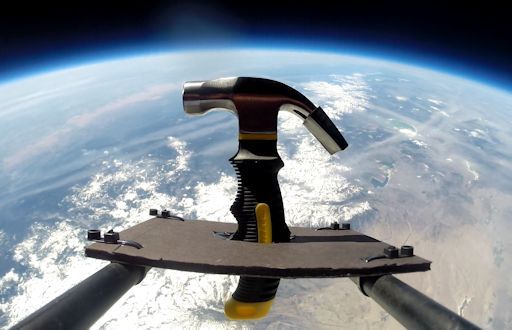
These compact 8 oz. hammers are light enough to fly on a balloon yet dense enough to deliver a powerful blow. The magnetic head holds a nail for one-handed starting, and the stubby 6 in. length is perfect for tight work areas.
Each space hammer comes with a unique gift card showing the tool floating at the top of Earth's atmosphere. The interior of the card tells the story of the flight and confirms that this gift has been to the edge of space and back again.
Far Out Gifts: Earth to Sky Store
All sales support hands-on STEM education
Realtime Aurora Photo Gallery
Free: Spaceweather.com Newsletter