A CME MIGHT HIT EARTH TODAY: A slow-moving coronal mass ejection (CME) might graze Earth's magnetic field today, Nov. 1st. The solar storm cloud left the sun on Oct. 27th and has been lumbering across the sun-Earth divide ever since. A glancing blow from the CME could spark minor geomagnetic storms and auroras around the Arctic Circle. Aurora alerts: SMS Text.

BLUE MOONLIT AURORAS: Last night, a Blue Moon flooded the heavens with lunar glare. But in northern Norway, the sky was mainly green. Marianne Bergli took this picture while Trick or Treating in Kvaløya:
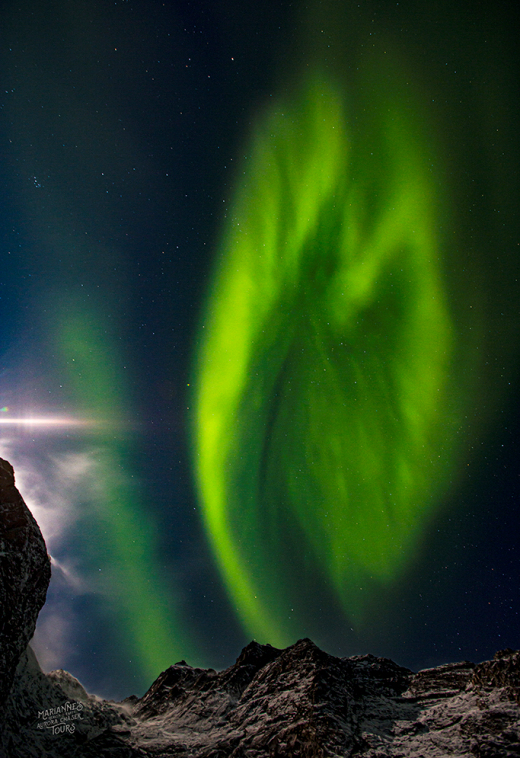
"What a great start to Halloween," says Bergli. "The full Moon lit up the landscape and our wonderful mountains, while the Green Lady danced overhead. I just love this."
The night after Halloween could be even better, if a slow-moving CME grazes Earth's magnetic field as predicted by NOAA. Stay tuned for more.
Realtime Aurora Photo Gallery
Free: Spaceweather.com Newsletter
HALLOWEEN MOONRISE: You know it must be Halloween when the full Moon turns into a candy dish. "That's what the Moon looked like last night when it rose over Raritan Bay," reports Jim Haklar of South Amboy, New Jersey. "I documented the phenomenon with this snapshot."
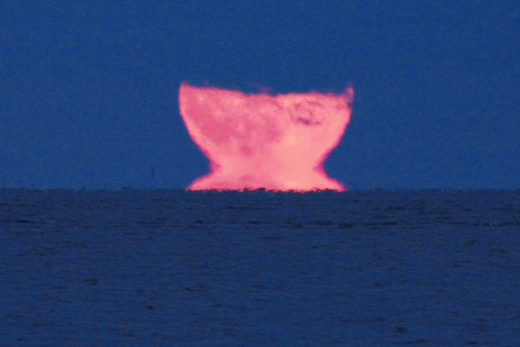
"This is how it actually looked," he says, "only slightly lightened and sharpened with Photoshop."
What happened to the normally round lunar disk? The top was blocked by a line of low-hanging clouds, while the bottom was deformed by a mirage. It's called an "inferior mirage." A layer of warm air near the sea surface creates an inverted image of the Moon, which smushes together with the actual Moon above it, forming the pedestal of the candy dish.
Inferior mirages can also cause green flashes. Haklar didn't see one, probably because the flash was blocked by clouds, but Rick Stankiewicz did. "I witnessed the rare and wonderful sight of a green flash on top of a pumpkin-colored lunar disk on Halloween," says Stankiewicz. Click here for a treat.
Realtime Spaceweather Photo Gallery
Free: Spaceweather.com Newsletter
THE ARCTIC NORTHERN LIGHTS PENDANT: On Jan. 22, 2020, the students of Earth to Sky Calculus launched a cosmic ray balloon to measure atmospheric radiation inside the Arctic Circle. This pendant hitched a ride, floating more than 75,000 feet above the frozen terrain of northern Sweden:
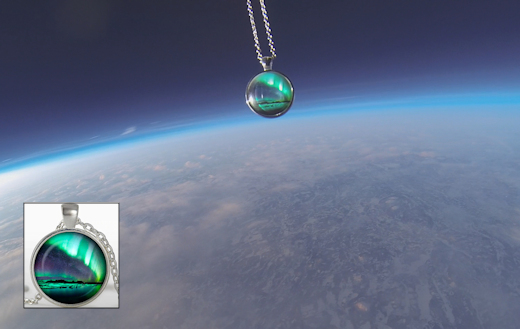
You can have it for $139.95. The students are selling Northern Lights pendants to support their cosmic ray ballooning program. Each one comes with a greeting card showing the necklace in flight and telling the story of its journey to the edge of space and back again.
Bonus: Look carefully at the photo above. In the background are Polar Stratospheric Clouds (PSCs)--the most beautiful clouds on Earth. The pendant actually touched these clouds on the way to the stratosphere. This is the only thing you can buy that has actually touched a PSC.
Far Out Gifts: Earth to Sky Store
All sales support hands-on STEM education
Realtime Aurora Photo Gallery
Free: Spaceweather.com Newsletter