WEAK IMPACT: A slow-moving coronal mass ejection (CME) expected to hit Earth's magnetic field on Nov. 1st arrived right on time. However, its impact was weak. Neither geomagnetic storms nor bright auroras were observed when the solar storm cloud passed by our planet between 1200 UT and 1700 UT. Aurora alerts: SMS Text.

YET ANOTHER SUNSPOT: A new sunspot, potentially a large one, is rotating into view over the sun's southeastern limb. Its leading dark core is inset in this magnetic map from NASA's Solar Dynamics Observatory:

The +/- polarity of the sunspot marks it as a member of Solar Cycle 25. This comes as no surprise. Almost every sunspot this year has belonged to the new solar cycle. Seasons are changing on the sun, and today's sunspot is the latest sign of increasing activity.
Amateur astronomers with safely-filtered telescopes are encouraged to monitor developments as this sunspot group rotates fully into view.
Realtime Spaceweather Photo Gallery
Free: Spaceweather.com Newsletter
BLUE MOONBOW: Northern autumn is the season for fogbows. Moisture rising from sun-heated ground condenses in the cool night air, producing low-hanging fogs. When light from the rising sun or Moon hits the mist--voilà--a fogbow. Heiko Ulbricht of Grumbach, Germany, photographed this one on Halloween:

"This is a lunar fogbow," says Ulbricht. "We had extremely dense fog in Saxony, but the Blue Moon shone very brightly through it. What a wonderful Halloween night!"
Fogbows are cousins of rainbows, and they are formed in essentially the same way: Light bounces in and out of water droplets to produce a luminous arc. However, fog droplets are tinier than raindrops. This causes, in fog, a diffraction effect not seen in ordinary rainbows; as a result, the colors are smeared together resulting in a nearly-white arc.
Realtime Spaceweather Photo Gallery
Free: Spaceweather.com Newsletter
THE ARCTIC NORTHERN LIGHTS PENDANT: On Jan. 22, 2020, the students of Earth to Sky Calculus launched a cosmic ray balloon to measure atmospheric radiation inside the Arctic Circle. This pendant hitched a ride, floating more than 75,000 feet above the frozen terrain of northern Sweden:
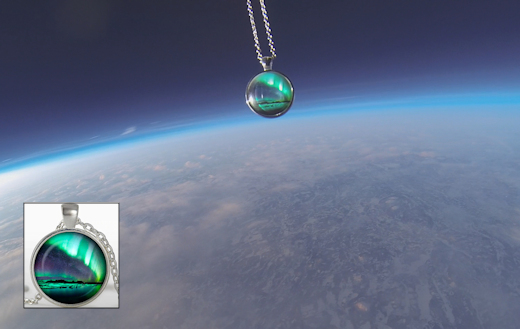
You can have it for $139.95. The students are selling Northern Lights pendants to support their cosmic ray ballooning program. Each one comes with a greeting card showing the necklace in flight and telling the story of its journey to the edge of space and back again.
Bonus: Look carefully at the photo above. In the background are Polar Stratospheric Clouds (PSCs)--the most beautiful clouds on Earth. The pendant actually touched these clouds on the way to the stratosphere. This is the only thing you can buy that has actually touched a PSC.
Far Out Gifts: Earth to Sky Store
All sales support hands-on STEM education
Realtime Aurora Photo Gallery
Free: Spaceweather.com Newsletter