'ELECTION DAY ASTEROID' MISSES EARTH: Asteroid 2018 VP1 approached Earth on Nov. 2nd ... and missed. The 3-meter wide space rock had a 1 in 240 (0.41%) chance of hitting our planet on the eve of US Election Day, but no fireballs or impact-infrasounds were detected. Break out the Oreos and let the election begin!
ANOTHER BIG SUNSPOT: A new sunspot group is rotating into view over the sun's southeastern limb--and it's a big one. At least three dark cores the size of Earth are inset in this magnetic map from NASA's Solar Dynamics Observatory:

The +/- polarity of the sunspot group marks it as a member of Solar Cycle 25. This comes as no surprise. Almost every sunspot this year has belonged to the new solar cycle. Solar Cycle 25 is taking a firm hold on the sun.
Earlier today (Nov. 3rd at 0703 UT) the sunspot produced a minor C1-class solar flare. A pulse of UV radiation from the flare briefly ionized Earth's upper atmosphere, causing a low-frequency radio blackout over the Indian Ocean: map. Mariners and ham radio operators in the area may have noticed unusual propagation effects at frequencies below ~5 MHz.

Using an H-alpha filter tuned to the red glow of solar hydrogen, Apollo Lasky photographed the sunspot from his backyard observatory in Naperville, Illinois:

"The sunspot looks menacing," he says.
This sunspot, if it holds itself together, will face Earth for the next two weeks as it rotates across the face of the sun, potentially setting the stage for a sustained stretch of solar activity. Amateur astronomers with safely-filtered telescopes are encouraged to monitor developments. Solar flare alerts: SMS Text.
Realtime Spaceweather Photo Gallery
Free: Spaceweather.com Newsletter
A FAR-OUT GIFT FROM THE ARCTIC STRATOSPHERE: You can't touch a Polar Stratospheric Cloud (PSC), but this pendant did. Last January, the students of Earth to Sky Calculus launched it to the Arctic stratosphere onboard a cosmic ray balloon. En route, it flew through a gorgeous display of PSCs:
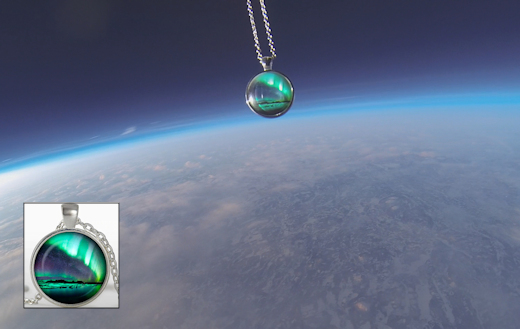
This is the only thing you can buy that has actually touched a PSC. Twice actually. The pendant flew through PSCs on the way UP to the stratosphere and parachuted through them again on the way DOWN.
You can have it for $139.95. The students are selling the pendants to support their cosmic ray ballooning program. Each one comes with a greeting card showing the necklace in flight and telling the story of its journey to the edge of space and back again.
Far Out Gifts: Earth to Sky Store
All sales support hands-on STEM education
Realtime Aurora Photo Gallery
Free: Spaceweather.com Newsletter