NORTHERN TAURID FIREBALLS: If you see a fireball this week, it's probably a piece of Comet 2P/Encke, source of the annual Northern Taurid meteor shower. Northern Taurid meteors are notoriously slow and bright, and they fly out of an easy-to-find patch of sky near the Pleiades. The shower will be active all week as Earth passes through the comet's broad trail of gravelly debris. Forecasters expect no more than ~5 Taurids per hour when the shower peaks on Nov. 11-12, but sometimes just one Taurid is enough. Look up after midnight for best results. Sky maps: Nov. 11, 12.


HERE COMES COMET ATLAS: Comet ATLAS (C/2020 M3) is approaching Earth. At closest approach on Nov. 14th it will be 0.358 AU (54 million km) away--not quite close enough to make it a naked-eye object. But can you say "photo-op"? Glowing like an 8th magnitude star, this remarkably beautiful comet is an easy target for backyard telescopes. Austrian amateur astronomer took this picture of Comet ATLAS passing the Orion Nebula on Nov. 8th:

The comet's green atmosphere is huge. This composite photo from Dan Bartlett of June Lake, California, shows that it is nearly as wide as a full Moon. Hence the following tip for astrophotographers: You'll need a wide field to capture the entire comet. It gets its verdant hue from diatomic carbon (C2), a compound which glows green in the near vacuum of space.
The fact that the comet is passing through Orion makes it easy to find. On Nov. 11th, draw a line through the stars of Orion's Belt: It leads directly to the comet. And on Nov. 15th (within hours of closest approach to Earth), the comet will pass a fraction of a degree from the bright star Bellatrix, the hunter's left shoulder. Deep exposures may show Bellatrix shining through the outskirts of ATLAS's atmosphere. Sky maps: Nov. 10, 11, 12, 13, 14, 15, 16.


Realtime Comet ATLAS Photo Gallery
Free: Spaceweather.com Newsletter
SUNSPOT SUNSET: Giant sunspot AR2781 is decaying. It's still big enough to add interest to the sunset. Peter Lowenstein sends this short video from Mutare, Zimbabwe:

"I was able to photograph the sunspot archipelago using a compact camera with thin clouds and atmospheric smoke haze acting as a solar filter," says Lowenstein. "I used a tripod-mounted Panasonic Lumix DMC-TZ60 in sunset mode with digital zoom magnification."
Caution: Even when the sun is dimmed by low-hanging clouds or haze, it can still be dangerously bright, especially when magnified by unfiltered optics. If you chose to photograph the low sun, as Lowenstein did, use the camera's LCD screen for safe viewfinding. Never look at the sun through the eyepiece of an unfiltered camera.
Realtime Spaceweather Photo Gallery
Free: Spaceweather.com Newsletter
A BLACK PEARL IN THE STRATOSPHERE: It came from Tahiti--and now it's been to the edge of space. On Oct. 30, 2020, this genuine Black Tahitian South Sea Cultured Pearl flew to the stratosphere onboard an Earth to Sky Calculus cosmic ray balloon, soaring 98,424 feet above the Sierra Nevada mountains of central California:
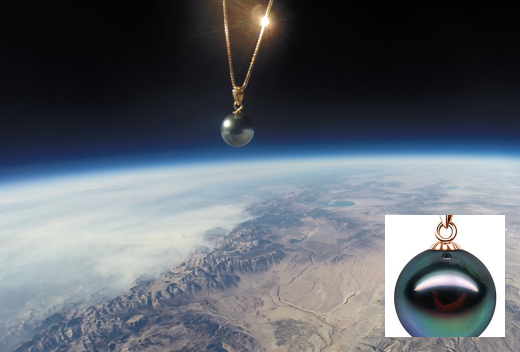
You can have it for $229.95. The students are selling these exotic space pearls to fund their cosmic ray monitoring program. Measuring 10 mm in diameter, the pearl has an 18K rose gold clasp and is suspended from a matching 925 Sterling Silver chain. Each pearl comes with a greeting card showing the pendant in flight and telling the story of its journey to the edge of space.
Far Out Gifts: Earth to Sky Store
All sales support hands-on STEM education
Realtime Aurora Photo Gallery
Free: Spaceweather.com Newsletter